
We’ve all been there: standing over an open suitcase two hours before a flight, wondering how on earth those “essential” outfits are going to fit. In 2026, with airline baggage fees reaching an average of $35 to $50 for the first checked bag, learning how to pack a suitcase isn’t just a convenience—it’s a financial strategy.
Whether you’re prepping for a 10-day European vacation or a 48-hour business blitz, knowing how to pack a suitcase efficiently will save your wardrobe, your back, and your sanity. Let’s dive into the art of modular packing.
Understanding the Foundation: How to Pack a Suitcase Efficiently
Efficiency starts long before you touch your luggage. It begins with the 5-4-3-2-1 Rule, a favorite among minimalist travelers who refuse to pay for overweight baggage.
- The Strategy: For a week-long trip, pack 5 sets of socks and underwear, 4 tops, 3 bottoms, 2 pairs of shoes, and 1 accessory (like a hat or watch).
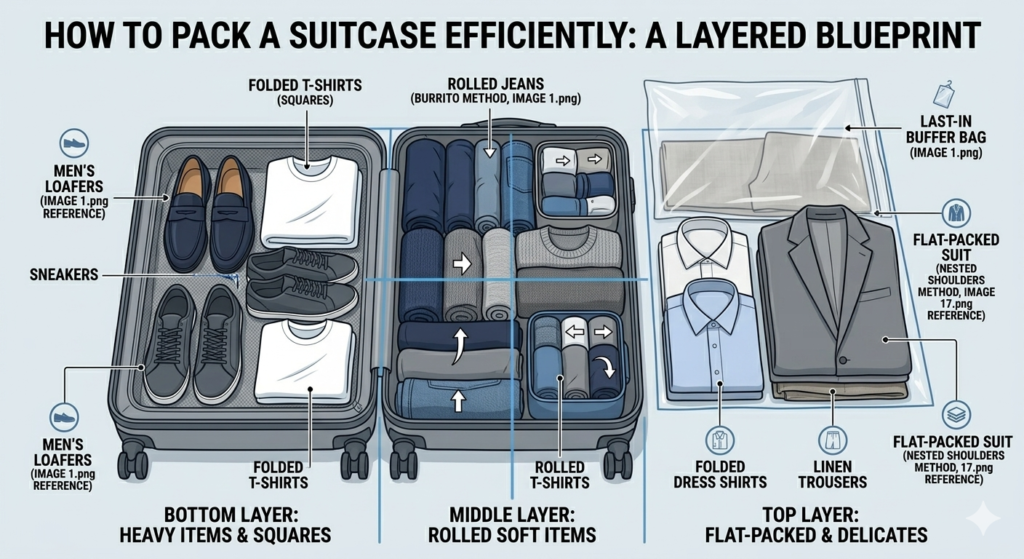
- The “Weight Distribution” Rule: Always place your heaviest items—shoes, toiletry kits, and hair dryers—at the bottom of the suitcase (near the wheels).
- Pro Tip: According to luggage durability tests, placing heavy items at the top causes the suitcase to topple over and puts 30% more stress on the zipper seams.
Specialized Skills: How to Pack a Suit in a Suitcase
The biggest fear for business travelers is arriving at a 9:00 AM meeting with a blazer that looks like an accordion. If you don’t have a garment bag, mastering how to pack a suit in a suitcase is your secret weapon.
The “Inside-Out Shoulder” Method (Step-by-Step):
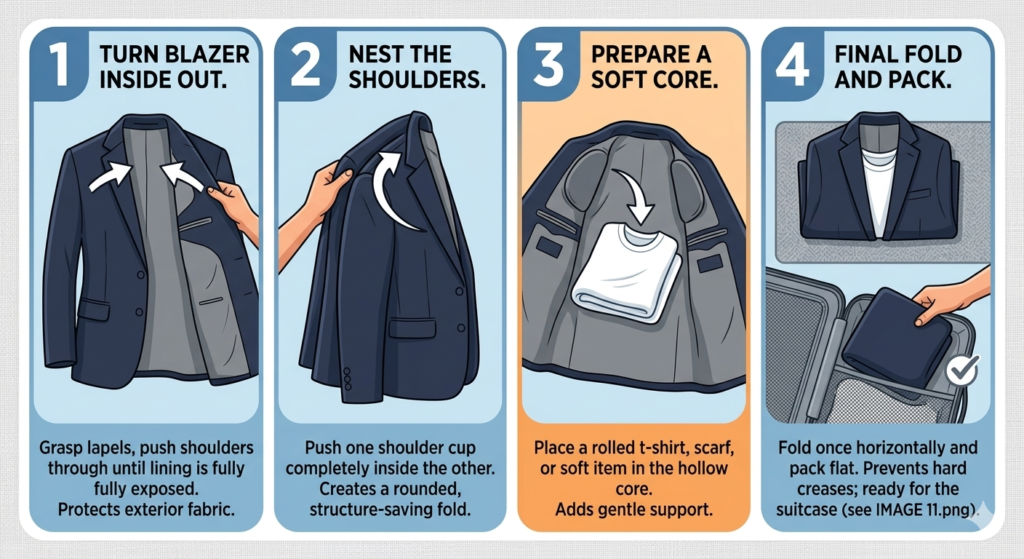
- Turn the blazer inside out, but keep the sleeves tucked inside as normal. This protects the delicate outer fabric from friction and snags.
- Pop the shoulders: Push one shoulder into the other so they nestle together. This creates a rounded shape that resists sharp creasing.
- The “Shirt Core” Hack: Place a folded dress shirt in the center of the blazer before folding it in half. This creates a “buffer” that prevents a hard crease from forming in the middle of the jacket.
- Case Study: James, a consultant who travels 40 weeks a year, swears by this method. “I stopped paying for hotel dry cleaning the moment I learned to nest the shoulders. My suits come out 95% wrinkle-free every time.”
The Battle of Methods: Rolling vs. Folding
There is a science to space management. A 2025 study on spatial geometry in luggage found that rolling soft items can save up to 20% more volume than traditional folding.
When to Roll:
- Best for: T-shirts, jeans, pajamas, and synthetic fabrics.
- Technique: Fold the item in half once, then roll tightly like a burrito. This eliminates “air pockets” between layers.
When to Fold:
- Best for: Starched cotton shirts, linen trousers, and pleated skirts.
- Technique: Use the “Bundle Packing” method, where you wrap delicate items around a soft core (like a pouch of socks) to avoid hard fold lines.
| Category | Rolling Method | Folding Method | Best Practice |
| Space Saving | Excellent | Average | Best for T-shirts and jeans |
| Wrinkle Prevention | Moderate | Good | Best for linen and cotton |
| Visibility | High (Drawer-style) | Low (Stacked) | Use with Packing Cubes |
The “Layering” Blueprint: A Bottom-to-Top Layout
Think of your suitcase like a house. You need a solid foundation before you add the roof. This architectural approach is key to knowing how to pack a suitcase efficiently.
- The Base Layer (The Foundation): Shoes (stuffed with socks to maintain shape) and heavy toiletry bags.
- The Middle Layer (The Filler): Rolled jeans and sweaters. Fill the gaps between shoe soles with smaller rolled items to create a flat surface.
- The Top Layer (The Fragiles): Your suit (packed as described above), dress shirts, and items you’ll need immediately upon arrival.
- The “Last-In” Buffer: Lay a dry-cleaning plastic bag over the very top. The thin plastic reduces friction between your clothes and the suitcase lid, which is the #1 cause of surface wrinkles during transit.
Pro Tips: Small Hacks with Big Impact
- The Shoe Secret: Never leave the inside of your shoes empty. They are the perfect “hard shell” protection for fragile items like perfume bottles (wrapped in a sock) or sunglasses.
- Leak-Proofing: Air pressure changes cause plastic bottles to expand. The Plastic Wrap Trick: Unscrew the cap, place a small square of plastic wrap over the opening, and screw the cap back on. It creates a vacuum seal that prevents messy spills.
- The Scent Secret: Toss a single dryer sheet or a small cedar sachet into the mesh pocket. It absorbs the “stale plane air” smell and keeps your wardrobe smelling fresh for the entire trip.
FAQ: How to Pack a Suitcase Efficiently?
How can I pack a suitcase efficiently without adding extra weight?
The key is the luggage itself. In 2026, premium polycarbonate shells weigh less than 5 lbs. Beyond that, wear your heaviest items—like boots and winter coats—on the plane instead of packing them. This can save you up to 4 lbs of luggage weight.
Can I pack my suit in a carry-on?
Absolutely. In fact, it’s safer because you control how the bag is handled. Using the “Inside-out shoulder” method, a suit takes up about 1/4 of a standard carry-on. Just ensure it is the very last item you place inside to avoid crushing.
How do I deal with dirty laundry on the way back?
Always pack an ultra-lightweight, expandable laundry bag. As the trip progresses, your “clean” side of the suitcase shrinks and your “laundry” side grows, keeping your fresh clothes isolated from odors.
Conclusion: Traveling Lighter and Smarter
At the end of the day, the best tip for how to pack a suitcase is to be a ruthless editor. If you haven’t worn that “extra” shirt in three months at home, you definitely won’t wear it on vacation.
By knowing how to pack a suitcase efficiently, you transform from a stressed-out tourist into a streamlined traveler. You’ll spend less time wrestling with zippers and more time enjoying your destination. Remember, the goal of travel is to collect memories, not just more stuff.