
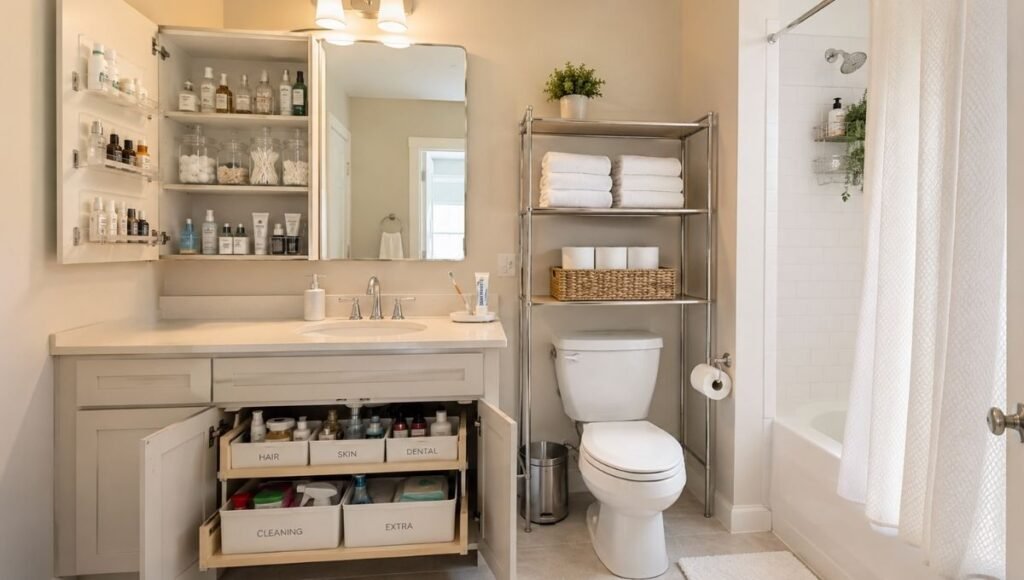
The bathroom is the smallest room in most homes and somehow manages to be one of the most chaotic. Three half-empty bottles of the same shampoo. The cabinet under the sink where things go to be forgotten. A counter covered with products you use daily alongside products you used once six months ago. The drawer that requires a specific technique to open without everything launching forward.
What makes bathroom organization particularly frustrating is the combination of small space, high daily traffic, and an enormous number of small items that don’t stack, don’t stand up on their own, and come in wildly inconsistent sizes. The shampoo bottle is tall. The cotton swabs are small. The hair dryer cable goes everywhere. There’s a pipe running directly through the middle of the cabinet.
The good news is that the bathroom responds faster to organization than almost any other room — because the space is small, the impact of even one change is immediately visible and immediately functional. One organized drawer changes how a bathroom feels to use.
This guide covers every storage zone in the bathroom: the counter, the cabinets, the drawers, the space above the toilet, and the shared bathroom strategies for households with multiple people competing for the same limited space.
Key Takeaways
- The bathroom is used an average of 6-8 times per day by each household member — making it the highest-traffic room relative to its size in most homes. Small organizational improvements have immediate, daily impact.
- Research from the American Cleaning Institute found that the average person spends approximately 1.5 years of their life in the bathroom — optimizing this space has a disproportionate quality-of-life return.
- The most common bathroom organization mistake is buying storage products before measuring the space, particularly the under-sink cabinet. Pipes, the garbage disposal, and cabinet depth all affect what fits.
- Bathroom counter clutter is almost always a symptom of inadequate hidden storage, not a habit problem — when products don’t have a designated home inside a cabinet or drawer, they default to the counter.
- A bathroom used by multiple people requires zone-based organization (each person’s products in a designated section) rather than category-based organization (all shampoos together) to function sustainably.
Step 1: The Bathroom Audit
Before organizing anything, do a product audit. Bathrooms accumulate expired, duplicate, and abandoned products faster than almost any other space in the house — because items arrive frequently (travel sizes, gifts, impulse purchases) and leave slowly.
What to remove immediately:
- Expired medications, skincare, and cosmetics (most skincare products expire 6-12 months after opening, marked with a small jar symbol on the packaging)
- Products you’ve tried once and won’t use again
- Multiple open bottles of the same product — consolidate where possible
- Empty or nearly-empty containers you’ve been “finishing”
- Hotel toiletries accumulated beyond what you’ll realistically use in the next 6 months
Medication disposal note: Expired or unused medications should not go in the trash or be flushed. Many pharmacies and hospitals have medication take-back programs — check the FDA’s drug disposal locator for your nearest site.
In most bathrooms, this audit removes 20-30% of the volume before a single organizer is purchased. That space recovery is free.
Bathroom Counter Organization: The Clear Surface Rule
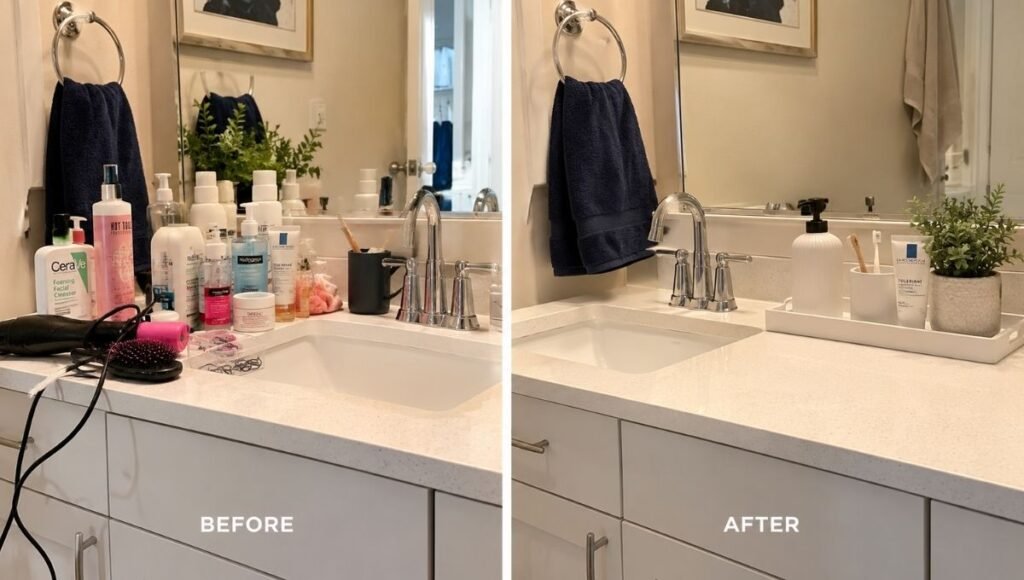
The counter is the most visible surface in the bathroom and the one that accumulates most persistently. The goal isn’t a completely bare counter — it’s a counter where every item is there intentionally, because it’s used daily and needs to be immediately accessible.
What earns counter space: Items used every single day, every time you use the bathroom: toothbrush and toothpaste, hand soap, a single face moisturizer if used daily, current skincare in active use. That’s approximately the right number of counter items for most people.
What doesn’t earn counter space: Products used occasionally, products you’re “almost done with,” the backup soap, the face mask used once a week, the electric toothbrush charging base that could go on a shelf. These items belong in a drawer or cabinet, retrieved when needed, returned when done.
The tray method: A small tray on the counter creates a physical boundary — items inside the tray are intentional, items outside it signal that the tray contents need editing. A tray also makes counter cleaning dramatically faster: lift the tray, wipe the counter, replace the tray. One motion instead of moving six individual items.
Vertical counter solutions for small bathrooms: When counter space is genuinely at a premium, a two-tier counter organizer, a small rotating organizer, or a slim countertop cabinet with shelves moves storage vertical rather than horizontal, freeing counter surface while keeping products accessible.
Under Sink Bathroom Organization: Solving the Cabinet Chaos
The cabinet under the bathroom sink is where most bathroom organization breaks down — because it’s awkward (pipes take up valuable space), deep (things get lost in the back), and has no inherent organization system.
Measure Before You Buy Anything
This is the step most people skip and then regret. The under-sink cabinet has three measurements that determine what will fit:
- Width: The interior width of the cabinet, minus any pipe clearance needed
- Depth: Most bathroom cabinets are 18-20 inches deep — shallower than kitchen cabinets
- Height: The usable height on each side of the pipe
Measure all three before purchasing any organizer. Bring the measurements to the store or have them ready when shopping online. The pipe placement also matters — measure where it sits so you can identify organizers designed to work around it.
The Best Under Sink Organization Solutions
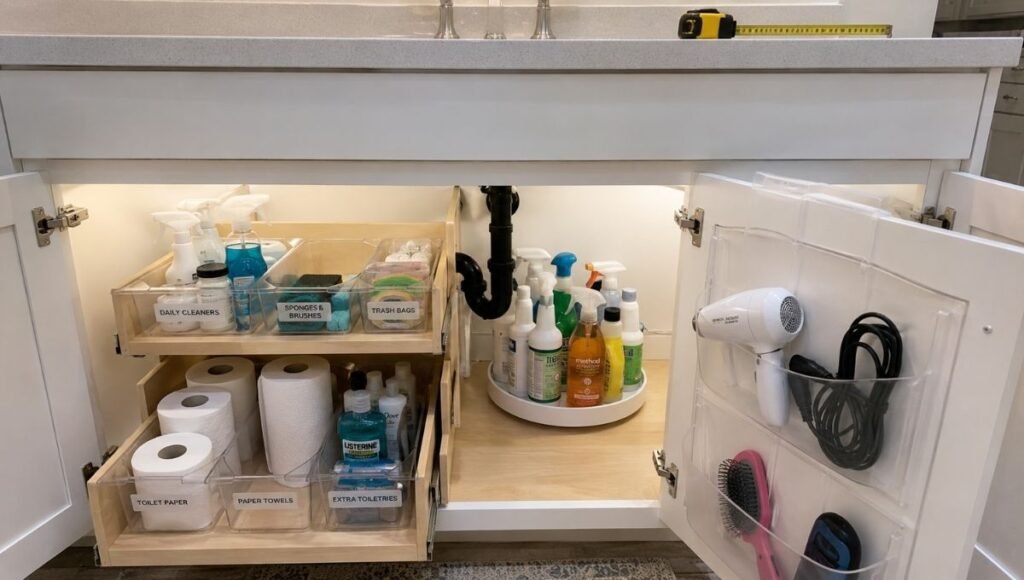
Pull-out drawers and sliding organizers: The highest-impact under-sink solution for most bathrooms. A two-level pull-out organizer designed to fit around pipes brings everything in the back of the cabinet to the front with a single slide. No reaching, no knocking things over to access items at the back.
Turntable (Lazy Susan): For deep under-sink cabinets, a turntable makes every item accessible with a spin rather than requiring you to remove front items to access back items. Measure using your tallest item — spin it around the cabinet to find the maximum diameter that clears the pipes and cabinet walls.
Stackable clear bins: Sort by category and stack vertically to use the height on each side of the pipe. Clear bins let you see contents without opening — essential for items stored in the back half of the cabinet.
Cabinet door organizers: The back of the cabinet door is consistently underused. An over-door organizer or adhesive-mounted pockets holds frequently reached items — cleaning supplies, a spare toothbrush, cotton products — at the door rather than buried in the cabinet.
How to Organize Under the Bathroom Sink by Category
Once the right organizers are in place, sort contents by how often they’re accessed:
Front zone (most accessible): Items used weekly — cleaning supplies, backup toilet paper, extra soap Middle zone: Items used occasionally — first aid supplies, hair tools, skincare backstock Back zone: True backup stock — extra products bought in bulk, seasonal items
Label everything. A label on each bin removes the “where does this go?” decision for everyone in the household.
How to Organize Bathroom Cabinets and Medicine Cabinet
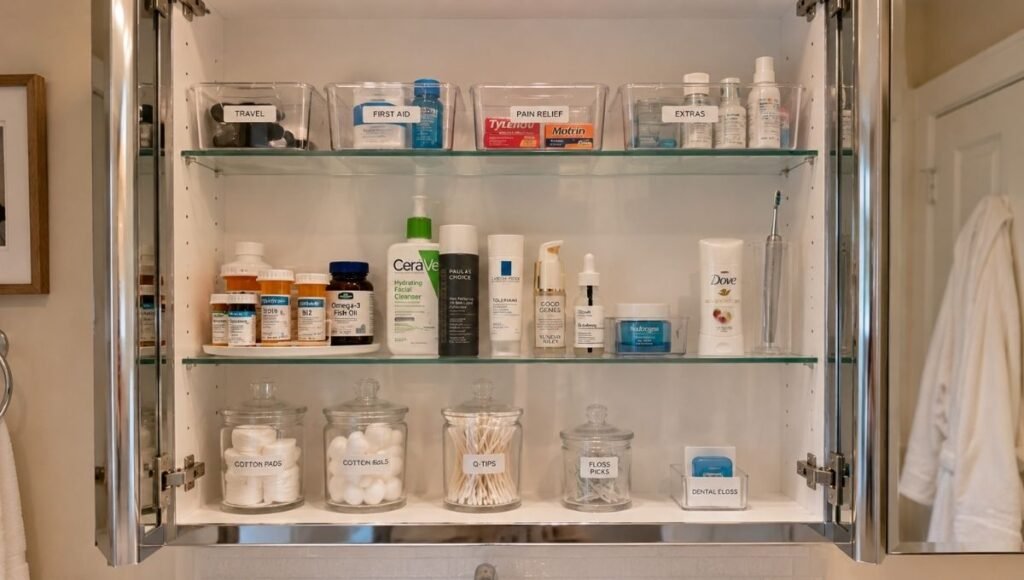
The medicine cabinet or bathroom wall cabinet is prime real estate — it’s at eye level, directly accessible during the daily routine, and in most bathrooms criminally underutilized.
The frequency principle for cabinet shelves:
- Top shelf (slightly less accessible): Items used occasionally — backup medications, first aid supplies, products used weekly
- Middle shelf (eye level, most accessible): Daily-use medications, current skincare, contact lens supplies, items used morning and evening
- Bottom shelf: Frequently restocked items — cotton pads, Q-tips, dental floss
Decanting small items: Cotton balls, Q-tips, and cotton pads stored in small clear apothecary jars or canisters take up less space than their original packaging, are easier to access, and make the cabinet look significantly more intentional. This is one of the lowest-cost, highest-visual-impact bathroom organization changes.
The expired product check: Set a reminder twice a year to check medicine cabinet contents for expiration dates. The medicine cabinet is where expired products are most likely to create a genuine safety issue — expired medications can lose effectiveness, and expired eye drops or contact lens solution can cause harm.
How to Organize Bathroom Drawers
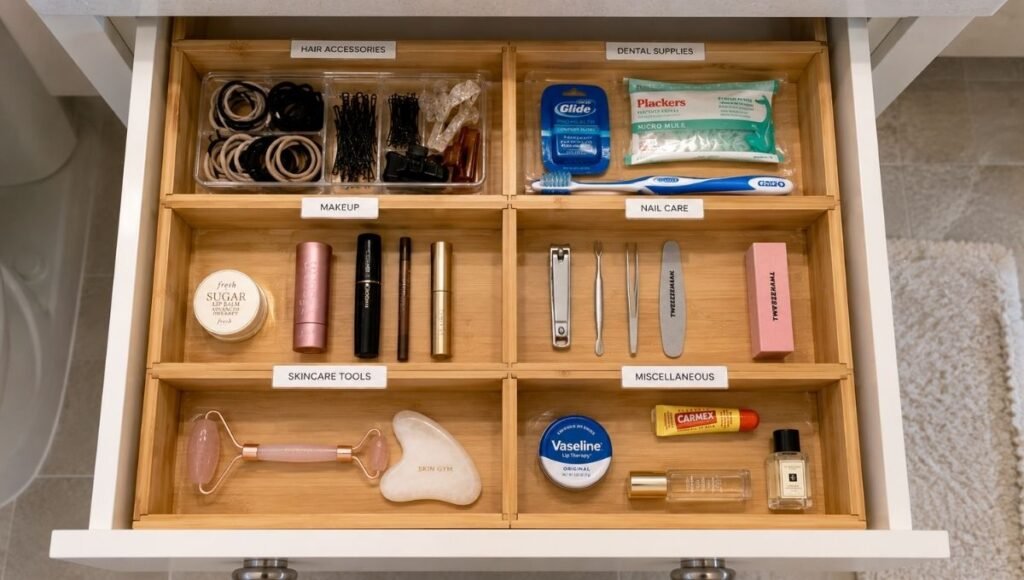
Bathroom drawers without dividers become small-item chaos zones — bobby pins mixed with lip balm mixed with dead batteries mixed with travel-size products from 2019. The solution is always dividers, but the right dividers depend on what’s being stored.
Expandable bamboo or plastic drawer dividers fit most standard bathroom drawer sizes and create dedicated compartments for each category. One compartment for hair accessories, one for dental supplies, one for daily makeup, one for small tools (nail clippers, tweezers). Items have homes; the drawer stays organized with minimal ongoing effort.
Clear acrylic organizer inserts are the premium version — each section is specifically sized for a category of item. More expensive but more durable and more visually satisfying.
The single-category rule: Each drawer section holds one category of items. When categories mix, the drawer reverts to chaos within days. The divider is only effective if the category assignment is enforced.
For drawers with multiple users: Assign one compartment or one section of the drawer per person rather than organizing by product category. Each person’s daily items in their section, retrieved from their section, returned to their section. This works sustainably where category organization (all mascaras together) often doesn’t.
Over Toilet Storage Ideas: Using the Vertical Space
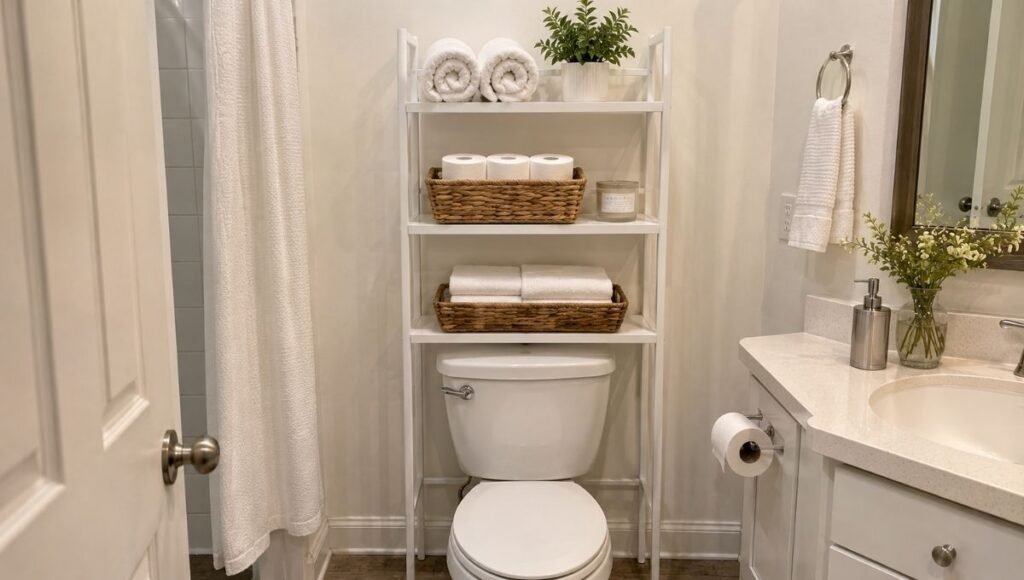
The wall space above the toilet is consistently the most underused storage zone in a bathroom — typically 24-30 inches of usable width and 36-48 inches of wall height that currently holds nothing.
Freestanding over-toilet shelving unit: A freestanding unit that straddles the toilet tank adds 2-3 shelves of storage in a footprint that’s already occupied. No installation required, fully adjustable, works in rental bathrooms. Holds spare toilet paper, towels, decor, and backup products.
Floating shelves above the toilet: For a more permanent and customizable solution, two or three floating shelves installed above the toilet create open storage for items you want visible and accessible. Baskets on shelves contain loose items while maintaining the open aesthetic.
What to store above the toilet:
- Spare toilet paper (the most logical location — immediately accessible when needed)
- Extra hand towels and washcloths in a basket
- Backup personal care products
- Decorative items that also serve a function (a plant, a candle, a small basket)
Bathroom Organization for Multiple People
A shared bathroom used by two or more people requires a fundamentally different organizational approach than a single-person bathroom — because category organization (all face wash together, all shampoos together) breaks down the moment multiple people’s products get mixed together.
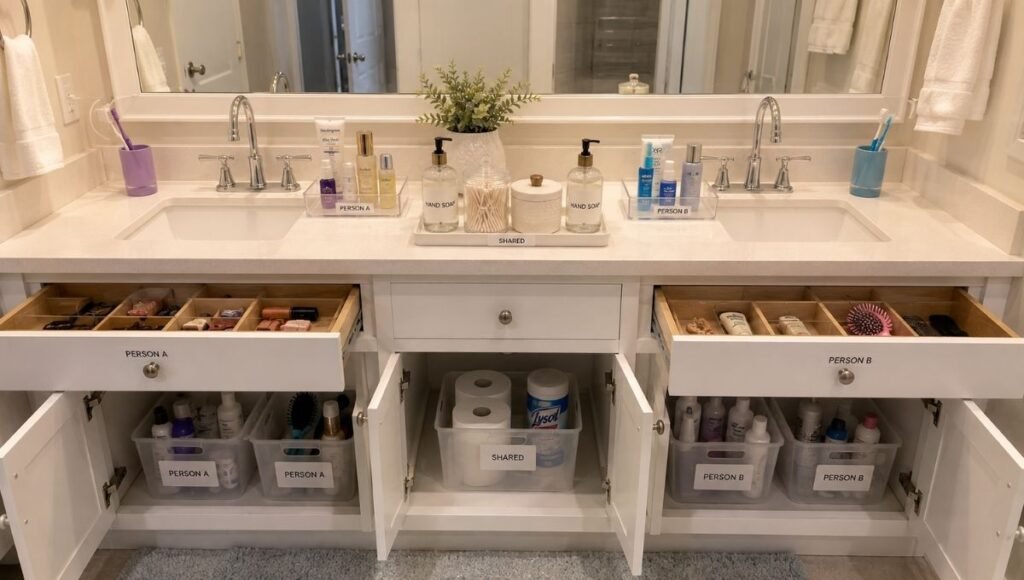
The person-based zone system: Assign each person who uses the bathroom a dedicated zone: one drawer, one shelf section, one cabinet compartment. Each person’s daily products live in their zone. Morning and evening routines happen in each person’s zone without touching anyone else’s products.
This works for couples, families with older children, and shared households. It requires slightly more total space per person than category organization, but it’s dramatically more maintainable because the mental load of “where does this go?” is eliminated for everyone.
Color-coded systems for families with young children: Each child gets a color — color-coded toothbrush holder, cup, and hook. Everything in their color is theirs. Children as young as 4-5 can independently navigate a color-coded system without parental direction.
The shared product zone: Designate one section for genuinely shared products — hand soap, toilet paper, cleaning supplies, shared medications. This section is stocked communally and maintained as shared responsibility.
Small Bathroom Organization: No Space Left Behind
In bathrooms where every inch matters, five zones are commonly overlooked:
The back of the door: Over-door organizers with pockets hold a surprising amount — hair tools, styling products, extra supplies — in a space that otherwise goes completely unused. For rental bathrooms, over-door designs require no installation.
Inside cabinet doors: Adhesive hooks and small mounted organizers on the inside of cabinet doors hold a hair dryer, flat iron, or small items without taking up any shelf space.
Shower wall space: Shower caddies, wall-mounted dispensers for shampoo and conditioner, and adhesive shelving use the shower wall to hold products that would otherwise sit on the floor or shower ledge, creating a cleaner look and easier cleaning.
The space between sink and wall: A slim rolling cart sized to fit in the gap between the sink cabinet and the wall holds hair products, extra toiletries, or cleaning supplies in space that currently holds nothing.
Towel bars and hooks: Properly utilized towel bars and hooks eliminate the floor pile of towels that accumulates in most bathrooms. One hook per person for their daily towel; a bar for hand towels in a visible, accessible location.
If You Only Have 10 Minutes Right Now
10 minutes: Do the product audit in the most cluttered zone of your bathroom — the cabinet under the sink, the medicine cabinet, or the counter. Remove expired items, combine duplicate partials, discard anything you’re not using. See how much space that alone creates.
20 minutes: Clear the bathroom counter completely. Wipe it down. Return only items used every single day. Find a temporary home (a bin, a shelf, inside the cabinet) for everything else. Live with a clear counter for one week and notice whether the items left off it were actually needed there.
30 minutes: Tackle the bathroom drawers. Pull everything out, add drawer dividers, sort into categories (or person-based zones for shared bathrooms), put everything back. Label each section. One organized drawer demonstrates the whole system.
FAQ: Bathroom Organization Ideas
What is the best way to organize a small bathroom? Maximize vertical space — over-toilet shelving, wall-mounted shelves, and the back of the door are consistently the most underused zones in small bathrooms. Keep only daily-use items on the counter; everything else lives in a cabinet or drawer. A slim rolling cart in any available gap adds meaningful storage without any floor footprint.
How do I organize under the bathroom sink with pipes? Measure the cabinet interior — width, depth, and height on each side of the pipe — before purchasing any organizer. Pull-out sliding organizers designed to work around pipes are the most functional solution. A turntable (lazy Susan) is highly effective for deep cabinets. Use the cabinet door for frequently accessed small items with an over-door or adhesive organizer.
How do I organize bathroom cabinets? Apply the frequency principle: daily-use items at eye level (middle shelf), occasional-use items on upper shelves, backup stock on lower shelves. Decant small items like cotton balls and Q-tips into clear canisters. Check for expired products twice a year. Label shelves if the cabinet is shared.
How do I organize a bathroom used by multiple people? Use person-based zones rather than category organization. Each person gets a dedicated drawer, shelf section, or cabinet compartment for their personal products. Shared products (hand soap, toilet paper, cleaning supplies) go in a clearly designated shared zone. Color-coding works well for households with young children.
What should I keep on the bathroom counter? Only items used daily — toothbrush, toothpaste, hand soap, and current daily skincare. Everything else belongs in a drawer or cabinet. A small tray creates a visual boundary and makes counter cleaning faster. Items outside the tray indicate the system needs editing, not more counter space.
How do I keep a bathroom organized long term? A weekly 5-minute bathroom reset — returning all products to their homes, wiping surfaces, restocking toilet paper and soap — prevents the gradual accumulation that leads to full reorganization sessions. A twice-yearly expired-product purge keeps the medicine cabinet current. The organizational system works long-term only if every product has a designated home that everyone who uses the bathroom knows and follows.
Start With One Zone Today
The bathroom doesn’t need a full weekend to feel meaningfully more organized. Pick the zone causing the most daily friction — the counter that’s always covered, the drawer that won’t close, the cabinet that requires excavation to find anything — and spend 20 minutes on just that one zone.
Clear it. Measure it if it’s the under-sink cabinet. Remove what’s expired or unused. Add one organizer if it’s genuinely needed. Put everything back with a category or person-based logic.
That one zone, done properly, changes how the whole bathroom feels to use. The rest follows the same logic.
Explore more on Vomoxs:
- Small Bathroom Storage Ideas: Making the Most of a Tight Space
- Home Organization Ideas: The Complete Room-by-Room Guide
- How to Declutter Your Home: A Room-by-Room Guide
References
- American Cleaning Institute (2023). Cleaning Habits Survey: Time Spent in Bathroom Environments. Annual consumer research on bathroom usage patterns.
- U.S. Food and Drug Administration (2024). How to Dispose of Unused Medicines. FDA consumer guidance on safe medication disposal. fda.gov/drugs/safe-disposal-medicines.
- Saxbe, D. E., & Repetti, R. (2010). No Place Like Home: Home Tours Correlate With Daily Patterns of Mood and Cortisol. Personality and Social Psychology Bulletin, 36(1), 71–81.
Category: Room Organization | Reading time: 10 min | Last updated: 2026