
You’ve read the productivity articles. You’ve bought the planners, the matching storage bins, the label maker that sat in its box for three months before you finally used it once. You’ve started routines with genuine enthusiasm and abandoned them quietly, usually somewhere around day four. You’ve reorganized the same drawer twice in one year.
And yet the person in the office who somehow always knows where everything is, who never seems frantic, whose home always looks like a calm decision was made about where things go — that person feels like a different species.
Here’s what that person will tell you if you ask: they’re not naturally organized. They just stopped fighting their own habits.
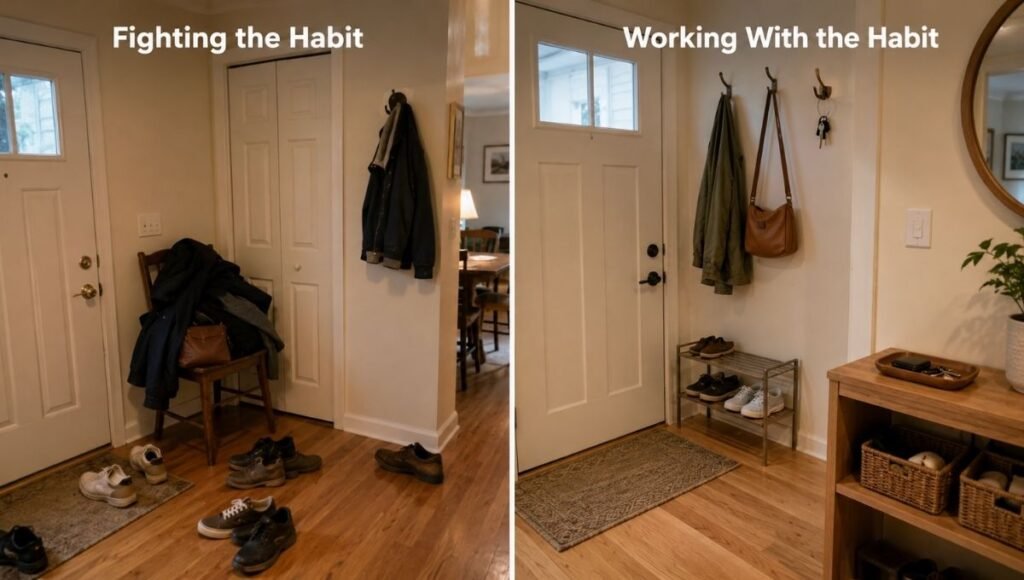
The most useful thing anyone said about organization in recent years came from an anonymous comment online: “Store items where you drop them anyway. Organization that fights habits always loses.” This is the insight that makes everything else make sense. The problem isn’t that you’re disorganized. It’s that your systems are asking you to behave differently than you naturally do — and habits always win over systems.
This guide is about building systems that work with how you actually live, not against it.
Key Takeaways
- Research from Princeton Neuroscience Institute found that visual clutter in the environment competes directly for cognitive attention — a disorganized home creates measurable mental load even when you’re not actively trying to find something.
- The primary reason organization systems fail isn’t lack of discipline — it’s that the system requires more effort than the alternative. Effective systems make the organized choice the easy choice.
- A 2019 study in Personality and Social Psychology Bulletin found that people with cluttered homes had elevated cortisol levels throughout the day, while people who described their homes as “restful” showed lower stress markers.
- Highly organized people consistently report one shared habit: a daily reset of 10-15 minutes, not a weekly deep clean. Prevention is dramatically easier than recovery.
- Organization for families and shared households requires different design than single-person systems — the system has to be simple enough for every person who uses the space, or it will be maintained by only one person indefinitely.
Why Your Organization Systems Keep Failing
Before building any new system, it’s worth understanding why the last one didn’t hold — because if the root cause isn’t addressed, the same thing happens again.
Most organization advice is built on the assumption that you need better habits. But habits are extraordinarily resistant to change, especially when they’re competing against a system that requires more effort. The real question isn’t “how do I build better habits?” It’s “how do I design my environment so the right habit is the easy one?”
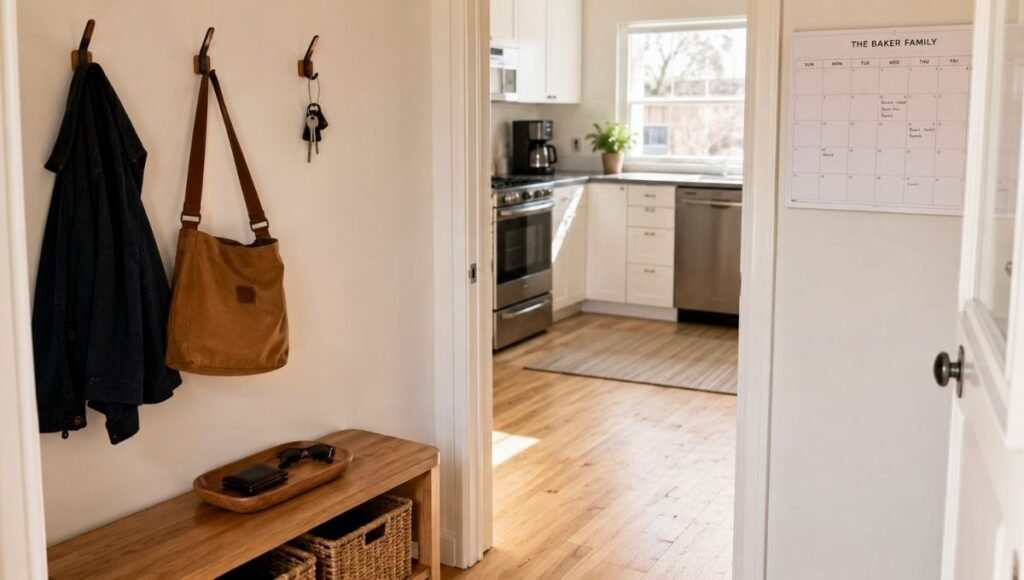
The storage-where-you-drop-it principle: If you always drop your keys on the counter by the door, no amount of intention will consistently make you walk to the designated hook by the closet. The solution isn’t to keep trying to change the behavior — it’s to put the hook by the door. This sounds obvious, but it contradicts almost all organization advice, which focuses on behavior change rather than environment design.
The complexity problem: Systems that require multiple steps don’t get used. A filing system with 14 subcategories gets used for a week and then items start accumulating on top of the cabinet. A single inbox tray that gets processed once a week gets used indefinitely. Every additional step in a system is an opportunity for it to break down.
The shared household problem: A system that one person designs and maintains doesn’t survive contact with other household members who weren’t part of the design. Children find the path of least resistance. Partners do too. A system that requires everyone to understand and follow a specific organizational logic will be maintained by the person who created it — and resented by them — indefinitely.
Editor’s note: The single most liberating reframe in organization is this: if your system keeps failing, the system is the problem, not you. Willpower is a finite resource. Environment design is not.
How to Organize Your Life: Start With Your Physical Environment
The most immediate, highest-impact thing you can do to become more organized is to redesign your physical environment so the right choices are the easy choices. Not more discipline. Less friction.
The drop zone audit: Walk through your home and identify every surface that consistently accumulates things. The kitchen counter. The dining chair. The nightstand. The spot by the front door. These aren’t failures — they’re data. They tell you where items need homes, not where you need better habits.
For each accumulation zone, ask two questions: What type of items accumulate here? And what would make it easier to put those items away than to leave them here?
Sometimes the answer is adding a hook, a tray, or a small basket directly at the drop zone rather than fighting the drop zone. A basket by the couch for remote controls and chargers isn’t aesthetically perfect — but if it gets used consistently and the current system doesn’t, the basket wins.
The one-touch rule: Every time you pick something up, it goes to its final home — not to a temporary holding location. Mail goes directly into the inbox tray or the recycling. Dishes go directly into the dishwasher. Clothes go directly onto the hook or into the hamper. This sounds small, but the accumulation of “I’ll deal with it later” decisions is the primary mechanism through which organization systems unravel.
The visible versus hidden storage principle: Items you use daily need to be immediately visible and accessible — not behind a door, not in a drawer, not requiring any opening or searching. Items used weekly can be one step away. Items used monthly or seasonally can be fully stored. Most organization problems come from daily-use items being stored in weekly or monthly-use locations — meaning they never actually get put away because getting them out and putting them back is too inconvenient.
How to Create a Routine That Actually Sticks
Most routine advice fails for the same reason most diet advice fails: it’s designed for an idealized version of your life rather than the actual one.
The most effective routines are built on existing behaviors, not new ones. Behavioral science calls this “habit stacking” — attaching a new behavior to something you already do automatically. You already make coffee every morning. That’s an anchor. Everything you want to do in the morning can be attached to that anchor rather than requiring a separate act of will.
The Morning Anchor Routine
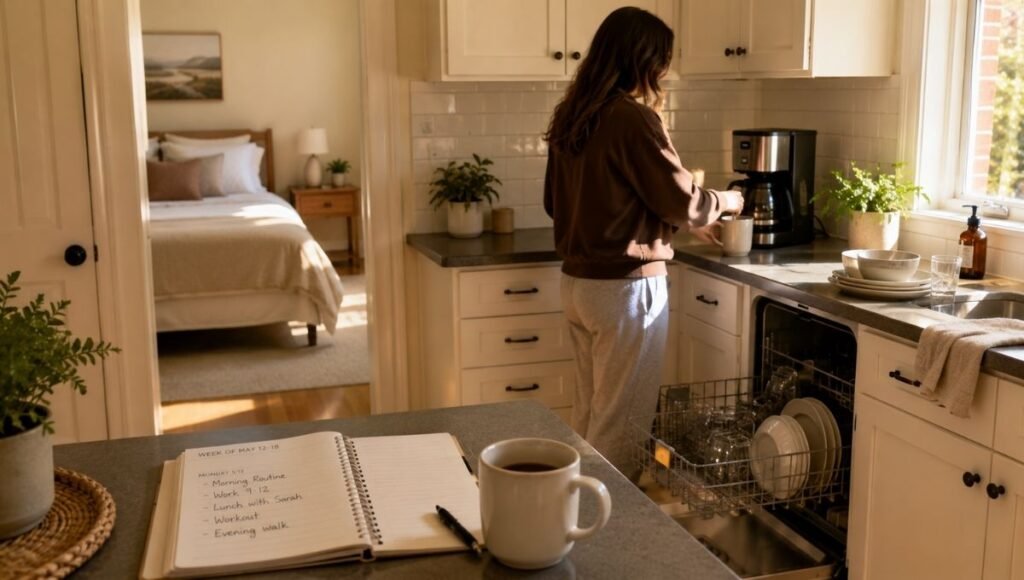
Pick one existing morning behavior — waking up, making coffee, brushing your teeth — and attach 2-3 organizational actions to it. Not 10. Not a full morning routine. Two or three things that take under 5 minutes total.
For most households, the highest-impact morning organizational actions are:
- Make the bed immediately after getting up (takes 90 seconds, signals the start of the day, prevents the bedroom from feeling chaotic)
- Start the dishwasher or empty it from the night before (keeps the kitchen functional throughout the day)
- Check the day’s schedule for anything that needs preparation (prevents the scrambling that creates mess)
That’s it. Three actions, under 5 minutes, attached to existing behavior.
The Evening Reset
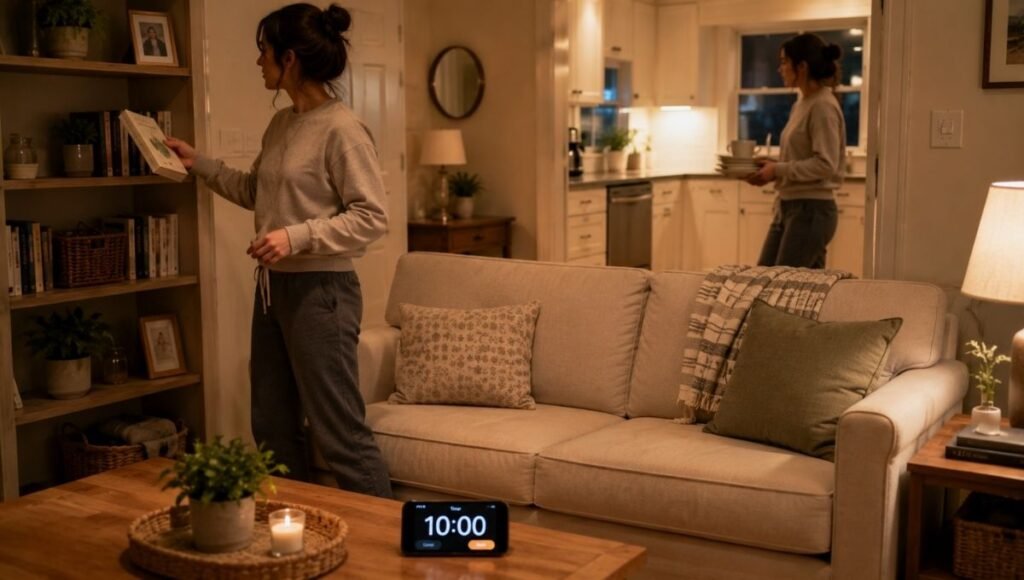
This is the single habit that most consistently separates organized households from disorganized ones. Not a weekly clean. Not a monthly overhaul. Ten minutes every evening, doing the same things in the same order.
The evening reset addresses everything that accumulated during the day before it has the chance to compound. It takes 10 minutes when done daily. It takes 3 hours when done weekly.
A functional evening reset:
- Return everything that migrated during the day to its home (dishes to dishwasher, clothes to hamper or hook, items to their designated locations)
- Clear the main surfaces — kitchen counter, coffee table, any landing zones
- Set out anything needed for tomorrow morning (bag packed, coffee maker ready, anything that prevents morning scrambling)
The timer trick from an organized home blogger that actually works: set a 10-minute timer and work until it goes off, then stop. The timer does two things — it creates urgency that prevents perfectionism, and it creates a defined endpoint that makes starting easier. You’re not committing to cleaning until it’s done. You’re committing to 10 minutes.
How to Stay on Top of Housework Without Spending Your Life Cleaning
The question most people are actually asking when they search for organization advice is this: how do I maintain a house without it consuming all my free time?
The answer isn’t a better cleaning schedule. It’s reducing the amount of maintenance the house requires in the first place — through reduced clutter, better storage design, and distributed daily habits rather than concentrated weekly sessions.
The maintenance math: A kitchen counter wiped down daily takes 60 seconds. A kitchen counter wiped down after a week of accumulation takes 8 minutes and more effort. A bathroom sink cleaned daily takes 30 seconds. A bathroom sink cleaned weekly takes 5 minutes and a cleaning product. The daily version takes less time across the week and keeps the space consistently functional. The weekly version takes more total time and results in a space that’s unpleasant to use for most of the week.
Category batching: Rather than cleaning room by room, batch similar tasks across rooms. All the surface-wiping in the house done in one pass. All the vacuuming done in one pass. All the laundry started, transferred, and folded in one session. Batching reduces the setup-and-transition time that makes cleaning feel longer than it is.
The 2-minute rule: If a task takes less than 2 minutes, do it immediately rather than adding it to a mental or physical to-do list. Wiping the stovetop after cooking. Hanging up the coat when you take it off. Rinsing the dish before it sits in the sink. The accumulation of 2-minute tasks that get deferred is the primary source of most household maintenance load.
Family Command Center Ideas: Organization for Shared Households
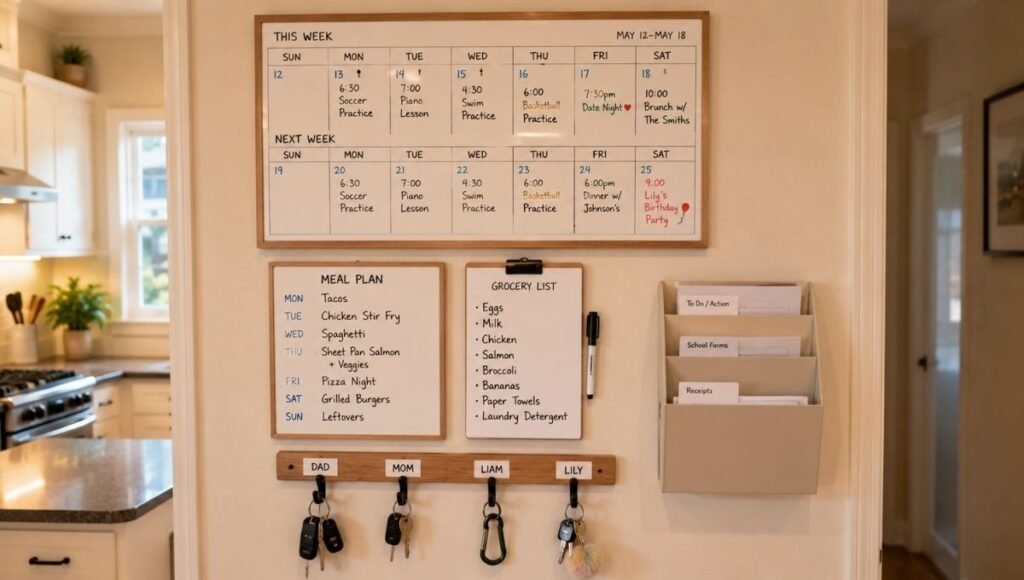
Single-person organization is relatively straightforward — one person designs the system, one person maintains it. Family organization is fundamentally different because the system has to work for multiple people with different habits, different ages, and different relationships to tidiness.
The family command center is the most effective tool for coordinating a shared household — not because it’s a product category, but because it creates a single designated location for shared information and household logistics.
What a family command center actually needs:
A calendar showing the household’s schedule for the current week and next week — not a year-view, not a full month. The week ahead, visible at a glance.
A meal plan for the week, visible in the kitchen. This eliminates the daily “what’s for dinner?” decision and the reactive grocery shopping that results from not having one.
A running grocery list that anyone in the household can add to. Physical (a notepad on the refrigerator) or digital (a shared notes app) — whatever gets used. The only system that doesn’t work is one that only one person maintains.
An incoming-mail and paperwork tray with a defined processing schedule. Mail comes in, goes in the tray, gets processed once a week. Paper doesn’t accumulate on the counter because the tray is the counter’s designated purpose.
A place for keys, wallets, and daily-carry items — hooks or a tray at the entry point of the house. Every adult and older child has a designated spot. The 5 minutes spent looking for keys every morning is a system problem, not a personal failing.
The family system design principle: Build the system for the least organized person who uses it, not the most organized. A system that works perfectly when everyone complies but fails when one person forgets isn’t a resilient system. Design for the realistic household, not the ideal one.
Getting Organized at Home: The Realistic Starting Point
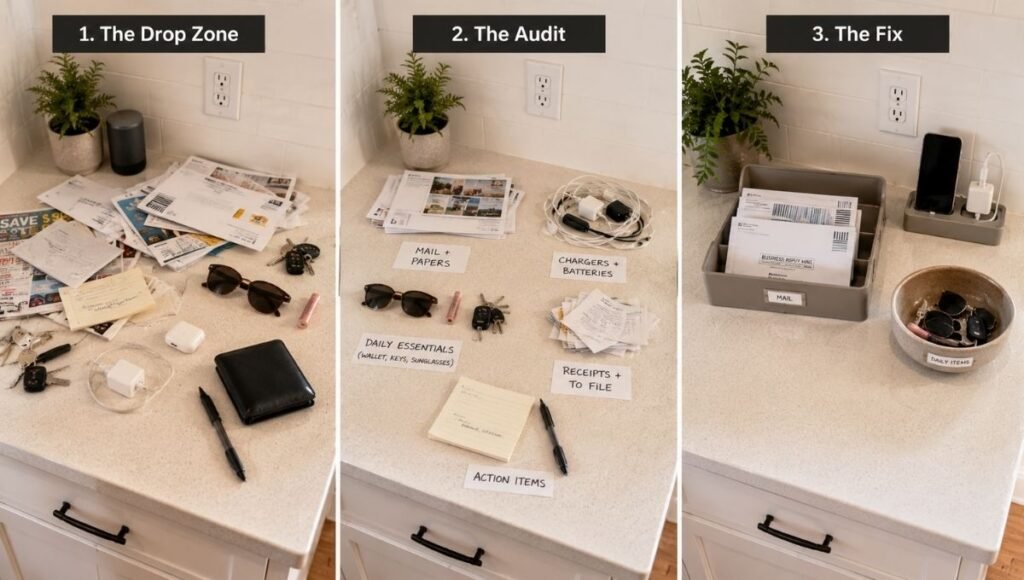
The gap between “disorganized” and “organized” is almost never a single overhaul weekend. It’s a series of small design decisions that accumulate until the environment makes organization easier than disorganization.
Start with the area that causes the most daily friction. Not the attic. Not the garage. The counter you look at every morning. The spot where things pile up. The drawer you can’t close.
Make one design change: add a hook where things get dropped, remove excess items from the surface, add a small basket for the things that always end up there anyway. Live with that change for a week. See if it holds. If it does, make the next one.
This is slower than a weekend overhaul. It’s also dramatically more likely to still be working in six months.
If You Only Have 10 Minutes Right Now
10 minutes: Do the evening reset — right now, regardless of the time of day. Clear every surface in the main living area. Return items to their homes. Set a timer, work until it goes off. See what the space looks and feels like after 10 minutes of focused reset.
20 minutes: Do the drop zone audit. Walk through the house with a notepad and write down every surface where things accumulate. For each one, identify what accumulates there and why. This audit costs nothing and tells you exactly where your organizational energy should go.
30 minutes: Pick one accumulation zone and redesign it. Add the hook. Move the basket. Put the thing where it actually gets dropped. Make one environmental change and observe whether it gets used naturally over the next week.
FAQ: How to Be More Organized
Is being organized a personality trait or a skill? Research consistently shows it’s a skill — or more accurately, a set of environmental design decisions. People who appear naturally organized have typically iterated on their systems until the organized choice became the easiest choice in their environment. The trait framing is counterproductive because it implies some people simply can’t be organized, which isn’t supported by evidence.
How do I get organized when I’m overwhelmed and don’t know where to start? Start with the physical environment, not a schedule or a routine. Pick the one space that causes the most daily stress — usually the kitchen counter or the entryway — and spend 20 minutes designing it so the right choices are easier than the wrong ones. Visible improvement in one space creates the momentum to address the next one.
How do I create a morning routine I’ll actually stick to? Attach it to something you already do automatically. Don’t create a standalone morning routine — stack 2-3 habits onto an existing anchor behavior like making coffee or brushing your teeth. Keep it under 5 minutes total for the first month. Add complexity only after the core habit is automatic.
How do I stay organized with kids? Design the system for the least organized person who uses the space, which in a family with young children means very simple, very physical systems. Labeled bins at child height. Hooks instead of hangers. One basket per category rather than elaborate subcategories. Involve older children in designing their own organizational systems — children who participated in the design are more likely to maintain the system.
How long does it take to become more organized? The environmental changes — adding hooks, redesigning storage, creating drop zones — can be made in a weekend and start working immediately. The habits — the daily reset, the one-touch rule, the morning anchor — take 4-6 weeks of consistent repetition to become automatic. The realistic timeline for a noticeably more organized home is 4-8 weeks of small, consistent changes. Not a single overhaul weekend.
Pick One Change. Make It Today.
The most organized homes aren’t the ones that underwent the most dramatic transformation. They’re the ones where someone made one small environmental change, watched it work, and made another one.
Pick one drop zone. Add the hook, the basket, or the tray. Put it exactly where things get dropped, not where they’re supposed to go. See if it gets used without any additional effort or intention.
That’s the beginning. The rest follows the same logic, one small design decision at a time.
Explore more on Vomoxs:
- How to Declutter Your Home: A Room-by-Room Guide
- House Cleaning Checklist: The Complete Daily, Weekly, and Monthly Guide
- Home Organization Ideas: The Complete Room-by-Room Guide
References
- McMains, S., & Kastner, S. (2011). Interactions of Top-Down and Bottom-Up Mechanisms in Human Visual Cortex. Journal of Neuroscience, 31(2), 587–597. Princeton Neuroscience Institute research on visual clutter and cognitive attention.
- Saxbe, D. E., & Repetti, R. (2010). No Place Like Home: Home Tours Correlate With Daily Patterns of Mood and Cortisol. Personality and Social Psychology Bulletin, 36(1), 71–81.
- Wood, W., & Neal, D. T. (2007). A new look at habits and the habit-goal interface. Psychological Review, 114(4), 843–863. Research on habit formation and environmental design.
Category: Organized Living | Reading time: 10 min | Last updated: 2026