
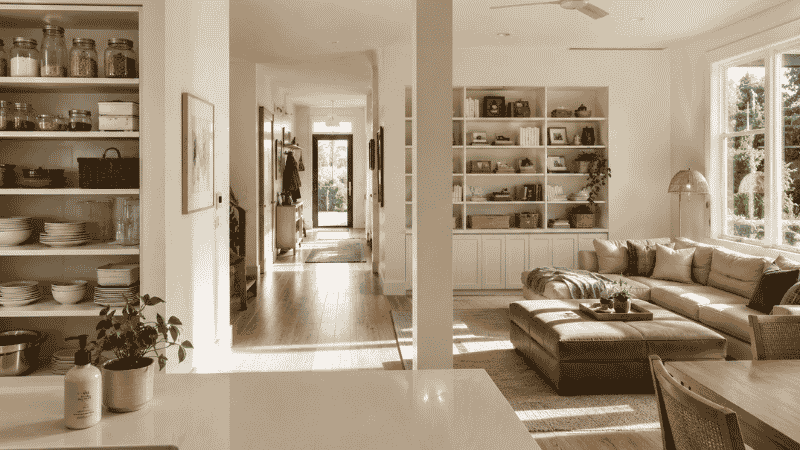
An organized home isn’t about perfection. It’s not about matching baskets or color-coded shelves or a pantry that looks like a magazine spread. It’s about a home where you can find what you need in under 10 seconds, put things away without thinking twice, and walk into any room without that low-level background stress that clutter quietly produces all day long.
The challenge is that most people try to organize their entire home at once — a frantic weekend of rearranging, some new bins, and a deep satisfaction that lasts about two weeks before everything drifts back. The reason this happens isn’t lack of effort. It’s lack of system.
A system means each room has a clear organizational logic, each item has a real home, and maintaining that order takes minutes per week rather than full weekend overhauls every few months. Building that system takes time — but it’s built room by room, one decision at a time, not all at once.
This guide covers every major area of the home with the core principles and immediate action steps for each. Each section links to a complete room-specific guide when you’re ready to go deeper. Start with the room that frustrates you most. Do that one well. Then come back for the next.
Key Takeaways
- Research from UCLA’s Center on Everyday Lives and Families found that household clutter directly elevates cortisol levels — meaning an organized home isn’t just aesthetically pleasant, it measurably reduces daily stress.
- The most effective home organization follows one universal principle: store things where you use them, not where they seem logical in theory.
- Decluttering always comes before organizing. No system works when there’s more stuff than space to hold it.
- Maintenance habits — 10 minutes per week per room — matter more than the initial organization session. Systems that require constant willpower to maintain will always eventually fail.
- Every room in this guide has a “start here” action you can take in the next 15 minutes, regardless of how much time you have overall.
Before You Organize Any Room: The Declutter Principle
Every home organization guide eventually tells you to declutter. Most treat it as a quick preliminary step before the real work begins. It isn’t.
Decluttering is the work. Organization is what you do with what remains.
If you try to build an organizational system around more possessions than your home can comfortably hold, the system will always be fighting a losing battle. Items will have nowhere to go, surfaces will accumulate overflow, and the “organized” state will be fragile and temporary.
The question to ask about every item in every room isn’t “where should this go?” It’s “does this earn its place in my home?” Things that genuinely earn their place — items you use regularly, things you actively love, possessions that serve a real function in your current life — deserve a thoughtful home. Everything else is creating work for you every day without giving anything back.
Start here: Before reading any further, identify the one room in your home that causes you the most daily stress. That’s where you start — not the biggest room, not the most visible one, but the one that costs you the most mental energy every day.
For the complete room-by-room declutter system: → How to Declutter Your Home: A Room-by-Room Guide
Kitchen Organization Ideas: Where Daily Life Runs Smoother
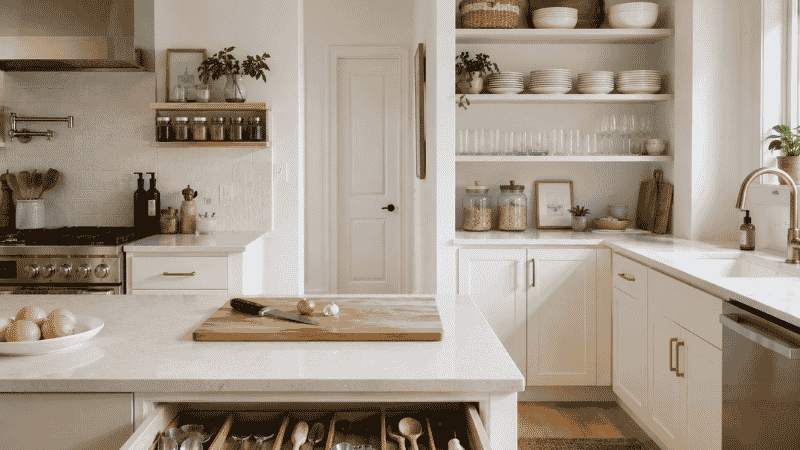
The kitchen is where disorganization has the most immediate, daily impact. Every meal involves navigating whatever system — or lack of system — exists in your cabinets and drawers. A kitchen that works well doesn’t just look better. It makes cooking genuinely faster and less frustrating.
The organizing principle that makes the biggest difference in a kitchen is proximity to use: items live where they’re used, not where they seem to belong categorically. Spices near the stove. Prep tools near the cutting board. Dishes near the dishwasher. This single principle, applied consistently, reduces the daily friction of cooking more than any organizer product.
How to Organize Kitchen Drawers
Kitchen drawers become chaotic for a specific reason: they have no assigned job. Everything lands in whatever drawer has space, and within weeks every drawer is a mix of unrelated items with no logic connecting them.
The fix is zone assignment — each drawer gets a single job before anything goes back in. The drawer closest to the stove holds only cooking utensils used while something is on the heat. The drawer nearest the prep counter holds only prep tools. The cutlery drawer holds only cutlery.
Start here: Open your most chaotic kitchen drawer right now. Count how many items in it actually belong to that drawer’s natural zone. Everything else is a misplaced item that’s been making the drawer harder to use every day.
For the complete kitchen drawer organization system: → How to Organize Kitchen Drawers (and Actually Keep Them That Way)
How to Organize Kitchen Cabinets
Kitchen cabinets present a different challenge: depth and vertical space that most people never fully use. The average kitchen cabinet wastes 40–60% of its vertical capacity because items sit in a single flat layer when shelf risers, stackable organizers, and tiered systems could create two or three functional layers in the same space.
The cabinet organization framework that professional organizers use consistently is the zone system: map your kitchen into cooking zone, prep zone, serving zone, and pantry zone, then assign cabinets to zones before deciding where specific items go. This prevents the common mistake of putting items wherever they fit rather than wherever they’ll actually be used.
Start here: Open the cabinet you use most often. Does everything in it belong to the same zone — the same cooking task? If not, there are misplaced items creating daily friction that a simple rearrangement would eliminate.
For the complete kitchen cabinet organization system: → How to Organize Kitchen Cabinets: A Step-by-Step Zone System
Bedroom and Closet Organization Ideas
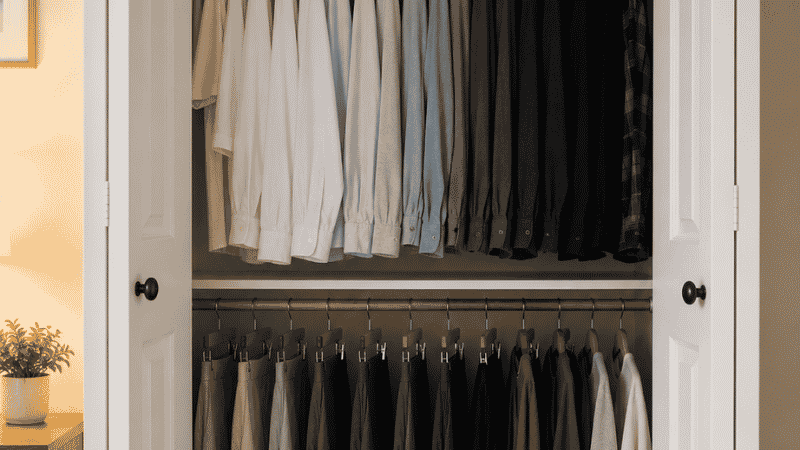
The bedroom should be the easiest room to decompress in. For most people it’s the opposite — a closet that doesn’t close properly, clothes on a chair that’s become a permanent fixture, a nightstand buried under everything that gets put down without thinking.
Bedroom organization has two distinct challenges: the visible surfaces (nightstands, dressers, the chair) and the storage systems (closet, under-bed space, drawers). They require different approaches and are best tackled separately.
How to Organize a Small Closet
Small closets fail for a predictable reason: the default single-rod-and-one-shelf setup was designed for a fraction of what most people actually own. The result is a packed rod where finding anything requires sliding a dozen hangers, and a top shelf that’s become a storage zone for things you’ve forgotten you own.
The two changes with the highest impact in any small closet cost under $30 and require no installation. A double hang rod that hooks over the existing rod adds a full second hanging level for shorter items — shirts, folded pants, jackets — effectively doubling hanging capacity in those sections. A shelf riser on the top shelf creates two storage levels where there was one, using vertical space that’s currently empty.
Beyond tools, the organizing principle that matters most in a small closet is frequency: daily-wear items at center and eye level, occasional items at the edges, seasonal items on the top shelf or in another storage location entirely. Most people organize by category (all shirts together, all pants together) when organizing by frequency of use would serve them far better.
Start here: Look at your hanging rod. Pull out every item you haven’t worn in the past 3 months and push it to one end. What’s left in the center is your actual active wardrobe — and it probably takes up significantly less than half the rod.
For the complete small closet organization system: → How to Organize a Small Closet (Even If It’s Stuffed With Clothes)
Bathroom Organization Ideas
Bathrooms accumulate clutter faster than almost any other room because they’re used multiple times daily, the surfaces are small, and products arrive continuously with every grocery run. The cabinet under the sink becomes a storage void. The counter collects everything that doesn’t have a real home. The shower grows a colony of half-empty bottles.
What makes bathroom organization stick is zone thinking applied to a small space: every surface and storage area gets an assigned category, and nothing lives in a zone that doesn’t belong to it. The counter holds only what’s used twice daily. Under the sink holds only sink-adjacent items. The shower holds only shower products.
Small Bathroom Storage Ideas
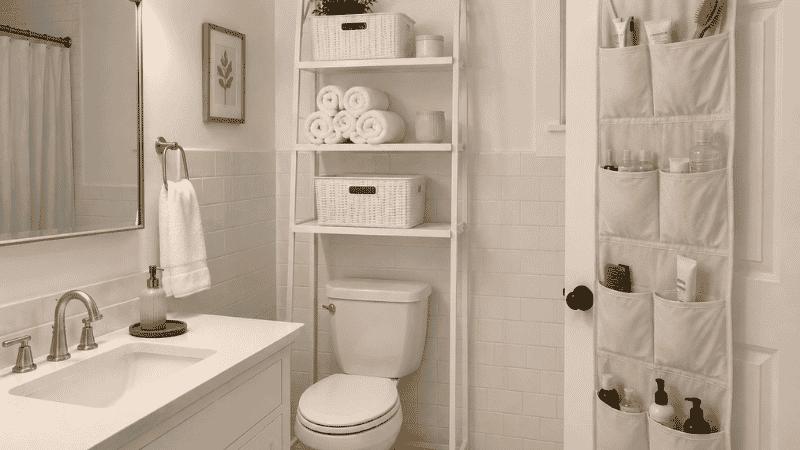
Small bathrooms have less obvious storage than they appear to — because most people use only two or three of the available storage zones. The wall above the toilet is almost always empty. The back of the bathroom door holds nothing. The inside of cabinet doors is unused. These three zones alone, properly utilized, can add significant storage capacity to any small bathroom without touching the floor plan.
For renters and anyone who can’t drill into walls, the options are better than most people realize. A freestanding over-toilet etagere sits on the floor and adds three shelf levels above the tank with no wall attachment. An over-door organizer with clear pockets hooks over the door frame and holds an enormous number of bathroom items in a space that currently holds nothing. Adhesive wall mounts handle everything from toothbrush holders to soap dispensers without leaving permanent damage.
Start here: Open your bathroom cabinet and remove everything expired. Just that. Most people free up 20–30% of bathroom storage space in this single step — products that have been occupying prime real estate while offering nothing in return.
For the complete small bathroom storage system: → Small Bathroom Storage Ideas: 12 Ways to Organize When You Have Almost No Space
Small Space and Apartment Organization Ideas
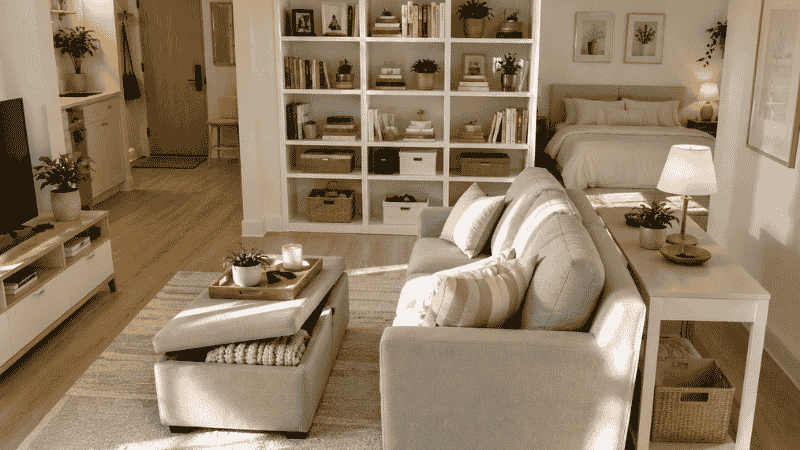
Small apartments and compact homes have a specific organizational challenge that larger homes don’t: there’s no spare room to absorb overflow. Every item that doesn’t have a deliberate home becomes immediately visible as clutter. There’s no basement to store the “I’ll deal with this later” boxes, no guest room that serves as a catch-all, no garage for the seasonal overflow.
This constraint, frustrating as it is, actually creates better organizational habits when worked with rather than against. Small spaces require intentionality that larger homes can avoid — and the result, when the system works, is a home that stays organized with significantly less effort than a larger space.
How to Organize a Small Apartment
The principle that makes small apartments work is every piece of furniture earning double duty. A bed frame with built-in drawers replaces a dresser. A storage ottoman replaces a coffee table while holding blankets and board games. A bookcase used as a room divider in a studio creates two zones and provides storage on both faces. In a small space, any piece of furniture that only does one thing is probably not earning its footprint.
The second principle is vertical thinking. Small apartments typically use 4 feet of their 8-foot ceiling height. Floating shelves installed from mid-wall to ceiling-height add significant storage capacity while keeping floor space completely clear. Tall, narrow storage units hold more than their footprint suggests and draw the eye upward, making rooms feel larger.
Start here: Count the pieces of furniture in your main living area. How many of them have storage built in? How many are purely single-function? Identifying one piece that could be replaced with a storage-integrated equivalent is the most efficient upgrade available in a small space.
For the complete small apartment organization system: → Small Space Storage Ideas: How to Organize a Small Apartment Room by Room
Decluttering: The Foundation of Every Organization System
No organization system works without a regular declutter habit. This isn’t a one-time event — it’s a twice-yearly practice that keeps the volume of possessions calibrated to the actual storage capacity of your home.
The most common misconception about decluttering is that it’s about becoming minimalist or getting rid of things you love. It isn’t. It’s about being honest about what’s currently earning its place in your home versus what’s staying out of guilt, habit, or inertia. Those are very different categories, and only one of them deserves your storage space.
How to Declutter Your Home Without Getting Overwhelmed
The reason decluttering feels overwhelming is decision fatigue — making hundreds of keep-or-let-go decisions in sequence depletes cognitive resources faster than almost any other mental task. This is why “do the whole house in a weekend” almost never works. It’s not about willpower. It’s about cognitive load.
The approach that consistently works: one room at a time, one session at a time, starting with the easiest room first. The bathroom has the most objective criteria (expired, broken, unused) and the fewest emotionally loaded items. Starting there builds decision-making momentum and produces visible results quickly — exactly what you need before tackling the harder rooms.
The specific tool for emotionally difficult items — sentimental objects, expensive things you don’t use, gifts that carry obligation — is the 3-month box: seal uncertain items in a box, date it, and put it out of the way. If you haven’t opened it or thought specifically about an item in 3 months, the decision has been made for you.
Start here: Walk through your home with a single garbage bag. Collect only obvious garbage — expired things, broken things, packaging that’s been sitting out. No decisions required, no categories to navigate. This one step, done in 15 minutes, creates visible space and the momentum to continue.
For the complete decluttering system: → How to Declutter Your Home: A Room-by-Room Guide for When You Don’t Know Where to Start
The Home Organization System That Actually Maintains Itself
Getting organized once is the easier part. Staying organized is where most people struggle — and where most organization advice falls short, because it focuses entirely on the setup and ignores the maintenance.
The home organization systems that hold up long-term share three characteristics:
They’re built around real behavior, not ideal behavior. If you always drop your keys on the kitchen counter, the solution isn’t to discipline yourself into using the key hook by the door — it’s to put a key hook on the kitchen counter. Systems that require you to behave differently than you naturally do will always eventually fail.
They have margin. A system where every space is filled to capacity has no room for error. The first rushed morning or tired evening breaks it, and recovery requires significant effort. Every storage zone should be at 70–80% capacity, not 100%. The empty space isn’t wasted — it’s what makes the system resilient.
They have a reset habit. A 10-minute weekly reset — returning items to their homes, clearing surfaces that have accumulated things — prevents the gradual drift that turns into a major reorganization project every few months. Ten minutes is short enough to actually do consistently. Consistently is the only thing that matters.
How to Stay Organized at Home Long Term
The weekly reset works best when it’s scheduled rather than done “when it needs it” — because “when it needs it” is a judgment call that’s easy to defer, while a specific time slot is not. Sunday evening before the week starts, Saturday morning as part of a routine, whatever time is consistently available works equally well. The time matters less than the consistency.
Beyond the weekly reset, a monthly scan of the spaces that accumulate fastest for your specific household — probably the kitchen counter, a specific drawer, and one or two surfaces — catches accumulation early before it becomes a project.
Twice yearly — spring and fall work naturally for seasonal transitions — a full room-by-room reassessment: does what’s stored still reflect what’s currently used? Wardrobes change, hobbies evolve, families grow and shift. The organization system should reflect the household as it actually is, not as it was when you first set things up.
Home Organization Checklist: Where to Start in Every Room
Use this as a quick reference when you’re not sure where to begin in a specific room.
Kitchen:
- Assign each drawer a single zone job before putting anything back
- Store items near where they’re used, not near similar items
- Add a shelf riser to the spice cabinet for two visible rows
- Use a turntable in deep cabinets for bottles and jars
- Assign the under-sink cabinet to cleaning products only
Bedroom and Closet:
- Reorganize hanging clothes by frequency of use, not category
- Add a double hang rod for shorter items to double hanging capacity
- Use under-bed space for seasonal items in proper storage bags
- Clear nightstand surface to only items used in the bedroom
Bathroom:
- Remove all expired products before organizing anything else
- Use the wall above the toilet — etagere or floating shelves
- Move daily-use items to the most accessible counter or cabinet position
- Install an over-door organizer on the back of the bathroom door
Living Areas:
- Do a “doesn’t belong here” sweep before organizing — remove misplaced items first
- Ensure every large furniture piece serves a storage function
- Clear one main surface completely and keep it clear
Small Spaces:
- Replace single-function furniture with storage-integrated equivalents
- Use vertical wall space from mid-height to ceiling
- Apply “one in, one out” rule for all new items entering the space
FAQ: Home Organization Ideas
Where do I start when my whole home needs to be organized? Start with the room that causes you the most daily stress — not the most visible one or the biggest one, but the one that costs you the most mental energy every day. Do that room properly before moving to the next. One well-organized room builds momentum and gives you a reference point for what the rest can feel like.
What is the best home organization system? The best system is the one built around how you actually behave, not how you think you should behave. Zone-based organization — storing items near where they’re used — works in every room. Frequency-based organization — keeping most-used items most accessible — works within every zone. These two principles together create a system that reduces daily friction rather than adding to it.
How do I stay organized at home long term? A 10-minute weekly reset is the single most effective maintenance habit. Return misplaced items to their homes, clear surfaces that have accumulated things, and deal with anything that’s arrived without a designated place. This prevents gradual accumulation from becoming a reorganization project. Pair it with a twice-yearly full reassessment and a “one in, one out” rule for new possessions.
How do I organize my home on a budget? Decluttering costs nothing and has the highest impact of any single action. Beyond that, the highest-return purchases are shelf risers ($10–$20), over-door organizers ($15–$30), and drawer dividers ($15–$25) — all of which solve the most common organization problems for under $100 total. Buying organizers before decluttering is the most common budget mistake — you end up neatly organizing things you should have gotten rid of.
How long does it take to organize a whole house? For a typical 2–3 bedroom home, expect 20–40 hours of total organizing time spread across multiple sessions. Working in focused 30–60 minute sessions over several weeks produces better decisions than attempting everything at once — and is more sustainable for most households. A realistic timeline is 4–8 weeks for a full home, doing 2–3 sessions per week.
What should I organize first in a new home? The kitchen first — it affects every day immediately. Then the bedroom and closet — they affect how every morning starts. Then the bathroom. Common areas and storage spaces can be organized more gradually because the daily impact is lower. In a new home specifically, use the first 2 weeks as observation time before committing to any organization system — your actual habits will tell you where things naturally need to live.
The Organized Home Is Built One Room at a Time
An organized home isn’t a destination you arrive at and then maintain effortlessly. It’s a series of systems, built gradually, adjusted as your household evolves, and maintained with habits that take less time than the frustration they prevent.
The guides linked throughout this page cover each room in full detail — the specific steps, the tools worth buying, the mistakes worth avoiding, and the maintenance habits that make each system last. Pick the room that matters most to you right now. Read that guide. Take the first step it recommends.
That’s the whole system. One room, one step, one decision at a time.
Complete Guide Index
- Kitchen Drawers → How to Organize Kitchen Drawers (and Actually Keep Them That Way)
- Kitchen Cabinets → How to Organize Kitchen Cabinets: A Step-by-Step Zone System
- Small Closet → How to Organize a Small Closet (Even If It’s Stuffed With Clothes)
- Bathroom → Small Bathroom Storage Ideas: 12 Ways to Organize When You Have Almost No Space
- Small Apartment → Small Space Storage Ideas: How to Organize a Small Apartment Room by Room
- Decluttering → How to Declutter Your Home: A Room-by-Room Guide
References
- Saxbe, D. E., & Repetti, R. (2010). No Place Like Home: Home Tours Correlate With Daily Patterns of Mood and Cortisol. Personality and Social Psychology Bulletin, 36(1), 71–81. UCLA Center on Everyday Lives and Families.
- Roster, C. A., Ferrari, J. R., & Jurkat, M. P. (2016). The dark side of home: Assessing possession ‘clutter’ on subjective wellbeing. Journal of Environmental Psychology, 46, 32–41.
- Baumeister, R. F., Bratslavsky, E., Muraven, M., & Tice, D. M. (1998). Ego depletion: Is the active self a limited resource? Journal of Personality and Social Psychology, 74(5), 1252–1265.
Category: Room Organization | Reading time: 15 min | Last updated: 2026