
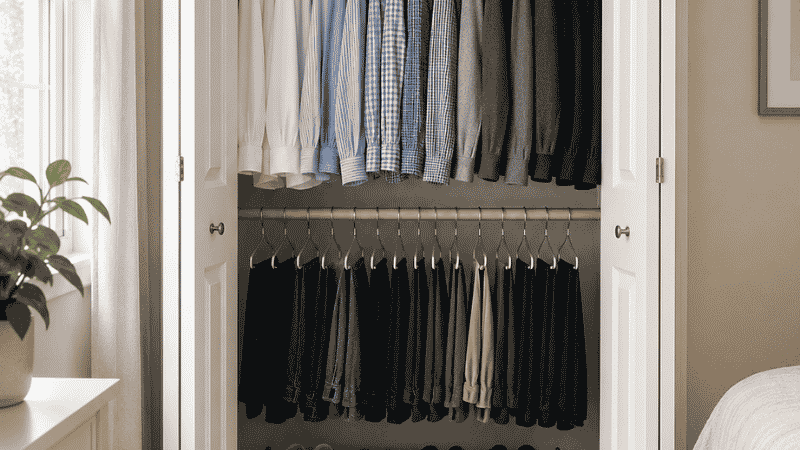
You open the closet doors in the morning, half awake, trying to find something to wear. Clothes are packed so tightly you can barely slide a hanger. You pull one thing out and two others fall off. Somewhere in the back, behind the jackets you haven’t touched in a year, there’s probably a shirt you’ve been looking for since March.
You close the doors. You’re already tired, and the day hasn’t started yet.
Here’s what most closet organization guides won’t tell you: the problem usually isn’t that your closet is too small. It’s that it’s trying to do too many jobs at once with zero structure. A small closet without a system will always feel chaotic — not because you’re doing something wrong, but because the default single-rod-and-one-shelf setup was genuinely never designed to hold a real person’s wardrobe.
The good news is that you don’t need a walk-in closet, a custom built-in system, or a weekend renovation to fix this. You need a method. This guide walks you through how to organize a small closet step by step — from the full clear-out to the long-term maintenance habits that most articles skip entirely.
No drilling required for most steps. Budget-friendly options throughout. And yes, this works for shared closets too.
Key Takeaways
- The average person wears about 20% of their wardrobe 80% of the time. Decluttering first — before buying a single organizer — is the step that makes everything else work.
- Vertical space is almost always wasted in small closets. Double hanging rods alone can increase your hanging capacity by up to 50% with zero renovation.
- The right organizer for your closet depends on your specific contents and measurements — not what looks good on Pinterest.
- Maintaining an organized small closet takes about 5 minutes per week, not another full weekend reorganization every few months.
- Renters and no-drill households have more options than they think — freestanding systems, tension rods, and over-door organizers require zero wall damage.
Step 1: Do the Declutter You’ve Been Avoiding
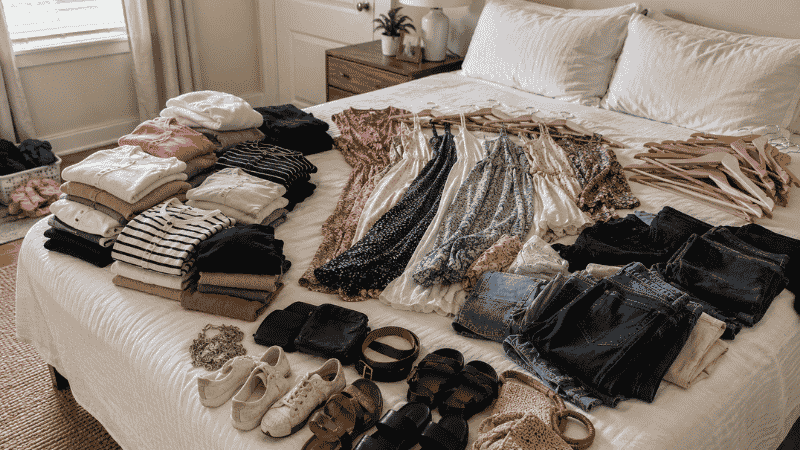
This is the step that actually determines how successful everything else will be — and it’s the one most people rush through or skip entirely.
You cannot organize your way out of too much stuff. If your small closet is holding 60 items and realistically only has space for 35, no amount of clever organization will make it feel calm. You have to make decisions first.
Pull everything out. All of it. Yes, this is going to look catastrophic for about 45 minutes. That’s completely normal — it’s part of the process, not a sign that something is going wrong.
Go through each item and ask three questions:
- Have I worn this in the past 12 months? (Seasons count — winter coat in summer is fine. A dress you keep “for someday” that someday never comes is not.)
- Does it fit right now, the way my body actually is today?
- If I were shopping and saw this in a store, would I buy it again?
If the answer to all three is no, it goes. If you’re on the fence about something, that’s usually your answer too — genuinely useful, loved items don’t cause fence-sitting.
One honest thing about decluttering: the guilt is real. Clothes that were expensive, clothes that were gifts, clothes that represent a version of yourself you’re still hoping to become — these are the hard ones. Research published in the Journal of Environmental Psychology found that people experience genuine psychological attachment to possessions, and that letting go requires consciously separating the item from the memory or identity it represents. Acknowledging that it’s hard doesn’t mean you have to keep everything. It just means you’re human.
A reasonable target for most small closets: aim to remove at least 20–30% of what was in there. If you get to 40%, even better.
Step 2: Measure Everything Before You Touch a Shopping Cart
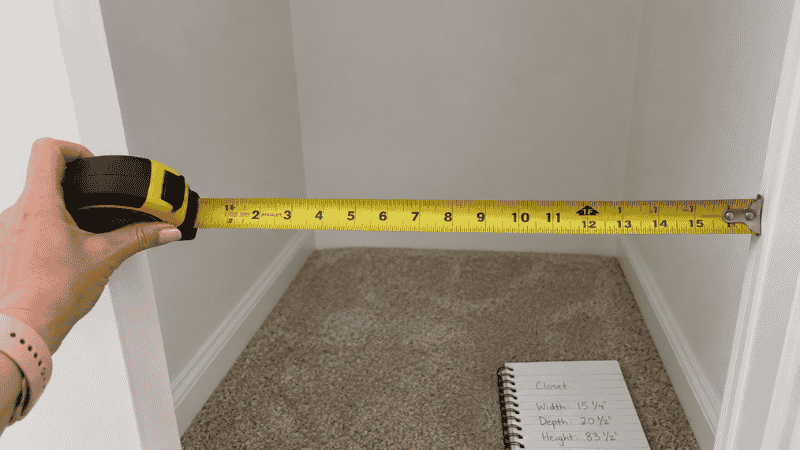
This step takes 10 minutes and saves you from the single most common closet organization mistake: buying organizers that don’t fit.
Grab a tape measure. Write down:
- Total width of the closet interior (wall to wall)
- Total depth (front to back — this matters for shelves and drawers)
- Height from floor to ceiling
- Existing rod height — where does the current hanging rod sit?
- Floor space — what’s actually available below the hanging clothes?
While you’re at it, count your items by category. How many hanging items? How many folded items? How many shoes? This tells you exactly what zones you need and how much space each zone requires. It’s the difference between a closet that works for your wardrobe specifically and one that looks organized in photos but doesn’t actually fit what you own.
Step 3: Assign Zones Based on How You Actually Get Dressed
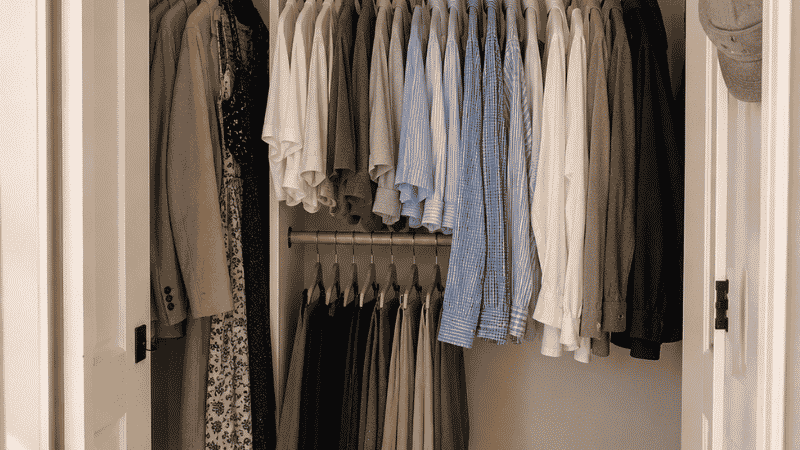
This is the principle that makes small closet organization feel effortless instead of forced: your closet should be organized around the sequence of how you get dressed, not around categories that look logical in theory.
Think about your actual morning. What do you reach for first? What goes on last? Where do you physically stand when you’re getting dressed?
A zone system that works for most small closets:
The Daily Zone — center and eye level, easiest to reach This is for your most-worn items: the 10–15 pieces you reach for multiple times a week. Shirts, pants, the everyday dresses. These live in the prime real estate of your closet — center rod, eye level, closest to the door.
The Occasional Zone — sides or slightly higher Work clothes you wear a few times a week, nicer pieces for weekends out, blazers. Still hanging, but pushed to the edges or a slightly higher rod.
The Seasonal/Storage Zone — back, top shelf, or under bed Off-season clothes, formal wear, anything you access less than monthly. These don’t need prime closet space. Vacuum storage bags, shelf bins, or under-bed storage take over here.
The Shoes Zone — floor or door Shoes you wear weekly go on a floor rack or the back of the door. Everything else goes in boxes, on a high shelf, or in another location entirely. Yes, really. Every pair of shoes doesn’t need to live in your main closet.
The Editor’s Take: Most people organize by category (all shirts together, all pants together) rather than by frequency. Reorganizing by how often you actually use something feels counterintuitive at first, then feels obvious after the first week.
Step 4: Use Your Vertical Space — It’s Almost Certainly Being Wasted
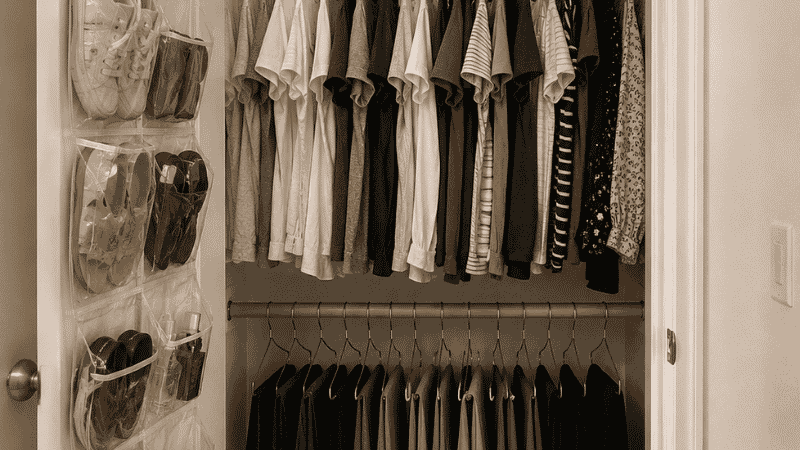
This is where small closets go from frustrating to surprisingly functional, without any renovation and often for less than $30.
The average closet has 7–8 feet of vertical space. The average single-rod closet uses maybe 4 feet of it. That’s a huge amount of wasted real estate hanging right in front of you.
The double hang method — the highest-impact change you can make:
Most items in your wardrobe are shorter than 40 inches when hanging: t-shirts, shirts, folded pants, jackets, blazers. That means a second rod underneath the existing one creates a full second layer of hanging space for these shorter items. A basic double hang rod costs $10–$20 and hooks over your existing rod with no tools required.
Long items — dresses, trousers hung full-length, long coats — get one dedicated section of the rod. Everything else gets doubled up.
Shelf risers and stackable bins for the top shelf:
The top shelf of most closets is a black hole. Things go up there and disappear. A shelf riser turns one shelf level into two, effectively doubling the storage capacity for folded items, bins, and boxes.
Over-door organizers for renters and no-drill spaces:
The back of a closet door is often completely unused. An over-door organizer with pockets can hold shoes, accessories, folded clothes, or small items — with zero wall damage and no tools. For a small closet in a rental, this is often the single highest-return upgrade available.
Floor space below the hanging clothes:
If you have a short-hang section, the floor below it is prime real estate. A small 3-drawer unit, a shoe rack, or a set of stackable bins can live here. Measure carefully — the height between the bottom of your clothes and the floor tells you what size unit will fit.
How to Organize a Small Closet With Lots of Clothes
This deserves its own section because it’s the situation where people feel most stuck — you’ve already decluttered, you really do need everything that’s left, and it still doesn’t fit.
First, audit your hanging vs. folding ratio. The biggest waste of space in most closets is hanging items that don’t need to be hung. T-shirts, knitwear, jeans, casual pants — these all fold perfectly well and take up a fraction of the space in a drawer or bin compared to on a hanger. Shifting your fold/hang ratio is often the single biggest space gain without adding any new storage at all.
File folding is not optional if you have too many clothes. File folding (standing clothes vertically like files in a filing cabinet rather than stacking them flat) means you can see everything in a drawer or bin at once, and pulling one item doesn’t disturb everything else. It was popularized by Marie Kondo but it’s genuinely effective regardless of your feelings about minimalism. A standard dresser drawer holds roughly twice as many items file-folded as it does stacked flat.
Seasonal rotation is your best tool. Off-season clothes don’t need to be in your active closet at all. Vacuum compression bags reduce the volume of bulky winter items (sweaters, down jackets, heavy blankets) by up to 80%. A single bag under the bed or on a high shelf frees up significant hanging and shelf space for the current season.
Accessories take up more space than you think. Scarves, belts, bags, hats — when these don’t have a dedicated place, they pile up and create visual chaos that makes a closet feel more overwhelming than it is. An over-door hook system for bags, a small basket for scarves, a belt hook on the rod — these small decisions have an outsized effect on how the closet feels to use.
No-Drill and Rental-Friendly Closet Organization
Renters and people in no-drill situations often feel like they’re excluded from closet organization advice. Most guides assume you can install shelving systems, mount brackets, or screw in hooks — none of which are options when you don’t own the walls.
Here’s what actually works without touching the walls:
Freestanding closet systems — these are modular shelving and hanging units that stand on the floor independently. They’re adjustable, movable, and come out clean when you leave. They’re more expensive than wall-mounted systems but genuinely transform a bare closet.
Tension rods — a single tension rod mounted horizontally between two walls (held in place by pressure, not screws) can add a whole extra hanging level. Works especially well in deep closets or for hanging pants, scarves, and lightweight items below a main rod.
Over-door everything — hooks, organizers, shoe pockets. The door is your best friend in a rental. Over-door solutions use zero wall space and cause zero damage.
Command hooks — for lightweight accessories, bags, and small items, Command hooks are technically removable and leave minimal damage. Worth checking your lease agreement before using them, but in most rentals they’re fine for small hooks on smooth walls.
If You Only Have 10 Minutes Right Now
Sometimes you don’t have a free Saturday. Sometimes you just want to do something about the closet before you close the door and walk away again. Here’s what you can realistically accomplish in short bursts:
10 minutes: Go through just your hanging clothes. Pull out anything you haven’t worn in 12 months. Put it in a bag by the door. Done. The closet already has more breathing room.
20 minutes: Reorganize your hanging rod by frequency. Daily wear in the center, everything else pushed to the sides. No buying anything, no measuring — just rearranging what’s already there.
30 minutes: Clear the floor completely. Everything that’s piled on the closet floor — move it, sort it, find it a real home or let it go. A clear floor makes a closet feel dramatically more organized even if nothing else changes.
The honest truth about 10-minute sessions: they work for maintenance, but they don’t replace a proper initial reorganization. Think of them as the habit that keeps the system working, not the thing that builds the system in the first place.
Why Your Closet Keeps Getting Messy Again
If you’ve organized your closet before and it was chaotic within a month, it wasn’t a personal failure. It was a systems failure. Here’s what usually goes wrong:
The organization system was built for who you wanted to be, not who you actually are. If you organized your closet while feeling very motivated and aspirational, you may have created a system that requires consistent, careful behavior to maintain. Most people — especially on busy mornings — need a system where putting things back takes zero thought. If your system requires unfolding, refolding, and carefully replacing an item in the exact right compartment, it will fail by week two.
The closet was overfull before you even started. Organization doesn’t solve a volume problem. If there’s no margin — no breathing room between items — the first time you’re in a hurry and shove something back quickly, the whole system starts to collapse.
There was no reset routine. A quick 5-minute weekly reset — returning anything that’s migrated to the wrong place, pulling out anything that’s been sitting untouched — is what keeps a closet organized for months instead of weeks. Without it, small chaos compounds into big chaos faster than you’d expect.
FAQ: How to Organize a Small Closet
How do I organize a small closet with lots of clothes? Start with a hard declutter, then shift your fold/hang ratio — many items you’re hanging can be folded and stored in a drawer, freeing up significant rod space. Add a double hang rod for shorter items, use vacuum bags for off-season pieces, and give accessories a dedicated zone so they stop creating pile-up chaos.
How do I organize a very small closet — like one that’s barely bigger than a wardrobe? In very small closets, vertical space is everything. A double hang rod, shelf risers on the top shelf, and an over-door organizer can nearly double your storage capacity without touching the walls. Be ruthless about keeping only what fits actively — anything seasonal goes under the bed or in another storage space.
What’s the best closet organization system for renters? Freestanding modular systems, tension rods, and over-door organizers are your three best options. They require no installation, cause no wall damage, and move with you. Avoid wall-mounted bracket systems unless your lease specifically allows it and you’re prepared to patch the holes before leaving.
How do I organize a small walk-in closet? Walk-in closets have more floor space but often suffer from the same single-rod, one-shelf setup as reach-in closets. Zone it by frequency (daily wear accessible, occasional wear further back), use all four walls, and consider a small center island or rolling cart if the floor space allows. The zone system matters more in a walk-in because it’s easier to let it become a dumping ground.
How long does it take to organize a small closet? A proper initial reorganization — full empty-out, declutter, measure, rearrange — takes most people 2–4 hours depending on how much is in there and how decisive you are during the declutter phase. After that, a weekly 5-minute reset is all you need to maintain it.
Do I need to buy new organizers to get my closet under control? Not necessarily. Many closets improve dramatically from decluttering and rearranging alone, without any new purchases. Once you’ve done the initial sort and measured your space, you’ll have a much clearer sense of what — if anything — is actually worth buying. Buying organizers before you’ve decluttered often just means neatly organizing things you should have gotten rid of.
How do I keep a small closet organized long-term? Two habits make the biggest difference: a weekly 5-minute reset (return strays, pull out anything that’s accumulated on the floor), and a seasonal review (twice a year, rotate out-of-season items and reassess what’s still earning its place). That’s genuinely it. The system does most of the work — the maintenance is just keeping it honest.
Start With One Section Today
If you’re feeling overwhelmed by the idea of tackling the whole closet, start smaller than you think you need to. Not the whole closet — just the hanging rod. Pull out everything, hang back only what you actually wear, and push the rest to one side.
That one change will make the closet easier to use tomorrow morning. And tomorrow morning being slightly better is the whole point.
The rest of the steps can happen gradually — one section, one weekend, one small decision at a time. The goal isn’t a Pinterest closet. It’s a closet you can find things in without starting your day frustrated.
Explore more on Vomoxs:
- How to Organize Kitchen Drawers (and Actually Keep Them That Way)
- Seasonal Clothing Storage: How to Switch Out Your Wardrobe Without Losing Your Mind
- How to Declutter Your Home: A Room-by-Room Checklist
References
- Roster, C. A., Ferrari, J. R., & Jurkat, M. P. (2016). The dark side of home: Assessing possession ‘clutter’ on subjective wellbeing. Journal of Environmental Psychology, 46, 32–41.
- Kondo, M. (2014). The Life-Changing Magic of Tidying Up. Ten Speed Press. — Referenced for file-folding methodology.
- Saxbe, D. E., & Repetti, R. (2010). No Place Like Home: Home Tours Correlate With Daily Patterns of Mood and Cortisol. Personality and Social Psychology Bulletin, 36(1), 71–81.
Category: Room Organization | Reading time: 10 min | Last updated: 2026