
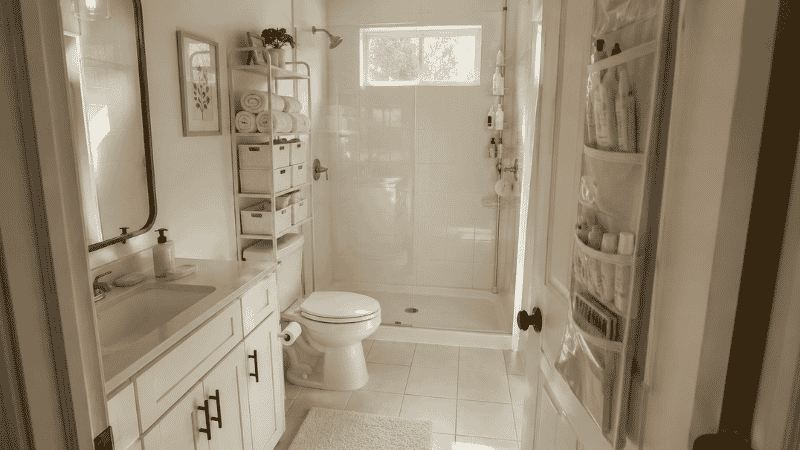
You know that moment when you open the bathroom cabinet and a cascade of half-empty bottles, expired face wash, and three different kinds of cotton balls comes tumbling out? And you stand there for a second — toothbrush in hand, already late — trying to figure out how this happened again?
Small bathrooms have a way of becoming chaos faster than any other room in the house. The space is tight, the surfaces are tiny, the storage was probably designed by someone who has never actually tried to fit two people’s morning routines into 40 square feet. And unlike a messy bedroom you can close the door on, the bathroom is non-negotiable — you’re in there every single day, multiple times, often when you’re tired or rushing.
Here’s what actually helps: not buying more organizers (yet), but building a zone-based system that works with your specific bathroom’s layout. This guide covers 12 small bathroom storage ideas organized by space — counter, under the sink, toilet area, shower, doors, and walls — so you can tackle one zone at a time and build a setup that genuinely lasts.
Rental-friendly options are marked throughout. No power tools required for most of these.
Key Takeaways
- The average small bathroom has at least 4 underused storage zones: the wall above the toilet, the inside of cabinet doors, the back of the bathroom door, and the space under the sink. Most people use maybe one of them.
- Buying organizers before decluttering first is the most common small bathroom storage mistake — you end up neatly organizing things you should have thrown away.
- Research from Princeton University’s Neuroscience Institute found that visual clutter directly competes for your brain’s attention, which is why a disorganized bathroom genuinely makes mornings feel harder than they need to be.
- Renters have more options than they think — adhesive hooks, over-door organizers, tension rods, and freestanding units work in virtually any bathroom without touching the walls.
- The goal isn’t a Pinterest bathroom. It’s a bathroom where you can find everything you need in under 10 seconds.
Start Here: Declutter Before You Organize Anything
This isn’t the exciting part, but skipping it is exactly why most people reorganize their bathroom three times and it still feels chaotic.
Open every cabinet, drawer, and shelf. Pull everything out. Then go through it ruthlessly:
- Expired products go immediately. Sunscreen, medications, old makeup, skincare with broken seals — check dates and toss without guilt. Most people find they’re storing products that expired 1–2 years ago.
- Duplicates get consolidated. Four half-empty bottles of the same shampoo? Pour them together. Two of everything is fine as backup. Five is just clutter with extra steps.
- “Someday” products get a time limit. That face mask you’ve had for 18 months unopened? Use it this week or let it go. “Someday” items are the silent space-wasters in every bathroom.
A study published in Personality and Social Psychology Bulletin found that people with cluttered homes showed higher levels of the stress hormone cortisol throughout the day — and the bathroom, as the first and last room most people visit daily, has an outsized effect on overall mood. The declutter isn’t just practical. It genuinely matters.
Editor’s note: Most people are shocked by how much they throw away in this step. It’s not unusual to clear an entire shelf just from expired products and duplicates.
Zone 1: The Counter — Clear It Down to Essentials Only
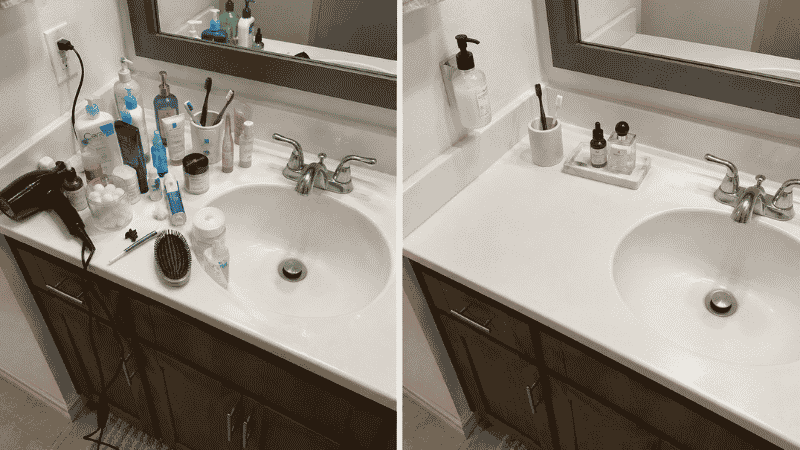
The bathroom counter is the most-used surface and the fastest to get chaotic. The fix isn’t more organizers — it’s deciding what actually earns counter space.
The 3-item counter rule: Only items you use every single day, twice a day, belong on the counter. For most people that’s: hand soap, toothbrush holder, and maybe a facial cleanser. Everything else has a home somewhere else.
Small Bathroom Storage Idea 1: Wall-Mounted Toothbrush and Soap Holders
Moving your toothbrush holder and soap dispenser off the counter and onto the wall immediately opens up significant surface space. Modern adhesive wall mounts (3M Command strips handle most lightweight bathroom accessories) mean no drilling, no damage, and easy removal.
Look for sets that include a toothbrush holder, soap dispenser, and a small cup holder — these typically run $15–$30 and instantly make a small counter feel twice as large.
Rental-friendly: ✅ Adhesive mounts, zero wall damage
Small Bathroom Storage Idea 2: A Single Tray to Contain What Stays on the Counter
Whatever does stay on the counter — perfume, a candle, daily skincare — group it on one small tray. A tray creates a boundary. Without it, items gradually spread across the entire counter. With it, the counter looks intentional even when it has a few things on it.
Marble, acrylic, or bamboo all work. The material matters less than having a defined edge that stops the creep.
Zone 2: Under the Sink — The Most Wasted Space in Most Bathrooms
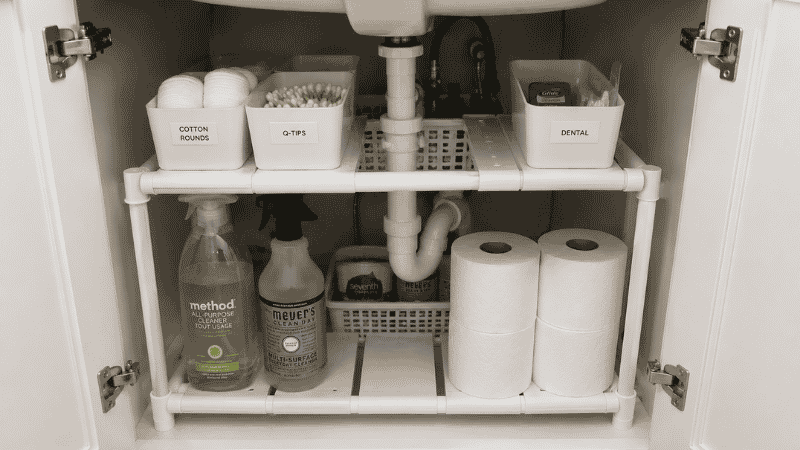
The cabinet under the bathroom sink is where organization goes to die. The plumbing creates awkward angles, things get shoved to the back and forgotten, and the whole area becomes a dark storage void.
It doesn’t have to be. It just needs structure.
Small Bathroom Storage Idea 3: Expandable Shelf Risers Around the Plumbing
Under-sink organizers designed specifically to work around plumbing pipes are one of the highest-impact purchases you can make for a small bathroom. They add a second level of storage above the pipes while keeping the area around them accessible.
Look for adjustable or expandable versions — the exact pipe configuration varies by bathroom, and a rigid organizer that doesn’t fit your plumbing is useless. Most adjustable under-sink shelves run $20–$40 and transform what was dead space into organized, tiered storage.
How to Organize Under Bathroom Sink by Category
Once you have the structure in place, organize by frequency of use:
- Front left/right (easiest to reach): Daily use items — hand soap refills, toilet paper backup, daily skincare
- Back left/right (harder to reach): Weekly or monthly use — cleaning products, first aid supplies, backup toiletries
- Top shelf level (above pipes): Items that stack well and you need occasionally — cotton rounds, q-tips in a small bin, hair ties
Pull-out bins or small baskets for the back sections make reaching deep items much easier and prevent the “I forgot this existed” problem.
Rental-friendly: ✅ Freestanding organizers, no installation
Zone 3: Above the Toilet — Prime Real Estate Most People Ignore
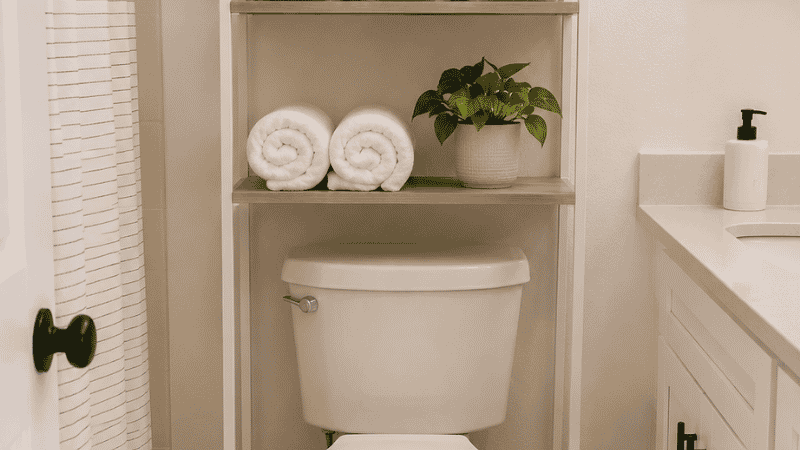
The wall space above your toilet is one of the most underused areas in a small bathroom. It’s at a convenient height, it’s near where you need most bathroom products, and — critically — it doesn’t take up any floor space at all.
Over the Toilet Storage Ideas That Actually Work
Option A: Over-toilet etagere (freestanding) A freestanding over-toilet shelf unit sits on the floor behind the toilet and frames the tank with 2–3 shelf levels above. No wall installation, completely portable, moves out in seconds. This is the highest-capacity option for renters or anyone who doesn’t want to mount anything.
Holds: Extra toilet paper, towels, decorative baskets with bathroom essentials, small plants.
Rental-friendly: ✅ Fully freestanding
Option B: Floating shelves (wall-mounted) If you can put holes in your walls, two or three floating shelves above the toilet create a clean, custom look with significant storage capacity. The key is spacing — leave at least 12 inches of clearance above the tank, and space shelves 10–12 inches apart so products aren’t jammed together.
Bottom shelf: Daily products you reach for often Middle shelf: Less frequent items in small baskets Top shelf: Decorative storage or backup supplies
Rental-friendly: ❌ Requires wall mounting
Option C: Cabinet above toilet A wall-mounted cabinet with a door gives you concealed storage — great for keeping the bathroom looking tidy without everything on display. More involved to install, but provides the highest visual cleanliness.
The honest truth about over-toilet storage: The etagere is the most practical and most rental-friendly option for small bathrooms. The floating shelf look is more minimal and modern. Neither is wrong — it depends on how much you want to see vs. hide.
Zone 4: The Shower — Stop Balancing Bottles on the Edge
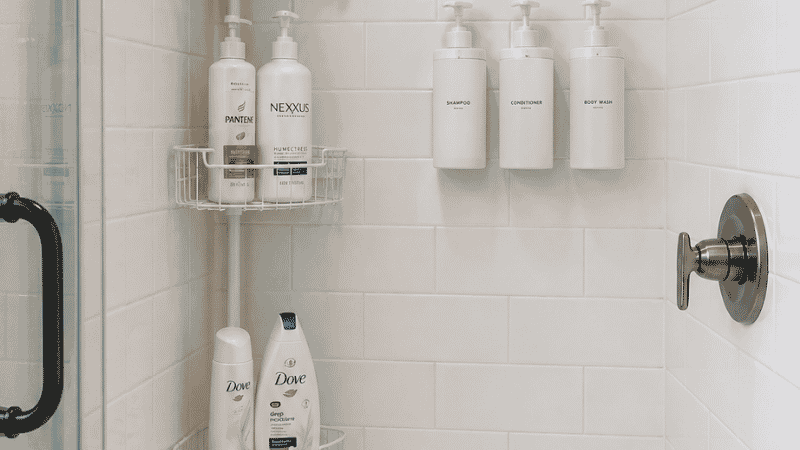
If you’re currently balancing shampoo bottles on the corner of the tub or on a flimsy caddy that keeps sliding down, this zone is probably causing you daily low-grade frustration.
Small Bathroom Storage Idea 6: Corner Tension Shelves
Tension pole shower caddies that stretch from floor to ceiling are the gold standard for small shower storage — they hold significant weight, adjust to any shower height, require no drilling, and provide 3–4 shelf levels. The key is installing them correctly: they need firm contact with both floor and ceiling to stay stable. Overtighten slightly; they should be very snug.
Rental-friendly: ✅ No drilling, pressure-mounted
Small Bathroom Storage Idea 7: Wall-Mounted Pump Dispensers for Shampoo and Body Wash
Switching from individual bottles to wall-mounted refillable pump dispensers is the single biggest visual upgrade you can make to a small shower. Three uniform dispensers mounted on the wall (shampoo, conditioner, body wash) replace the cluttered collection of different-sized bottles with something that looks intentional.
Adhesive mounting means no drilling. Refill from bulk bottles to reduce ongoing plastic waste and cabinet clutter from stored backups.
Rental-friendly: ✅ Strong adhesive mounting
Small Bathroom Storage Idea 8: A Simple Teak or Plastic Shower Bench
If your shower has any floor space, a small corner bench or teak stool serves double duty: it holds products on top and provides a surface for shaving or for kids’ bath toys without floor caddies crowding the drain area.
Zone 5: The Door — Yours Is Probably Completely Empty Right Now
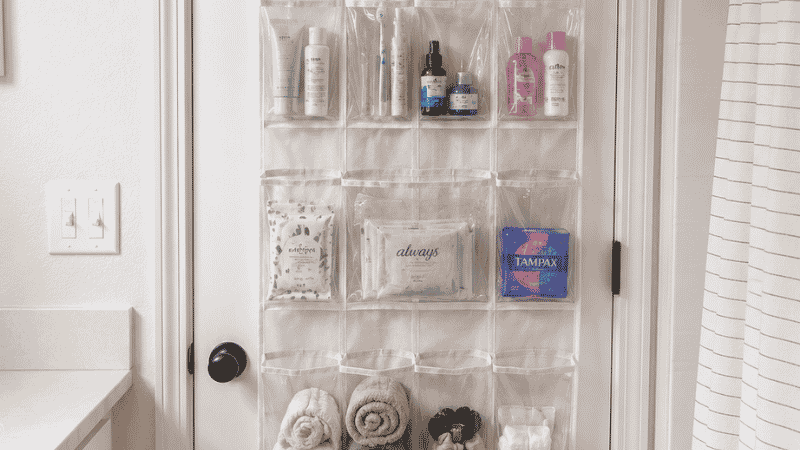
The back of the bathroom door is invisible when the door is open, which is exactly why most people forget it exists. In a small bathroom, it’s some of the most valuable storage real estate you have.
Small Bathroom Storage Idea 9: Over-Door Organizers for Toiletries
An over-door organizer with clear pockets holds an enormous amount of bathroom items — hair tools, travel-sized products, medicines, feminine hygiene products, makeup — in a space that currently holds nothing. Most over-door organizers hook over the door without any installation and hold 15–20+ items.
The best versions for bathrooms have pockets of varying sizes (so you can fit everything from a hair dryer to a lip balm) and are made from water-resistant material for the humid bathroom environment.
Rental-friendly: ✅ Hooks over door, no damage
Small Bathroom Storage Idea 10: Door-Mounted Hooks for Towels and Robes
A single over-door hook bar (holds 3–6 hooks) gives towels, robes, and bags a real home without using any wall space. This is especially useful in shared bathrooms where wall towel bars are already occupied.
Zone 6: Walls and Vertical Space — The Final Frontier
If you’ve worked through all the previous zones and still feel like you need more storage, your walls have more to give. Small bathrooms benefit enormously from vertical thinking — even 8 inches of unused wall space can hold a meaningful amount of storage.
Small Bathroom Storage Idea 11: Magnetic Strips for Small Metal Items
A magnetic strip mounted inside a cabinet door (or on a small section of wall) keeps bobby pins, tweezers, nail clippers, small scissors, and metal hair clips from disappearing into the drawer abyss. Items stick to the strip visibly and are retrievable in one motion — no rummaging.
Adhesive magnetic strips require no tools and cause no damage.
Rental-friendly: ✅
Small Bathroom Storage Idea 12: Bathroom Vanity Organization with Drawer Dividers
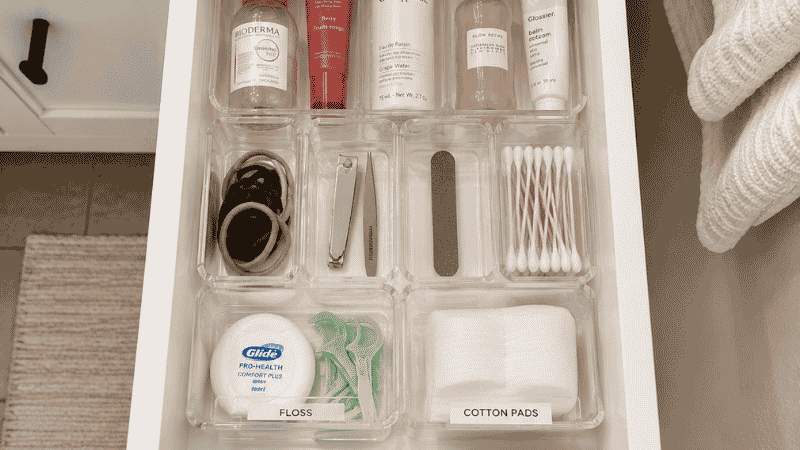
If you have any drawers in your bathroom vanity, they’re almost certainly underorganized. A set of modular small-bin drawer dividers — the same concept as kitchen drawer organization — transforms a chaotic bathroom drawer into a system where everything has one specific spot.
How to organize bathroom drawers by category:
- Daily zone (front): Toothpaste, face wash, daily moisturizer, contacts
- Grooming zone (middle): Tweezers, nail file, hair ties, cotton rounds
- Backup zone (back): Spare toothbrushes, travel sizes, overflow products
Clear acrylic dividers let you see what’s in each section without opening everything. Bamboo dividers are slightly more rigid and have a warmer aesthetic — both work equally well functionally.
Bathroom Organization Ideas for Small Bathrooms: What to Do When You Share
Shared bathrooms — whether with a partner, kids, or roommates — have an additional layer of complexity that most organization guides completely ignore. Everyone has different products, different habits, and a different tolerance for where the toothpaste cap goes.
Assign each person a dedicated zone, not just a shelf. When everyone shares the same space without boundaries, items migrate constantly. Even in a small bathroom, you can typically designate: one cabinet shelf per person, one section of the under-sink cabinet, one area of the shower caddy. Physical separation of storage reduces the daily “who used my moisturizer” friction dramatically.
Use color-coded or labeled bins for kids. In family bathrooms, small labeled bins — one per child — for their specific bath products mean kids can find (and return) their own things without help. This is one of those small systems that sounds overly simple and actually changes the morning routine.
If You Only Have 10 Minutes
10 minutes: Open the cabinet under the sink and throw out everything expired or that you haven’t touched in 6+ months. Just that. The space this creates will feel immediate and satisfying.
20 minutes: Clear the counter down to 3 items maximum. Find homes for everything else — even if it’s temporarily in a bin under the sink. A clear counter makes the whole bathroom feel larger without moving a single piece of furniture.
30 minutes: Install one over-door organizer on the back of the bathroom door and fill it with products currently cluttering your counter or cabinet. Thirty minutes of effort, significant daily impact.
FAQ: Small Bathroom Storage Ideas
What is the best small bathroom storage idea for renters? Over-door organizers, freestanding over-toilet etageres, tension pole shower caddies, and adhesive wall mounts are the four best rental-friendly solutions. None require drilling, all are removable without wall damage, and together they address every major storage zone in a small bathroom.
How do I organize a small bathroom with no storage at all? Start vertical. A freestanding over-toilet shelf unit and an over-door organizer add significant storage capacity without touching floors or walls beyond the door frame. Add a tension shower caddy and an under-sink expandable shelf unit and you’ve created functional storage in all four primary bathroom zones — in a bathroom that started with essentially nothing.
What should I store in a small bathroom vs. somewhere else? Daily essentials belong in the bathroom: products you use every single day. Monthly or occasional items (backup supplies, travel toiletries, seasonal skincare, guest products) are better stored in a nearby linen closet, bedroom, or hallway cabinet. Reducing what’s in the bathroom to only what’s regularly used is often the single most impactful change.
How do I organize bathroom cabinets when they’re too small? Use the inside of the cabinet door (adhesive hooks or a slim over-door organizer), add shelf risers to create vertical layers within the cabinet, and decant bulk items into smaller containers so you’re not storing oversized packaging. The goal is accessing more of the cabinet’s actual volume — most under-utilized cabinets waste 40–60% of their interior height.
How do I keep a small bathroom organized with kids? Give each child a labeled bin for their specific products, keep the floor completely clear of bath toys (a mesh bag hanging in the shower takes 30 seconds to install), and do a 5-minute bathroom reset at the end of each day before bedtime. In family bathrooms, the reset habit matters more than any individual organizational product.
Why does my bathroom get messy again so quickly? Usually one of three reasons: there’s still too much stuff for the space (the declutter wasn’t thorough enough), the organizational system requires too many decisions to maintain (putting something away takes more effort than leaving it on the counter), or there’s no dedicated home for one or two specific items that keep floating. Identify the specific culprit — it’s almost always one recurring item — and solve for that specifically.
How do I organize bathroom drawers effectively? Empty the drawer completely, measure it, then use modular small bins or dividers to create category zones: daily use at the front, grooming tools in the middle, backup supplies at the back. Label if you share the bathroom. The key is that every item has one specific bin — no floating loose items — so returning something to its place requires zero thought.
Start with One Zone This Weekend
If you try to reorganize the entire bathroom in one afternoon, you’ll probably burn out halfway through, leave everything half-done, and feel worse than when you started. That’s not a character flaw. That’s just too much at once.
Pick one zone — the counter, the under-sink cabinet, the back of the door — and do that one properly. Declutter it, measure it if you need new organizers, set it up, and stop there. A single well-organized zone creates momentum and gives you a reference point for how the rest can feel.
Small bathrooms can be genuinely functional. They just need a system that was designed for their actual size.
Explore more on Vomoxs:
- How to Organize Kitchen Drawers (and Actually Keep Them That Way)
- How to Organize a Small Closet (Even If It’s Stuffed With Clothes)
- How to Declutter Your Home: A Room-by-Room Checklist
References
- McMains, S., & Kastner, S. (2011). Interactions of Top-Down and Bottom-Up Mechanisms in Human Visual Cortex. Journal of Neuroscience, 31(2), 587–597. Princeton Neuroscience Institute research on visual clutter and cognitive load.
- Roster, C. A., Ferrari, J. R., & Jurkat, M. P. (2016). The dark side of home: Assessing possession ‘clutter’ on subjective wellbeing. Journal of Environmental Psychology, 46, 32–41.
- Saxbe, D. E., & Repetti, R. (2010). No Place Like Home: Home Tours Correlate With Daily Patterns of Mood and Cortisol. Personality and Social Psychology Bulletin, 36(1), 71–81.
Category: Room Organization | Reading time: 10 min | Last updated: 2026