
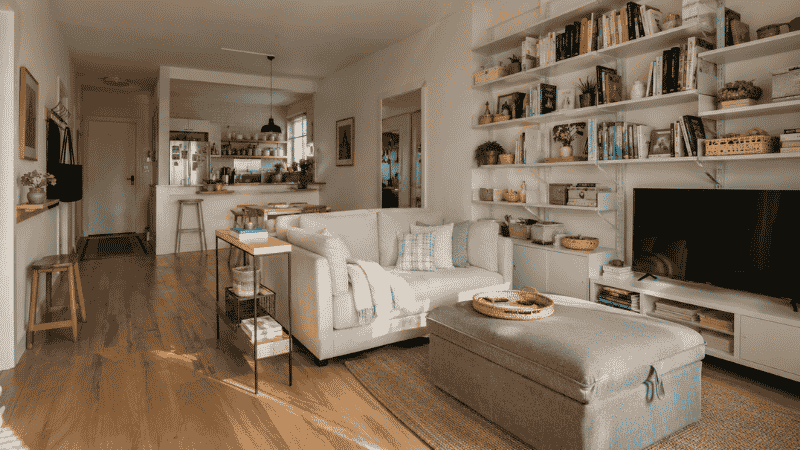
There’s a particular kind of frustration that comes with living in a small space. It’s not dramatic. It’s quiet and cumulative — the jacket that has nowhere to hang, the extra blanket stuffed behind the couch because there’s no closet for it, the kitchen counter that’s perpetually covered because there simply aren’t enough cabinets. You tidy up on Saturday and by Tuesday it looks exactly the same as it did before.
Here’s the thing most small space storage guides won’t say directly: buying more organizers is usually not the solution. The problem is almost never a lack of product — it’s a lack of system. Small apartments and tiny homes have real storage constraints, but they also almost always have underused space that a thoughtful approach can unlock.
This guide covers the small space storage ideas that actually move the needle — organized by room, ordered by impact, and designed for people who live in real homes with real messes and limited time. Whether you’re in a studio apartment, a one-bedroom with no closet, or just a house that somehow accumulates more than it can hold, there’s something here that will help.
Key Takeaways
- The average small apartment wastes an estimated 30–40% of its vertical storage potential — wall space, door backs, and ceiling-adjacent zones that most people never use.
- Multi-functional furniture (storage ottomans, bed frames with drawers, dining benches with lift tops) can replace 2–3 separate storage pieces in a small space, reducing both clutter and cost.
- Research from the Princeton Neuroscience Institute found that visual clutter competes directly for cognitive attention — meaning a disorganized small space isn’t just inconvenient, it genuinely makes thinking harder throughout the day.
- The most impactful first step in any small space isn’t buying new storage — it’s a focused declutter that removes everything that doesn’t regularly earn its place.
- Renters have more storage options than they think. Freestanding, over-door, tension-mounted, and adhesive solutions work in virtually any space without touching walls.
Before Anything Else: The Declutter That Changes Everything
This is the step every small space storage guide mentions and almost none of them take seriously enough. So let’s be direct about it.
You cannot store your way out of too much stuff. If a small apartment has 40% more possessions than it has natural homes for, no amount of clever organization will make it feel calm. The stuff will always win.
The declutter isn’t about becoming a minimalist or getting rid of things you love. It’s about being honest about what your space can actually hold versus what you’ve been trying to force into it. In a small space, every item needs to justify its square footage. That’s not a harsh standard — it’s the only standard that works.
A quick framework for each item:
- Do I use this at least once a month?
- If this broke or disappeared tomorrow, would I actually replace it?
- Is this item earning its space, or am I keeping it out of guilt, habit, or “someday”?
The honest truth: Most people find the declutter phase removes more than expected — and the space immediately feels more manageable before a single organizer is purchased. That feeling is real and it’s the foundation everything else builds on.
Small Space Storage Ideas for the Living Room
The living room in a small apartment does too many jobs — it’s the lounge, the dining area, sometimes the workspace, and often the only room guests see. Storage has to be invisible enough not to feel cluttered while being accessible enough to actually use.
Storage Idea 1: Choose Furniture That Pulls Double Duty
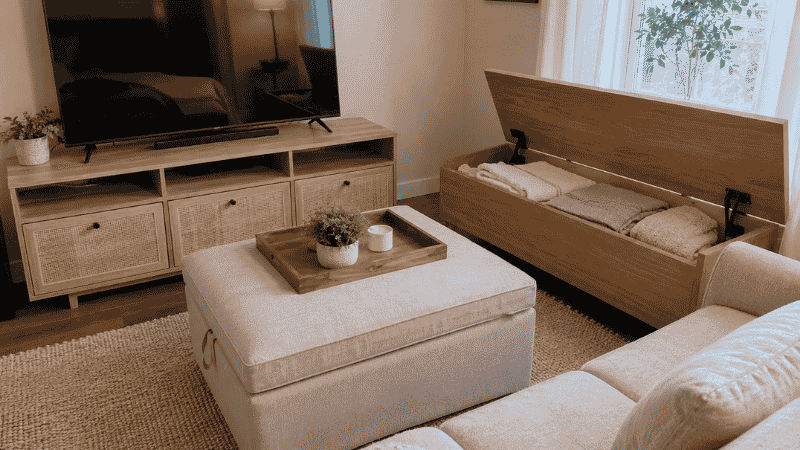
This is the highest-impact change you can make in a small living room, requiring zero additional square footage.
A storage ottoman replaces a coffee table while holding blankets, board games, or kids’ toys. A TV console with closed cabinet doors hides media clutter. A sofa with built-in chaise storage holds extra bedding. A dining bench with a lift-top lid stores linens, shoes, or seasonal items.
The principle: in a small space, every large furniture piece should earn its footprint in two ways — its function and its storage. If a piece only does one thing, it’s probably not earning its place.
Editor’s note: Storage ottomans are one of the most underrated buys for small apartments. They work as a coffee table, extra seating when guests arrive, and hold a surprising amount. The ones with removable trays on top are especially versatile.
Storage Idea 2: Go Vertical on Every Available Wall
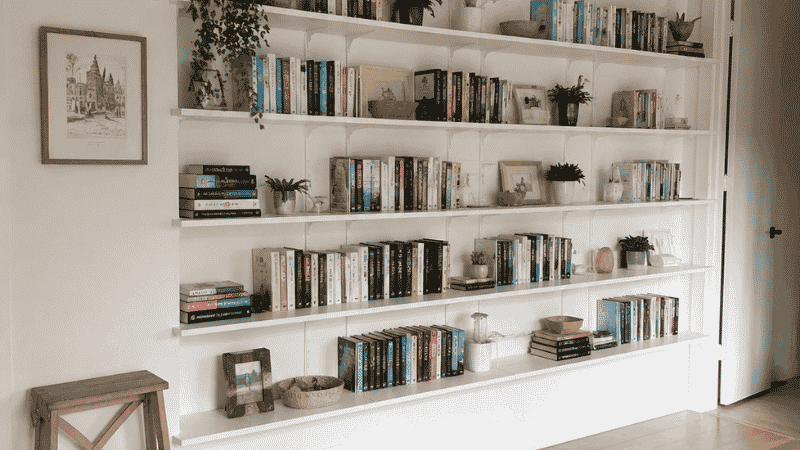
Small living rooms typically use maybe 4 feet of their 8-foot vertical space. Everything from that 4-foot mark to the ceiling is usually empty — a meaningful amount of storage potential in a small space.
Floating shelves installed at ceiling height are ideal for things you need occasionally: extra books, decorative storage boxes, seasonal items, backup supplies. The visual effect of high shelves also draws the eye upward, making a room feel taller.
For everyday items, a tall bookcase running floor to near-ceiling packs an enormous amount of storage into a minimal floor footprint — holding 3–4 times more than a side table while taking up a similar or smaller floor area.
Storage Idea 3: Use the Space Behind and Under Everything
A slim console table behind the sofa creates a surface for lamps and small items — and its legs keep visual weight light. The space under the sofa, if more than 4 inches off the ground, can hold flat under-bed storage bins for seasonal clothing or extra linens. Space that currently holds nothing but dust becomes functional storage without changing how the room looks.
Small Space Storage Ideas for the Bedroom
Bedrooms in small apartments are often the most compromised room — expected to hold all clothing, all bedding, and provide calm for rest, often with a closet too small for two people’s wardrobes or no closet at all.
Storage Idea 4: Your Bed Frame Is Your Biggest Storage Opportunity
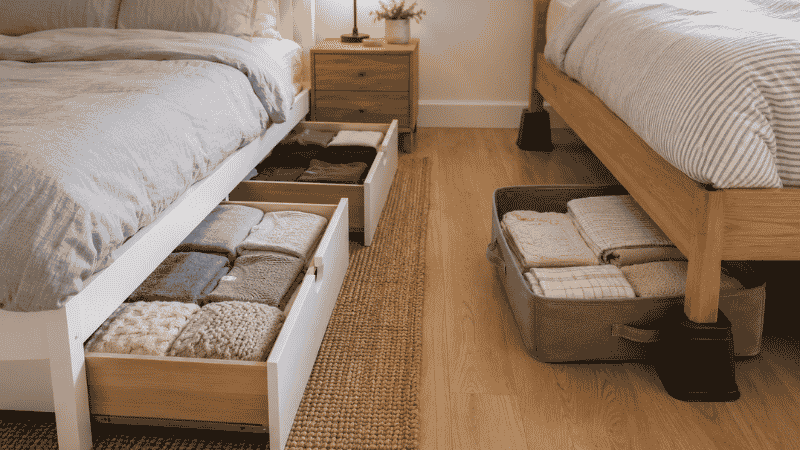
A bed frame with built-in drawers is one of the most space-efficient furniture purchases available for a small bedroom. Depending on size, a storage bed frame can hold the equivalent of a full 6-drawer dresser — a dresser you no longer need to fit into your bedroom.
If replacing the bed frame isn’t an option, bed risers lift a standard frame 3–6 inches, creating clearance for flat storage bins. A queen bed with 6 inches of clearance can hold 4–6 large flat bins — seasonal clothing, extra bedding, or anything that needs somewhere to live.
Storage Idea 5: How to Organize a Small Apartment Bedroom Without a Closet
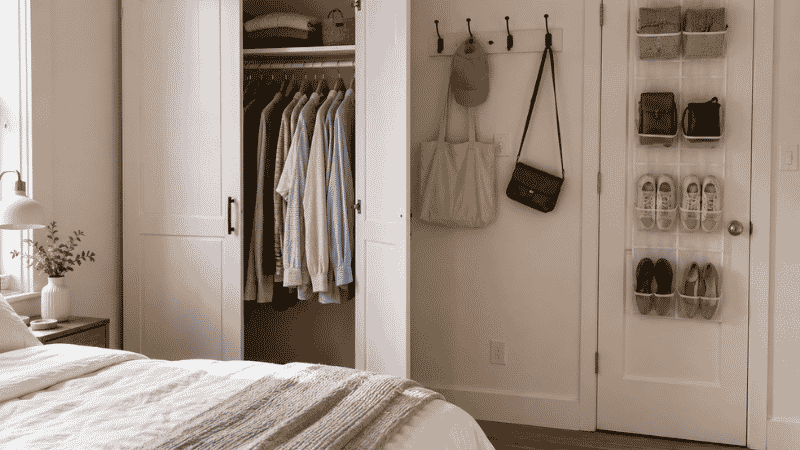
No closet is genuinely one of the harder small space challenges, but it’s more solvable than it feels:
A freestanding wardrobe — essentially a closet you bring in. A full-size freestanding wardrobe holds a similar amount to a reach-in closet. Takes wall space but requires nothing from the walls themselves.
A clothing rack with shelf above — works best when the wardrobe is curated. Pairs well with uniform hangers and shelf bins above for folded items.
Under-bed storage for everything not hanging — folded items, off-season clothes, and shoes can all live under the bed, freeing the rack for hanging items only.
The door and walls as closet annex — over-door hooks for bags and robes, wall-mounted hooks for accessories, an over-door shoe organizer for shoes or small folded items.
Storage Idea 6: Nightstand Alternatives That Store More
A traditional nightstand holds very little and takes up real floor space. A floating wall-mounted nightstand shelf takes zero floor space and holds everything a nightstand needs to hold — lamp, phone, book, glass of water. A small wall-mounted cabinet adds concealed storage for items you want close but not visible.
Small Space Storage Ideas for the Kitchen
Small kitchens are where disorganization has the most direct daily impact. The good news is that small kitchens respond quickly to organization because there’s less total area to address.
Storage Idea 7: Magnetic Knife Strip Instead of a Knife Block
A wall-mounted magnetic knife strip holds 6–8 knives in the space of a single wall strip — compared to a knife block that takes up significant counter space. This one swap frees up meaningful counter real estate and looks cleaner too.
Adhesive versions exist for renters who can’t drill. Rental-friendly: ✅
Storage Idea 8: The Inside of Cabinet Doors Is Free Storage
The inside of every kitchen cabinet door is usually empty. Adhesive hooks or a small mounted rack can hold: pot lids, measuring spoons, foil and wrap boxes, small cutting boards, or spice packets. Completely invisible when the cabinet is closed, requires no floor or counter space. Rental-friendly: ✅
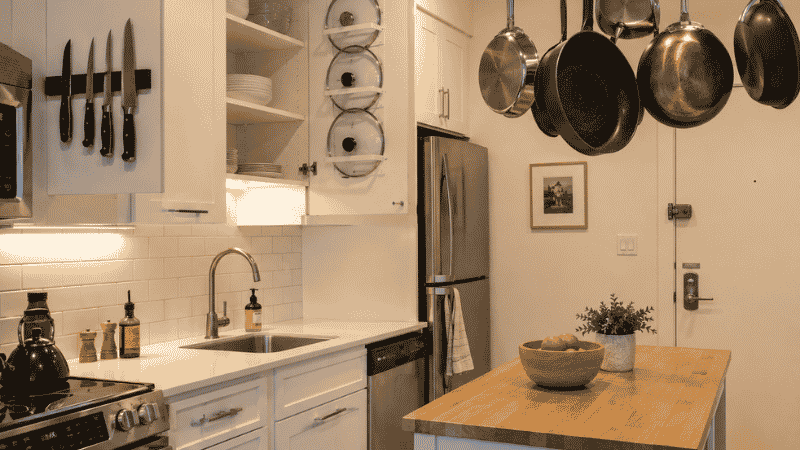
Storage Idea 9: Vertical Storage Ideas for Small Spaces — The Kitchen Version
Pots and pans stacked in a deep cabinet require removing everything on top to reach the bottom one. Three solutions:
- A pot lid organizer inside a cabinet door holds all lids vertically, each independently accessible
- A hanging pot rack takes pots completely off the shelf, freeing the entire cabinet
- A pull-out cabinet insert (no installation required for many versions) stores pots vertically like files, each immediately reachable
How to Organize a Studio Apartment: The One-Room Challenge
Studio apartments present a unique storage challenge because bedroom, living room, and sometimes dining area are one continuous space. Storage has to feel calm at all times — since you’re always “in” every room simultaneously.
The Room Divider That Also Stores Things
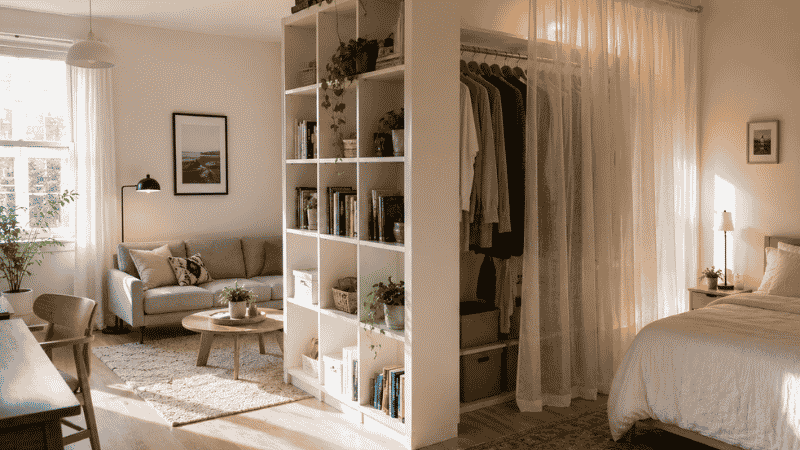
A bookcase or wardrobe used as a room divider creates visual separation between sleeping and living areas while doing double storage duty on both sides. Books and decor face the living area; clothing and personal items face the sleeping side. One piece of furniture, two zones, full storage on both faces.
Curtains as Closet and Zone Creators
A tension rod with floor-to-ceiling curtains creates an instant “closet” in any corner — hang a clothing rod behind the curtain, add a shelf above, and the entire storage area disappears behind fabric when not in use. A second set of curtains can divide the sleeping zone from the rest of the studio, creating separate room feel with zero permanent installation.
Rental-friendly: ✅ Tension rods, no wall damage
Why Your Small Space Keeps Getting Cluttered Again
If you’ve organized your small apartment before and it was chaotic again within weeks, it wasn’t a failure of effort. It was almost certainly one of these three things:
The system required too much maintenance. Any organization that depends on consistently careful behavior fails under a busy week. Systems that hold up are ones where putting something away is effortless — there’s one obvious place for everything, and returning it there takes zero thought.
Storage capacity still doesn’t match volume. If you have 30% more stuff than storage space, the system has no margin. The first tired evening breaks it, and recovery takes more effort than most people sustain. Volume must match capacity — which means decluttering is a twice-yearly habit, not a one-time event.
One or two “homeless” items are causing the cascade. In small spaces, there’s almost always a specific item with no home — a bag that lands on the floor, a jacket on a chair, mail on the counter. These anchor the surrounding chaos. Finding a home for that specific bag and that specific jacket often resolves a recurring mess faster than a complete reorganization.
If You Only Have 10 Minutes Right Now
10 minutes: Walk through your space and identify the three surfaces that collect the most clutter. Just identify — don’t clean yet. Knowing your specific chaos hotspots is the first step to solving them.
20 minutes: Clear one of those surfaces completely. A single clear surface in a small space has an outsized effect on how the whole place feels.
30 minutes: Tackle the space under your bed. Pull everything out, discard the expired and broken, put back only what earns that space. Clear under-bed space feels like gaining a whole room.
FAQ: Small Space Storage Ideas
What is the best small space storage idea that costs nothing? Reorganizing using vertical space you’re currently ignoring. Moving items from floor level to wall shelves, using door backs, and rearranging furniture so multi-function pieces do double duty costs zero dollars and creates meaningful additional storage immediately.
How do I create storage in a small apartment with no closets? A freestanding wardrobe for hanging clothes, under-bed storage for folded items, over-door organizers for shoes and small items, and wall hooks for bags together create a complete closet equivalent. None of these require any wall installation.
What are the best small apartment storage solutions on a budget? In order of value-per-dollar: a storage ottoman ($40–$80), bed risers ($15–$25) to unlock under-bed space, over-door organizers ($15–$30) for every door, and expandable drawer dividers ($15–$25). These four purchases solve the most common small apartment storage problems for under $150 total.
How do you organize a studio apartment so it doesn’t feel cramped? Keep floor space clear and move storage vertically. Furniture on legs keeps visual weight light. Storage that goes above eye level — ceiling-height shelving, tall wardrobes — adds capacity without adding visual clutter. A bookcase as a room divider creates zones without walls.
How do I keep a small space organized long term? Two habits matter more than any specific system: a monthly 15-minute reset (returning misplaced items, tossing anything without a home) and a twice-yearly declutter where you reassess whether what you’re storing still earns its space.
What small space storage ideas work best for renters? Everything freestanding or non-permanent: over-door organizers, freestanding shelving and wardrobes, storage ottomans, tension rods, and adhesive hooks. Command strips handle most lightweight accessories. For heavier items, freestanding solutions are almost always better for renters anyway — you take them when you leave.
What should I store outside the apartment to free up space inside? Seasonal items are the highest priority for offsite storage — holiday decor, off-season clothing, sports equipment. Anything accessed less than twice a year doesn’t need to occupy your limited apartment space. A small storage unit, a building storage room, or a family member’s space can hold these without the daily cost of taking up your living space.
Pick One Room. Start There.
The most common mistake in small space organization is trying to do everything at once. You spend a whole weekend reorganizing, run out of energy halfway through, and end up with everything half-done and feeling worse than before.
Pick the room that bothers you most. Do that one properly — the declutter, the zone planning, whatever storage additions make sense for that specific room. Let it be finished before moving to the next.
Small spaces respond faster to organization than large ones because every change is immediately visible. One well-organized room builds the momentum for the rest.
Explore more on Vomoxs:
- How to Organize a Small Closet (Even If It’s Stuffed With Clothes)
- Small Bathroom Storage Ideas: 12 Ways to Organize When You Have Almost No Space
- How to Organize Kitchen Drawers (and Actually Keep Them That Way)
References
- McMains, S., & Kastner, S. (2011). Interactions of Top-Down and Bottom-Up Mechanisms in Human Visual Cortex. Journal of Neuroscience, 31(2), 587–597.
- Roster, C. A., Ferrari, J. R., & Jurkat, M. P. (2016). The dark side of home: Assessing possession ‘clutter’ on subjective wellbeing. Journal of Environmental Psychology, 46, 32–41.
- Saxbe, D. E., & Repetti, R. (2010). No Place Like Home: Home Tours Correlate With Daily Patterns of Mood and Cortisol. Personality and Social Psychology Bulletin, 36(1), 71–81.
Category: Small Space Storage | Reading time: 10 min | Last updated: 2026