
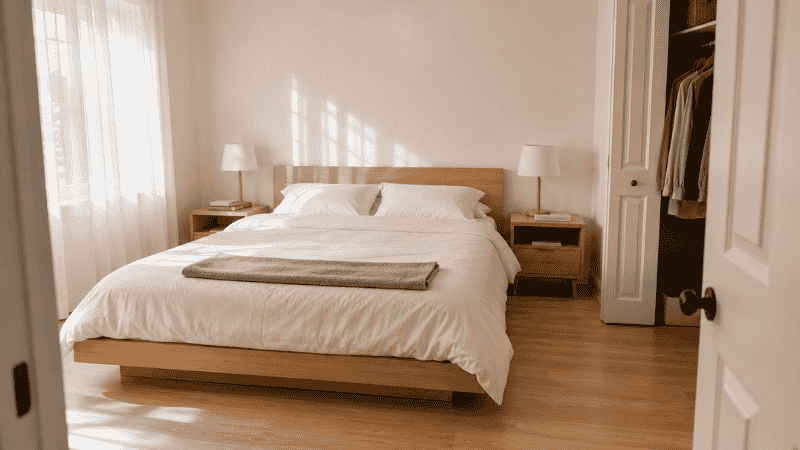
There’s a version of your bedroom that exists in your head — the one where you walk in at the end of the day and immediately feel your shoulders drop. Where the surfaces are clear, the light is soft, the air feels different somehow. Where the room is working for you instead of quietly against you.
Then there’s the actual bedroom. The chair with clothes on it. The nightstand that’s become a small museum of phone chargers, half-empty water glasses, books you haven’t opened in three weeks, and a phone charger for a phone you no longer own. The closet door that doesn’t quite close. The feeling that even when you clean it, it goes back to its natural state of mild chaos within days.
The gap between those two versions isn’t as wide as it feels. And it has almost nothing to do with budget, square footage, or interior design talent. It has to do with one thing: how much is in the room, and whether everything that’s there has a clear, designated home.
A minimalist bedroom isn’t an aesthetic — it’s a functional state. This guide shows you how to get there from wherever you are right now.
Key Takeaways
- Research published in Personality and Social Psychology Bulletin found that people who described their homes as cluttered had higher cortisol levels throughout the day — a bedroom that feels calm isn’t a luxury, it’s a measurable health outcome.
- The minimalist bedroom isn’t defined by how little furniture you own but by how much visual noise the room produces. A room with many items but each in its designated place feels calmer than a sparse room with surfaces covered in random objects.
- The most impactful first step toward a minimalist bedroom costs nothing: removing items that don’t belong in a bedroom at all.
- Neutral colors don’t create calm — clear surfaces do. Color is secondary to the underlying organization.
- A minimalist bedroom can be maintained in 2 minutes per day. The daily reset habit matters more than any single organizational product or design choice.
What a Minimalist Bedroom Actually Means (And What It Doesn’t)
Before doing anything else, it’s worth clarifying what a minimalist bedroom actually is — because most people have an image in their head that makes the goal feel unachievable or unappealing.
A minimalist bedroom is not:
- An all-white room with no personality
- A room with no possessions
- A room that looks like a luxury hotel (which is actually not particularly comfortable to live in)
- Something that requires buying new furniture or repainting walls
- Achievable only in large, light-filled spaces
A minimalist bedroom is:
- A room where every item has a designated home
- A room where surfaces are intentionally clear rather than accidentally cluttered
- A room that produces low visual noise — where your eye can rest without landing on something unresolved
- A room where the dominant feeling is calm rather than “I should deal with that”
The practical implication: you can create a minimalist bedroom in any size space, with any existing furniture, without spending money on new pieces. The work is about subtraction and organization, not addition and decoration.
Step 1: Remove What Doesn’t Belong in a Bedroom
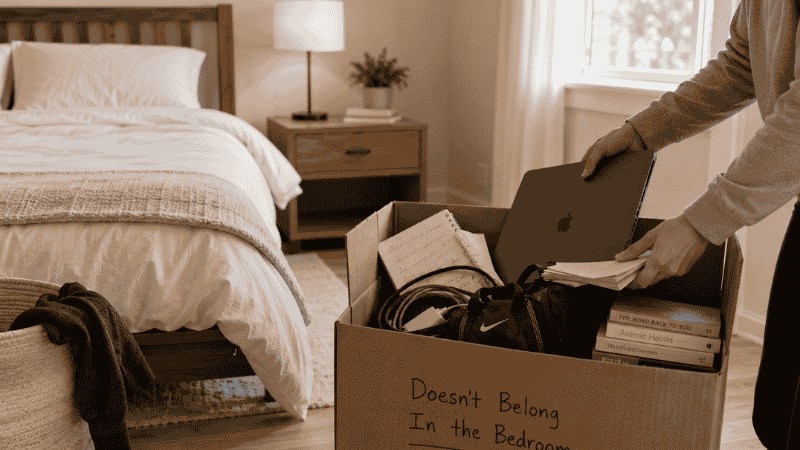
This is the step that makes the largest immediate difference and costs nothing.
Bedrooms accumulate non-bedroom items faster than any other room in the house — because the bedroom is private, guests don’t see it, and it’s where we put things when we need them out of the main living space “temporarily.” That temporary becomes permanent, and the bedroom becomes a storage annex.
Walk through your bedroom and identify everything that doesn’t serve the bedroom’s core purpose (sleep, rest, getting dressed):
Common items that don’t belong in bedrooms:
- Exercise equipment (unless you use it daily and it has a designated spot)
- Work materials and laptops (the bedroom-as-office creates sleep disruption — research from the National Sleep Foundation links blue light and work associations in the bedroom with reduced sleep quality)
- Children’s toys that migrated in
- Mail, paperwork, and administrative items
- Items waiting to be donated or dealt with
- Hobby supplies without a home elsewhere
- Suitcases and bags from trips that haven’t been unpacked
Remove these items from the bedroom before doing anything else. Don’t organize them in the bedroom — relocate them entirely. This single step often reduces visual noise by 30-40% without touching anything that actually belongs there.
Editor’s note: This step is uncomfortable because it exposes how the bedroom has been functioning as overflow storage. That’s fine. The discomfort is useful information about what needs a permanent home elsewhere in the home.
Minimalist Bedroom Ideas: The Surface Rule
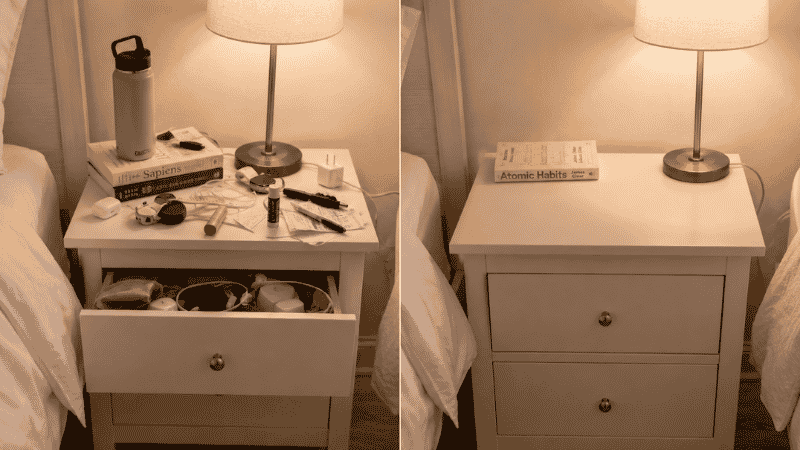
After removing non-bedroom items, the next principle that creates the most visible change is the surface rule: every horizontal surface in the bedroom holds only items used in the bedroom daily.
Apply it room by room:
Minimalist Bedroom Nightstand
The nightstand should hold: a lamp, your current book or e-reader, a phone charger (ideally tucked behind or through the nightstand), and water. That’s a complete nightstand. Everything else — the backup chargers, the old receipts, the lip balm from three months ago, the decorative object someone gave you — finds a home elsewhere or leaves entirely.
Inside the nightstand drawer (if it has one): use small bins or dividers to keep daily-use items organized. Reading glasses, medication, earbuds. Items you reach for regularly but don’t need on the surface.
The nightstand surface having only 3-4 items makes the entire bedroom feel calmer. This is disproportionate to the actual change — a clear nightstand surface creates a visual anchor that makes the rest of the room feel more ordered.
Dresser Top
A dresser top earns a small tray, a lamp if needed, and two to three intentional items. Not the accumulation of items that landed there and never left — the deliberate choice of what stays.
A small tray is the most useful dresser-top organizing tool: it creates a defined boundary. Items inside the tray are intentional. Items that drift outside the tray signal that the tray contents need editing.
Any Other Surfaces
Every shelf, windowsill, and flat surface in the bedroom follows the same logic. Ask of each item: “Is this here because I chose it, or because it arrived and never left?” The second category leaves.
Minimalist Bedroom Decor: What Stays and Why
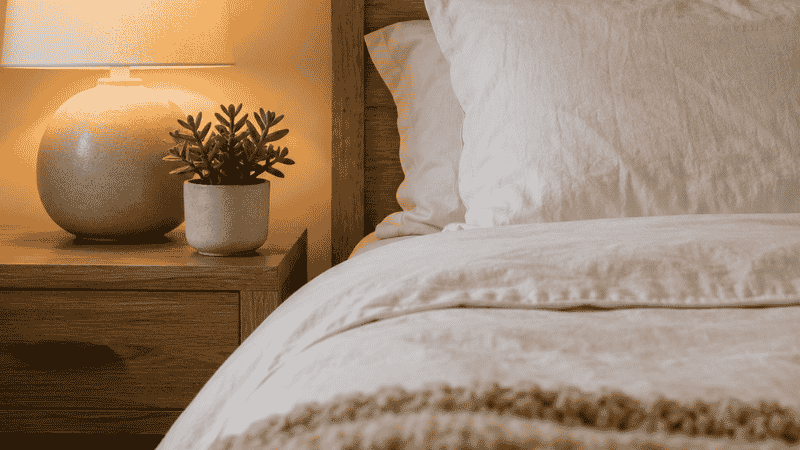
This is where most minimalist bedroom guides focus entirely — the aesthetic elements. Color palettes, furniture styles, texture combinations. This information is useful, but only after the subtraction work is done. Buying a beautiful linen duvet doesn’t create a minimalist bedroom if the surfaces around it are still covered in accumulated objects.
With that said, here’s what actually works once the room is organized:
Color
Neutral, muted tones create visual rest — not because neutrals are inherently superior, but because high-contrast or very saturated colors require more cognitive processing. Soft whites, warm beiges, greiges, muted greens and blues are popular in minimalist bedrooms because they recede visually rather than demand attention.
You don’t need to repaint. Start with the textiles — bedding, curtains, any cushions or throws — in more muted, harmonious tones. This has significant visual impact at relatively low cost.
Bedding
The bed is the visual anchor of the bedroom. Simple, high-quality bedding in one or two colors has more impact than elaborate layering. Linen is popular in minimalist bedrooms for its texture and its ability to look intentionally relaxed rather than accidentally rumpled. Cotton percale gives a crisper, more hotel-like result.
The practical minimalist bedding principle: a duvet or comforter in a simple case, two sleeping pillows, and one or two decorative cushions maximum. Beyond that, the bed starts to look labored rather than intentional.
Furniture
Minimalist bedroom furniture has clean lines and doesn’t add visual bulk. Low-profile platform beds open up the visual floor space of the room. Nightstands with storage (at least one drawer) keep surfaces clear. A single dresser handles clothing storage rather than multiple pieces competing for floor space.
You don’t need to replace furniture you own. Start with what’s there and address the organization — the same furniture in an organized room looks dramatically different than the same furniture in a cluttered one.
Lighting
Lighting has an outsized impact on how a room feels. Harsh overhead lighting makes rooms feel clinical. Warm, lower lighting (bedside lamps, wall sconces, dimmer switches on overhead lights) makes the same room feel significantly calmer. This is one of the most cost-effective changes in any bedroom.
Minimalist Bedroom Ideas for Small Rooms
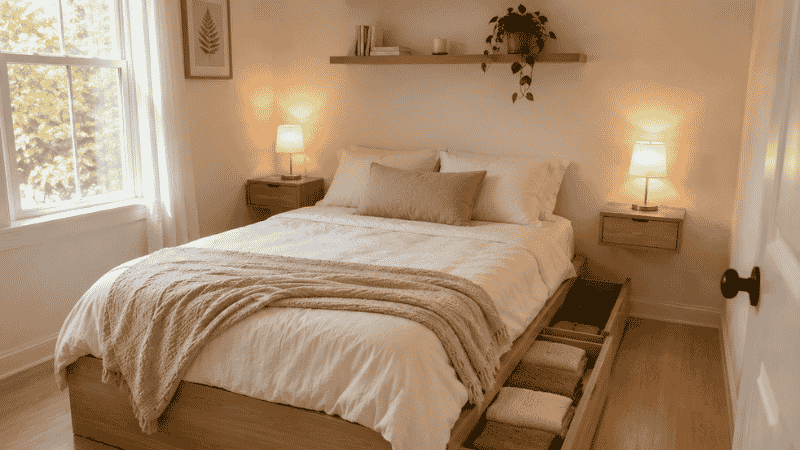
Small bedrooms benefit most from minimalist principles because every piece of visual noise is amplified in a smaller space. But small bedrooms also require specific adaptations.
Vertical Storage Over Floor Footprint
In a small minimalist bedroom, every storage decision should be evaluated against: does this keep the floor clear? Tall, narrow wardrobes over wide, low dressers. Floating nightstand shelves over floor-standing tables. Wall hooks over floor-standing racks.
A clear floor makes a room feel significantly larger. Storage that goes up rather than out preserves this effect.
Under-Bed Storage for the Small Bedroom
Under-bed storage is the most space-efficient option in a small room — it uses volume that’s already occupied by the bed’s footprint and adds zero floor space. Clear-lid bins with labels keep items organized and visible without requiring full removal to check contents.
The minimalist principle for under-bed storage: only items that don’t need to be accessed frequently. Seasonal clothing, extra bedding, shoes worn occasionally. Daily-use items under the bed create a retrieval problem that undermines the organization.
The One-Piece-at-a-Time Rule
In a small bedroom, replacing one piece of furniture at a time — when something wears out or when budget allows — with a piece that has built-in storage (a bed frame with drawers, a nightstand with shelving) gradually increases functional storage without increasing floor footprint.
Minimalist Living Room Connection: The Through-Line Principle
A minimalist bedroom doesn’t exist in isolation — it works best when it’s part of a consistent home-wide approach where items have designated homes in every room and surfaces in every room are intentionally managed rather than accidentally accumulated.
The minimalist living room follows the same principles as the bedroom: clear surfaces, items in designated homes, visual noise managed. The specific elements differ (sofas instead of beds, entertainment areas instead of closets) but the underlying logic is identical.
The most sustainable approach to minimalist living isn’t a one-time declutter — it’s a system where items have homes, where acquisition is thoughtful, and where a daily reset takes minutes rather than hours. The bedroom is often the best place to start because it’s private (the experiment doesn’t need to be perfect immediately) and because the impact on sleep quality provides immediate feedback.
Why Minimalist Bedrooms Fail (And How to Make Yours Last)
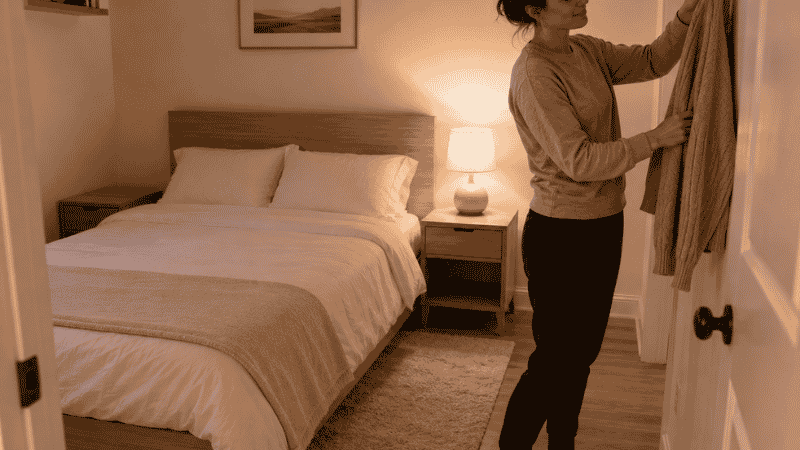
If you’ve created a minimalist bedroom before and it reverted to clutter within weeks, one of these was the cause:
The surfaces were cleared but items weren’t given real homes. Removing things from the dresser top is the first step. The second step — giving each removed item a designated home somewhere — is where most declutters stop. Items without homes find their way back to the nearest available surface.
The room was styled but not organized. Buying matching storage bins and neutral bedding creates an aesthetic but not a system. The same items in beautiful containers are still clutter if the containers are overfull and items can’t be retrieved easily.
The daily reset habit wasn’t established. A minimalist bedroom requires 2 minutes per day to maintain: clothes to their designated spots (hooks or hamper), surfaces cleared of anything that doesn’t belong there, bed made. Without this habit, the room drifts back to its previous state within days.
Too much was kept. If the room holds more items than it has natural homes for, it will always look cluttered regardless of how well those items are organized. Subtracting enough is a prerequisite that can’t be bypassed with better storage.
If You Only Have 10 Minutes Right Now
10 minutes: Walk through the bedroom and remove everything that doesn’t belong in a bedroom. Don’t organize it — just relocate it out of the room. Put it in a box in the hallway, another room, wherever. The bedroom will immediately feel different.
20 minutes: Clear every surface in the bedroom down to only items used daily. The nightstand, the dresser, any shelving. Items without obvious homes go in a temporary box outside the bedroom while you figure out where they belong.
30 minutes: Make the bed with intention — smooth sheets, arrange pillows deliberately. Clear both nightstands. Do a floor sweep — anything on the bedroom floor that doesn’t belong there goes to its actual home. A bedroom with a made bed, clear nightstands, and a clear floor feels dramatically different from the same room without those three things.
FAQ: Minimalist Bedroom
What makes a bedroom minimalist? A minimalist bedroom has clear surfaces (only items used daily live on top of furniture), low visual noise (the eye can rest without landing on something unresolved), and everything in the room has a designated home. It’s defined by function and organization rather than by a specific aesthetic or furniture style.
How do I start creating a minimalist bedroom? Start by removing everything that doesn’t belong in a bedroom — work materials, exercise equipment, items waiting to be dealt with, anything that arrived temporarily and never left. This costs nothing and typically reduces visual clutter by 30–40% before you’ve organized a single thing that stays.
Do I need to buy new furniture for a minimalist bedroom? No. The same furniture in an organized room looks dramatically different from the same furniture in a cluttered room. Focus on subtraction and organization first. If specific furniture upgrades make sense later (a bed with built-in storage, a nightstand with drawers), they’ll be clearer decisions after the underlying organization is in place.
What color should a minimalist bedroom be? Neutral, muted tones (soft whites, warm beiges, muted greens and blues) create visual rest because they recede rather than demand attention. But color matters significantly less than surface organization — a colorful bedroom with clear surfaces feels calmer than a white bedroom with cluttered surfaces.
How do I maintain a minimalist bedroom long-term? A 2-minute daily reset: clothes to their designated spots, surfaces cleared of anything that doesn’t belong there, bed made. This habit prevents the gradual accumulation that makes full reorganizations necessary. Additionally, a monthly check of whether items have migrated back to surfaces catches drift before it compounds.
Can a small bedroom be minimalist? Small bedrooms benefit most from minimalist principles because visual noise is amplified in smaller spaces. Prioritize clear floors, vertical storage, and under-bed storage. The one-piece-at-a-time principle — gradually replacing furniture with pieces that have built-in storage — increases functional capacity without increasing floor footprint.
What’s the difference between a minimalist bedroom and a bare bedroom? A bare bedroom has few items because nothing has been added. A minimalist bedroom has exactly the right items — things that serve the room’s purpose and have designated homes — with nothing beyond that. A minimalist bedroom can be warm, personal, and comfortable. It just doesn’t contain things that don’t belong there.
Start With One Surface Tonight
You don’t need a weekend. You don’t need new furniture, a can of white paint, or a complete reorganization.
Clear one surface tonight — the nightstand, the dresser top, wherever the clutter is most visible. Remove everything. Return only what you use in the bedroom daily. Find a home for what remains or let it go.
That one surface, cleared intentionally, is the beginning of the bedroom that exists in your head. The rest follows the same logic, one surface at a time.
Explore more on Vomoxs:
- Bedroom Organization Ideas: How to Organize Your Bedroom for Good
- How to Organize a Small Closet (Even If It’s Stuffed With Clothes)
- How to Declutter Your Home: A Room-by-Room Guide
References
- Saxbe, D. E., & Repetti, R. (2010). No Place Like Home: Home Tours Correlate With Daily Patterns of Mood and Cortisol. Personality and Social Psychology Bulletin, 36(1), 71–81. Research on clutter and cortisol levels.
- National Sleep Foundation (2022). Bedroom Environment and Sleep Quality Survey. Research on bedroom environment, blue light, and sleep quality.
- Roster, C. A., Ferrari, J. R., & Jurkat, M. P. (2016). The dark side of home: Assessing possession ‘clutter’ on subjective wellbeing. Journal of Environmental Psychology, 46, 32–41.
Category: Small Space Storage | Reading time: 10 min | Last updated: 2026