
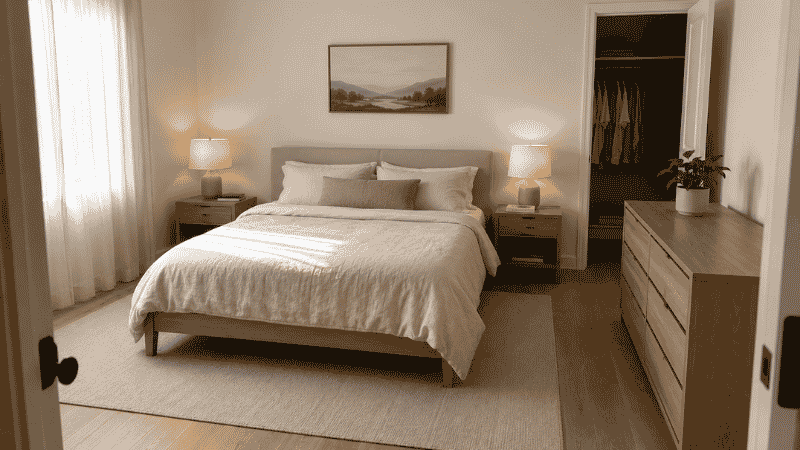
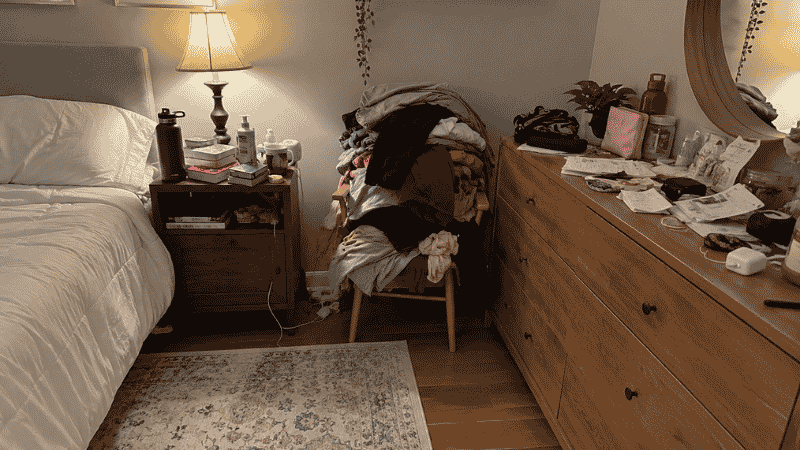
You get into bed at the end of a long day, pull up the covers, and look around. There’s a pile of clothes on the chair that’s been there so long it’s basically furniture now. The dresser surface has completely disappeared under a layer of stuff that somehow accumulates faster than you can clear it. The closet door doesn’t close properly. And somewhere in the back of your mind, while you’re trying to wind down, there’s this low-level awareness that the room is a mess — not a comfortable feeling to fall asleep to.
The bedroom is supposed to be the one room in the house that’s just for you. A place to decompress, actually rest, wake up without immediately feeling behind. But for most people it becomes the opposite — the room where everything lands when there’s nowhere else to put it, precisely because it’s the room guests don’t see.
Here’s what actually fixes it, and what keeps it fixed. Not 25 tips in random order, but a system — built from the most impactful changes down to the finishing touches — that takes the bedroom from dumping ground back to the room it was supposed to be.
Key Takeaways
- A study published in Sleep found that people who make their bed in the morning report better sleep quality — the bedroom environment directly affects sleep, not just aesthetics.
- The “chair pile” phenomenon — clothes accumulating on a designated chair — happens in an estimated 70% of bedrooms and almost always signals a missing system, not a habit problem.
- Bed frames with built-in storage can hold the equivalent of a full 6-drawer dresser, potentially eliminating the need for a separate dresser in small bedrooms.
- Surfaces that are 100% full attract more clutter; surfaces that are 80% clear stay clear. The margin matters as much as the organization.
- Maintaining a bedroom takes approximately 5 minutes per day when the right systems are in place — it’s the missing system, not the missing time, that causes most bedroom chaos.
Start Here: Declutter the Bedroom Before Organizing Anything
Every bedroom organization guide says this. Most treat it as a 20-minute preliminary step. It isn’t — it’s the main event, and rushing it is why most bedroom organizations revert within a month.
The bedroom collects two specific types of clutter that need different approaches: functional clutter (things you actually use but haven’t given a real home) and avoidance clutter (things you’re keeping because you’re not sure what to do with them, but they’ve lived in the bedroom so long they feel permanent).
For functional clutter: The question is “does this item belong in the bedroom, or does it belong somewhere else and I’ve just been storing it here?” Mail, work bags, gym equipment, kids’ toys, random cables — if it’s in the bedroom because it’s easier than putting it where it belongs, that’s where to start.
For avoidance clutter: The question is “am I keeping this because I actively want it, or because letting go feels harder than keeping it?” Clothes that don’t fit, gifts you feel obligated to keep, items from a previous version of your life — these are the ones that fill the bedroom without serving it.
The honest reality about decluttering a bedroom: Most people find the process takes 2–3 hours for a full bedroom, not the 30 minutes most guides suggest. The decisions are harder than kitchen expired products or bathroom empties. Build in the time, because a rushed declutter produces a temporarily tidy room that reverts immediately.
How to Organize a Bedroom: The Zone System
Once the declutter is done, the organizational framework that makes the biggest long-term difference in a bedroom is zone assignment — every area of the bedroom has a specific job, and only items that serve that job live there.
Most bedrooms naturally have four zones:
The sleep zone — the bed and immediate surroundings. Items here: things you use specifically at bedtime or when you wake up. Phone charger, book, water, glasses, medication if needed. Nothing else earns this zone.
The clothing zone — the closet, dresser, any clothing storage. Items here: everything you wear. This zone has its own complete organization logic (covered below).
The surface zone — dresser top, nightstands, any shelving. Items here: only what’s genuinely used in the bedroom daily. Surfaces in a bedroom should be 70–80% clear. Not for aesthetic reasons — for psychological ones. Research consistently shows that visual clutter in the bedroom environment disrupts the wind-down process before sleep.
The floor zone — the floor is not a storage zone. This sounds obvious and somehow still needs saying. A clear floor makes a bedroom feel dramatically larger and calmer, regardless of what else is happening in the room.
Bedroom Storage Ideas: The High-Impact Changes First
Idea 1: Make Your Bed Frame Do the Work
In a bedroom, the bed takes up 50–70% of the floor space. Most bed frames use that footprint for sleeping only. A storage bed frame uses it for sleeping and holds the equivalent of a full dresser in the drawer space underneath — which in a small bedroom means you may not need a separate dresser at all.
If replacing the bed frame isn’t currently an option, bed risers lift any existing frame 3–6 inches and create clearance for flat storage bins underneath. A queen bed with 6 inches of clearance holds 4–6 large flat bins — that’s seasonal clothing, extra bedding, or anything that needs to live somewhere but doesn’t need to be accessed daily.
Rental-friendly: ✅ Bed risers require no permanent installation
Under Bed Storage Ideas That Actually Work
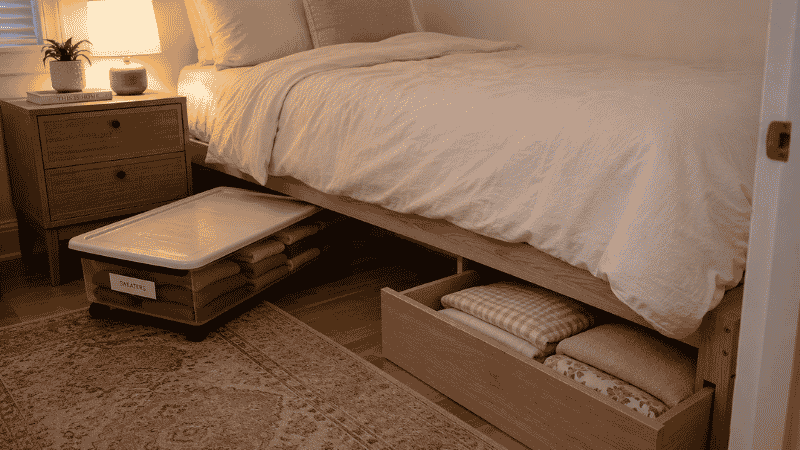
The under-bed zone is one of the most consistently underused storage spaces in any bedroom. The two reasons it fails when people try it: wrong containers and no system for what goes there.
What works under the bed:
- Seasonal clothing (vacuum compression bags reduce volume by up to 80% for bulky items like sweaters and down jackets)
- Extra bedding — the duvet set you use in winter, the lighter set for summer
- Shoes you wear occasionally but not daily
- Gift wrapping supplies
- Flat items like extra bed slats, rarely-used sporting equipment
What doesn’t work under the bed:
- Anything you need to access frequently — reaching under a bed daily defeats the purpose
- Loose items without containers — they migrate, collect dust, and become impossible to organize
- Things you’re keeping “just in case” — under-bed space is too valuable for avoidance clutter
Use containers with lids and wheels where the clearance allows. Label everything. The moment you can’t remember what’s under the bed, the space has stopped working as storage and started working as a hiding spot.
Idea 2: Fix the Nightstand Situation
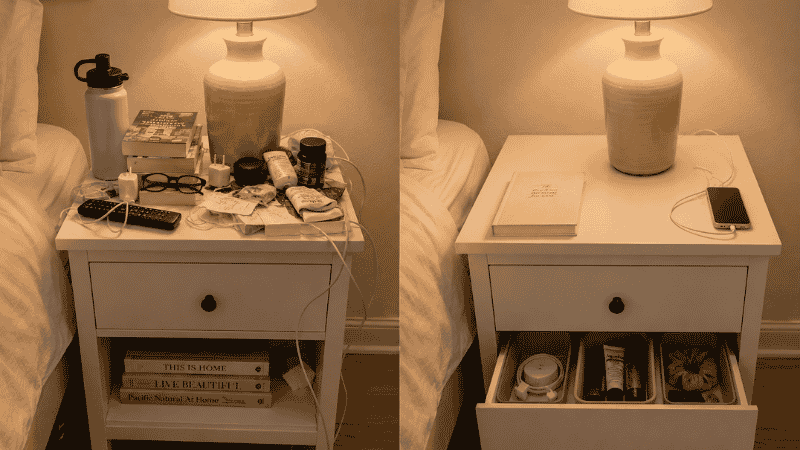
The nightstand is the most-used surface in the bedroom and consistently the most chaotic. The problem isn’t usually the nightstand itself — it’s that it’s trying to hold too many things for the space it has, or it has no storage and everything ends up on the surface.
If your nightstand has no drawers: Everything you want to keep nearby ends up on the surface, which creates clutter that catches more clutter. A nightstand with at least one drawer isn’t a luxury — it’s the difference between a clear surface and a perpetually messy one.
If your nightstand has drawers: Use small bins or dividers inside the drawers. Nightstand drawers are small and hold small items — without internal organization, everything mixes together and the drawer becomes a retrieval problem rather than a storage solution.
What earns nightstand space: Current book or e-reader, phone charger, glasses or contacts, lip balm, a notepad, any nightly medication. That’s a complete nightstand. Everything else is clutter waiting to accumulate.
Editor’s note: The floating wall-mounted nightstand shelf is genuinely underrated for small bedrooms. Zero floor space, holds everything a nightstand needs to hold, and keeps the floor area completely clear — which makes the room feel measurably larger.
Idea 3: Deal With the Chair
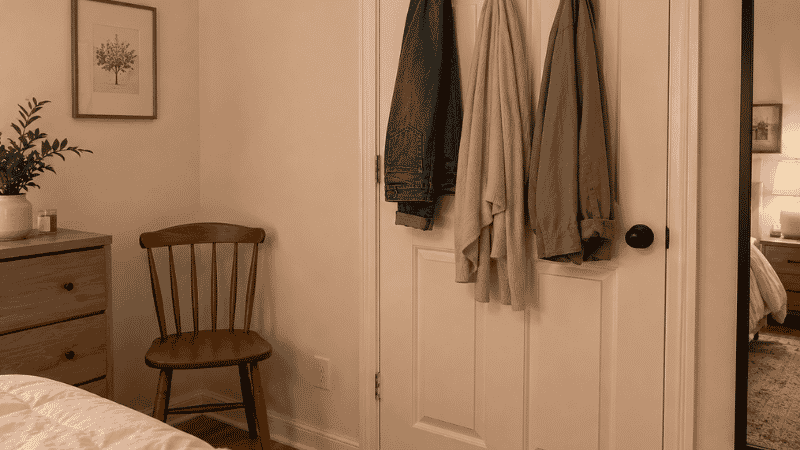
You know the chair. Every bedroom has one. It starts as a place to put tomorrow’s outfit and becomes a multi-week archive of worn-but-not-quite-dirty clothes.
The chair exists because there’s a real gap in most clothing systems: worn clothes that aren’t dirty enough to wash but aren’t clean enough to go back in the closet. Eliminating the chair without solving this gap just moves the pile somewhere else — the floor, the dresser, the end of the bed.
The actual solution to the chair pile:
A designated “worn but clean” zone — a hook, a small rack, a dedicated section of the closet — gives these clothes a real home that isn’t a chair. Three hooks on the back of the bedroom door, each holding one day’s worth of “worn but not done” items, gives you a three-day buffer before laundry happens. When all three hooks are full, it’s laundry time.
This sounds almost too simple. It works because it gives the clothes a legitimate system rather than fighting the behavior.
Small Bedroom Organization Ideas
Small bedrooms require a different approach than larger ones — not just “the same ideas but smaller,” but a fundamentally different priority order.
In a small bedroom, floor space is the most valuable resource. Every decision should be evaluated against: does this keep the floor clear, or does it add to the floor footprint?
This means:
- Tall, narrow storage over wide, low storage — a tall wardrobe takes 4 square feet of floor space and holds the equivalent of a wide dresser that takes 12
- Wall-mounted options wherever possible — floating shelves, wall hooks, mounted nightstand shelves
- Multi-function furniture exclusively — the ottoman at the foot of the bed that also stores extra blankets, the storage bench that sits under the window and holds seasonal items
- Vertical thinking on every wall — the space from shoulder height to ceiling is almost always unused in small bedrooms, and floating shelves in this zone add storage without reducing the visual floor space
The visual trick that makes small bedrooms feel larger: Keeping the bottom 3 feet of wall space clear. Storage that sits on the floor creates a visual boundary. Storage that floats on walls leaves the floor visually open, which makes the room read as significantly larger than it is.
How to Organize a Bedroom Without a Closet
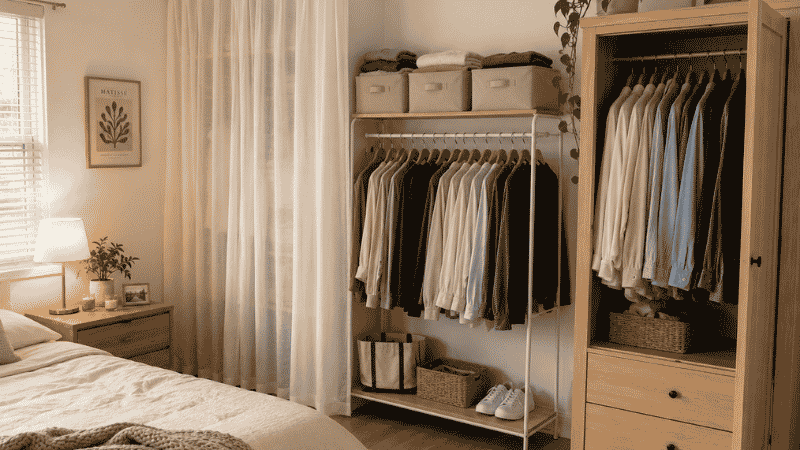
No closet is one of the most common complaints in older apartments and small homes, and one of the most solvable — though the solutions are less obvious than “use the closet.”
Option 1: Freestanding wardrobe A full-size freestanding wardrobe provides essentially the same storage as a reach-in closet — hanging rail, shelves, and often internal drawers — with no installation required. The visual trade-off is that it takes wall space and is visible, which means the wardrobe itself becomes part of the room’s aesthetic.
Option 2: Open clothing rack with shelf system A clothing rack with a shelf unit above creates a visible wardrobe system. Works beautifully with a curated wardrobe and uniform hangers; looks chaotic with an overcrowded one. The motivation to edit clothing regularly is built into this system — you can see everything, which means you can see what you don’t use.
Option 3: Curtained wardrobe zone A tension rod with floor-to-ceiling curtains hung from ceiling brackets (no drilling) creates a hidden wardrobe area in any corner. Behind the curtain: a clothing rod, a shelf above, and under-shelf bins below. In front of the curtain: nothing — just a clean visual wall of fabric. This is the most rental-friendly option and produces the cleanest aesthetic.
Option 4: Distributed storage No single wardrobe space at all — clothing stored in multiple locations by category and frequency. Daily wear in a small accessible rack or on hooks. Folded items in a dresser. Seasonal items under the bed. Occasional pieces in a wardrobe bag in another room. This requires more organizational discipline but works well when space genuinely doesn’t allow for any wardrobe unit.
How to Keep a Bedroom Organized Long Term
This is the section that makes the difference between an organized bedroom that lasts and one that reverts in six weeks.
The bedroom maintenance challenge is specific: unlike the kitchen, which gets disrupted and reset every day by cooking and cleaning, the bedroom drifts gradually. Nothing dramatic happens — things just land where they land, and over days and weeks the drift accumulates into a full reset.
The habits that prevent the drift:
The 2-minute rule at bedtime: Before getting into bed, spend 2 minutes returning things to their homes. Clothes to hooks or laundry. Items from the nightstand surface that crept in during the day. Water glass to the kitchen. Two minutes. This is the single habit that, done consistently, prevents the bedroom from ever requiring a major reorganization.
The Sunday reset: Once a week, 10 minutes to return anything that’s migrated, clear any surface that’s accumulated items, and do a quick check under the bed and inside the chair (if it still exists). Ten minutes prevents the two-hour session every few months.
The “does this belong here?” question: Any time you’re about to put something down in the bedroom, ask once: does this actually belong in the bedroom, or am I putting it here because it’s convenient? This one question, applied consistently, is what prevents the bedroom from becoming a dumping ground again.
If You Only Have 10 Minutes Right Now
10 minutes: Clear every horizontal surface in the bedroom completely. Put things where they belong, put things in a box if you don’t know where they belong, put things in the laundry if they’re clothes. A bedroom with clear surfaces feels organized even when it technically isn’t — and clear surfaces are the hardest thing to maintain, so starting here shows you immediately where the system gaps are.
20 minutes: Do the chair. Deal with everything on the chair — laundry in the hamper, clothes that are done being worn to the closet, everything else to its actual home. Then install three hooks on the back of the door or on a wall and designate them as the official “worn but not done” zone. The chair problem is solved with this one structural change.
30 minutes: Clear under the bed completely. Pull everything out, throw away or donate anything that doesn’t earn under-bed space, and put back only things in labeled containers. A clear, organized under-bed zone immediately makes the room feel more spacious and gives you meaningful additional storage for things that have been cluttering the room itself.
FAQ: Bedroom Organization Ideas
How do I organize a bedroom when I don’t know where to start? Start with surfaces. Walk through the bedroom and remove everything from every horizontal surface — nightstands, dresser top, any shelving. Put things where they belong, put uncertainties in a temporary box. A bedroom with clear surfaces immediately feels more organized and gives you a clearer picture of what else needs attention. Do this before buying a single organizer.
What is the best bedroom storage idea for a small room? The bed frame with built-in drawers is the highest-impact single change in a small bedroom — it holds dresser-equivalent storage in footprint that’s already occupied. Paired with bed risers under an existing frame (for flat bin storage) and a floating wall-mounted nightstand shelf (zero floor space), these three changes solve most small bedroom storage problems without adding to the floor footprint.
How do I organize a bedroom without a closet? A freestanding wardrobe for hanging clothes, under-bed storage for folded and seasonal items, wall hooks for daily-use items, and an over-door organizer for accessories create a complete closet equivalent in any bedroom. The curtained wardrobe zone (tension rod with curtains) is the most rental-friendly option and hides everything behind fabric for a clean look.
Why does my bedroom always look messy even after I organize it? Usually one of three reasons: there’s still more stuff than storage space (the declutter wasn’t thorough enough), one or two specific items don’t have a real home and keep accumulating wherever they’re put down, or there’s no daily maintenance habit and small drift compounds over days. Identify which one specifically — it’s almost always one of these, not all three — and solve for that.
How do I stop clothes from piling up on the bedroom chair? Install 2–3 hooks on the back of the door or a bedroom wall and designate them as the official home for “worn but not done” clothes. The chair exists because there’s a real category of clothes that are neither clean nor dirty — giving that category a real home (not a chair) eliminates the pile. When the hooks are full, it’s laundry time.
What should I keep on my nightstand? Current book or e-reader, phone charger, glasses or contacts, water, any nightly medication. That’s it. Everything else should live in a drawer or somewhere else entirely. A nightstand with more than 5–6 items on the surface will always look and feel cluttered.
How long does it take to fully organize a bedroom? A complete bedroom organization — full declutter, zone assignment, storage setup, and maintenance system — takes most people 3–5 hours spread across 2 sessions. The declutter phase takes longer than expected (1.5–2 hours for an average bedroom) because clothing decisions are genuinely harder than other categories. Budget realistically rather than optimistically.
Start Tonight — With Just the Surfaces
You don’t have to tackle the whole bedroom tonight. But you could clear every surface in 10 minutes, and that single change will make the room feel different enough that you’ll want to keep going.
Pick up the 2-minute bedtime habit this week. Do the Sunday reset once. Give the chair pile a real home on some hooks.
The bedroom that feels like a rest doesn’t require a renovation or a perfect system all at once. It just requires the right decisions, made room by room, surface by surface, until the space starts working for you instead of against you.
Explore more on Vomoxs:
- How to Organize a Small Closet (Even If It’s Stuffed With Clothes)
- How to Declutter Your Home: A Room-by-Room Guide
- Small Space Storage Ideas: How to Organize a Small Apartment Room by Room
References
- Gellis, L. A., & Lichstein, K. L. (2009). Sleep hygiene practices of good and poor sleepers in the United States. Behavior Therapy, 40(1), 1–9. Research on bedroom environment and sleep quality.
- Roster, C. A., Ferrari, J. R., & Jurkat, M. P. (2016). The dark side of home: Assessing possession ‘clutter’ on subjective wellbeing. Journal of Environmental Psychology, 46, 32–41.
- Saxbe, D. E., & Repetti, R. (2010). No Place Like Home: Home Tours Correlate With Daily Patterns of Mood and Cortisol. Personality and Social Psychology Bulletin, 36(1), 71–81.
Category: Room Organization | Reading time: 10 min | Last updated: 2026