
You pull the sheets out of the dryer, still warm, smelling clean. You tackle the flat sheet first — easy enough. Then comes the fitted sheet. You try to fold it once. It slides. You try again. The elastic corners won’t cooperate. Ten minutes later you’re holding something that resembles a deflated cloud, and you make a decision: you crumple it into a ball, open the linen closet, shove it somewhere toward the back, and close the door firmly.
The linen closet door is the thing that keeps this problem invisible. Behind it: an avalanche of half-folded sheets in assorted sizes, mismatched pillowcases, towels that may or may not belong to the same set. Next time you need fresh sheets, you’ll spend five minutes trying to figure out what’s a queen fitted sheet and what’s a full flat sheet, and whether the pillowcase you just pulled matches anything else in the pile.
The fitted sheet is genuinely one of the hardest household items to fold neatly. But it is learnable — and once you have the method, it takes under 90 seconds per sheet. This guide covers how to fold every piece of bedding, how to store sets together so you can find what you need in seconds, and how to organize a linen closet that actually stays organized.
Key Takeaways
- The fitted sheet’s elastic corners are what make it difficult — the solution is tucking corners into each other to neutralize the elasticity before laying the sheet flat.
- The pillowcase bundling method — storing an entire sheet set inside one pillowcase — eliminates the “which sheets go with what” problem permanently and makes linen closet organization nearly self-maintaining.
- Linen closets organized by bed size (twin, queen, king) rather than by item type (all fitted sheets together) are dramatically faster to use — you grab a complete set in one reach rather than hunting for matching pieces.
- Towels fold most efficiently using the thirds method, which produces a uniform rectangle that can be stored flat or vertically and holds its shape better than the traditional fold.
- Sheets fold best immediately after removing from the dryer — the warmth keeps fabric pliable, and wrinkles haven’t set yet.
How to Fold Bed Sheets: Start With the Right Sequence
Before getting into the specific folds, the sequence matters. Fold sheets immediately after removing them from the dryer — the warmth keeps the fabric pliable and wrinkles haven’t set. Cold, wrinkled sheets are significantly harder to fold neatly.
The recommended sequence for a full sheet set: fitted sheet first (hardest, do it while the motivation is fresh), flat sheet second, pillowcases last. Then bundle the whole set together before putting anything away.
How to Fold a Fitted Sheet: The Method That Actually Works
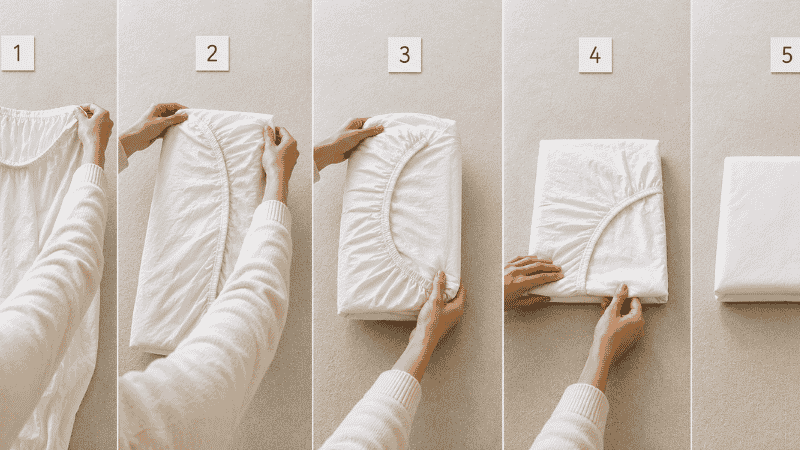
The fitted sheet defeats most people because they approach it like a flat sheet — trying to fold it into a flat rectangle while the elastic corners keep pulling everything out of shape. The solution is to eliminate the elastic’s influence first, by nesting all four corners into each other before ever laying the sheet on a surface.
Step-by-step:
Hold the sheet by two adjacent corners along the long side, with the sheet inside out and the elastic facing toward you. Put one hand inside each corner, fingers in the seam. You’re holding the sheet upright, like a bib, with two corners in your hands.
Bring your right hand to your left hand. Fold the right corner over the left corner so the right corner is now inside the left corner. You now have both corners nested together in your left hand.
Reach down and grab the third corner (the one hanging closest to you on the opposite long side). Flip this corner inside out and bring it up to meet your left hand. Tuck the third corner into the pocket formed by the first two corners. Your left hand now holds three corners nested together.
Grab the fourth and final corner. Flip it inside out and tuck it into the existing pocket. All four corners are now nested. The sheet should have a roughly C-shaped profile with no elastic pulling at the edges.
Lay the sheet on a flat surface — a bed, a table, or the floor. You’ll see a rough rectangle with one curved edge from the elastic. Fold that curved edge inward to create a straight edge. Adjust and smooth the overall shape into a clean rectangle.
Fold the rectangle in thirds from one direction (bring the left third to center, then the right third over that). Then fold in thirds from the other direction (bring the bottom third up, then the top third down). You now have a compact, flat package roughly the size of a piece of letter paper.
The test: The folded fitted sheet should sit flat on a surface without any corners springing out or elastic visible. If elastic is visible, one of the corners wasn’t fully nested. Unfold to the four-corner step and re-nest.
Editor’s note: The first attempt will probably not be perfect. The second attempt will be better. By the fifth or sixth time, it will take under 90 seconds and feel automatic. The learning curve is real but short.
The Quick Method When You’re in a Hurry
If time is short and precision is less important, the 60-second method: hold the sheet at two adjacent corners, nest them (steps 1-2 above), lay the sheet on a flat surface without completing the full nesting process, and fold into rough thirds in both directions. Not as neat, but far better than a crumpled ball.
How to Fold a Flat Sheet
Flat sheets are significantly easier than fitted sheets but benefit from a specific method that keeps the size-indicator hem visible.
Step-by-step:
Lay the flat sheet on a flat surface, face down. Fold in half lengthwise (bringing the long edges together). Fold in half again lengthwise — you now have a long, narrow rectangle one-quarter of the original width.
Fold in thirds from the width: bring the top third down, then fold the bottom third up over that. You should have a neat rectangle.
The size-indicator trick: Most flat sheets have a decorative hem or a slightly different texture on the top edge (the side that faces up on the bed). When folding, keep this edge visible on the outside of the final fold — it lets you quickly identify which side is “up” and also helps distinguish between sheet sizes when they’re stored together.
How to Fold Pillowcases
Pillowcases are the easiest piece of bedding to fold, which is convenient because they’re what most people use to bundle the entire set.
Standard fold:
Lay the pillowcase flat, open end toward you. Fold in half lengthwise. Fold in half again. Fold in thirds from the length, bringing the closed end to center, then the open end over. The open end tucks under slightly, keeping the fold secure.
For storage: Leave one pillowcase from each set unfolded until after you’ve bundled the complete sheet set inside it (see below).
The Pillowcase Bundling Method: The Game-Changer for Linen Closets
This is the single technique that transforms linen closet management from a constant puzzle into a system that practically runs itself.
The problem that pillowcase bundling solves: when sheets, flat sheets, and pillowcases are stored separately (all fitted sheets in one stack, all flat sheets in another, all pillowcases in a third), making a bed requires selecting three matching pieces from three different locations — and matching is harder than it sounds when you have multiple bed sizes.
The pillowcase bundle method:
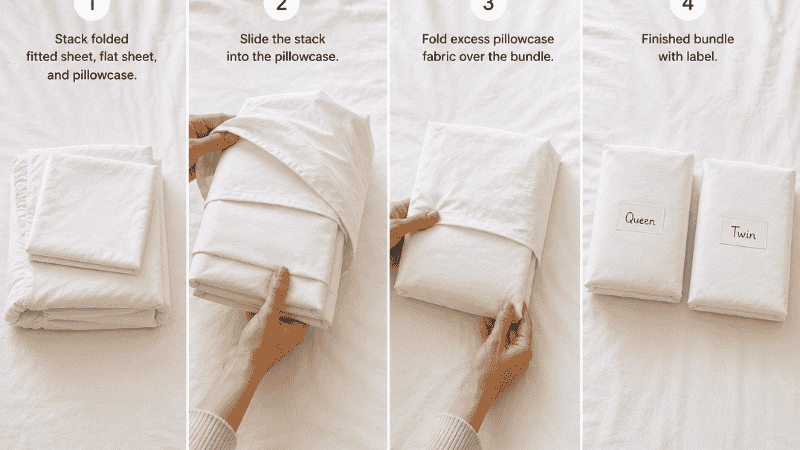
Fold the fitted sheet using the method above. Fold the flat sheet. Fold one of the pillowcases. Stack the folded fitted sheet, flat sheet, and folded pillowcase on top of each other.
Take the remaining pillowcase (unfolded) and hold it open. Slide the entire stack into the pillowcase. Push the stack all the way to the closed end of the pillowcase. Fold any excess pillowcase fabric over the bundle. The bundle is now a self-contained package holding every piece of a complete sheet set.
Label if needed: A small tag or label on the pillowcase reading “Queen” or “Twin” tells you the size at a glance — especially useful if you have multiple bed sizes in the household.
Why this works long-term: When you go to the linen closet for fresh sheets, you grab one bundle. Everything needed for that bed is in the bundle. No searching for matching pieces. When you put clean sheets away, they go back as a bundle. The linen closet organizes itself.
How to Fold Towels
Towels are the other major linen category, and they benefit from a specific folding method that creates a uniform shape for clean storage.
The Thirds Method for Bath Towels
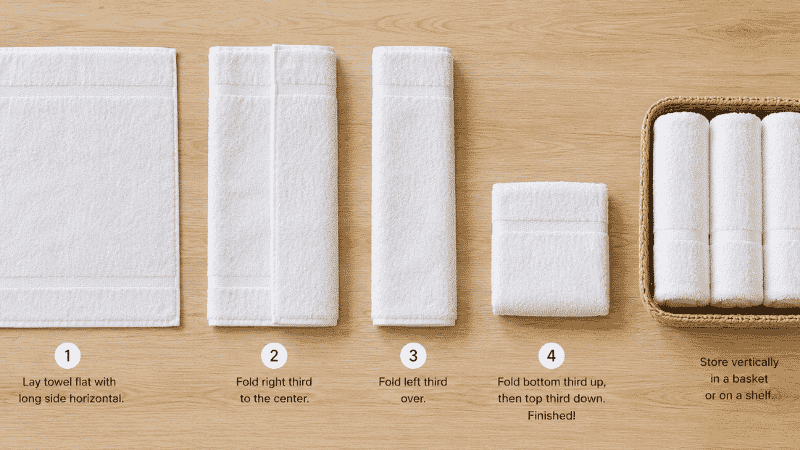
This method produces a towel that can be stored flat in a stack, vertically in a basket (file-fold style), or displayed on a towel bar.
Lay the towel flat, long side horizontal. Fold the right third to the center. Fold the left third over the top — you now have a long, narrow three-layer rectangle.
Fold the bottom third up. Fold the top third down over it. You now have a compact, uniform rectangle with no fraying edges visible.
For linen closet storage: Store towels with the folded edge facing out (not the raw edges). This creates a clean, uniform appearance on the shelf and makes it easier to pull one towel without disturbing the others.
How to Store Towels
Stack method: Stack flat, folded-edge forward, on an open shelf. Clean look, easy to pull from the top. The limitation: you can only easily access the top towel without disturbing the stack.
Vertical filing method: Store towels upright like files in a drawer or bin, the same principle as the file-fold for clothing. Every towel is individually accessible without disturbing others. Works especially well in deep shelves or baskets where horizontal stacking creates an inaccessible back row.
Roll method for small spaces: Roll towels tightly from one short end and store in a basket or bin. Rolling uses slightly more floor space per towel than folding but looks deliberately styled and works well in bathrooms with visible storage (shelves, hooks, baskets).
The best way to store towels long term: Keep guest towels in sealed bags or wrapped in tissue in the linen closet to prevent dust accumulation. Rotate actively used towels — putting freshly washed towels at the bottom of the stack so the older ones get used first.
Linen Closet Organization Ideas: The System That Holds
Knowing how to fold bedding is half the equation. The other half is how the linen closet itself is organized — because even perfectly folded sheets become chaos when there’s no system governing where things go.
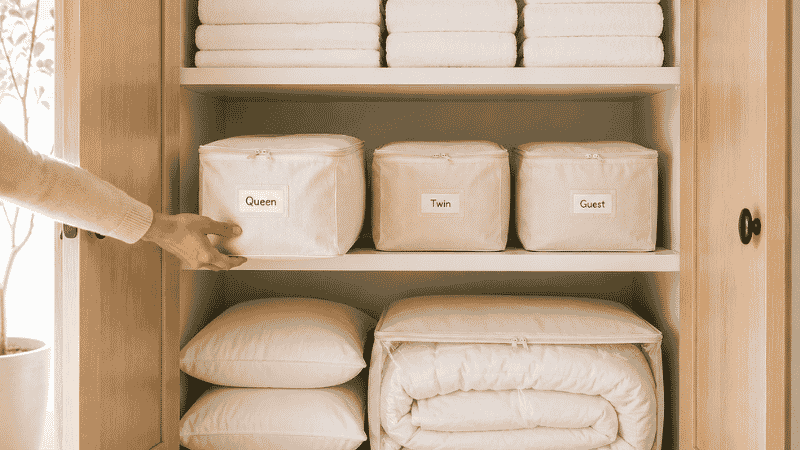
How to Organize a Linen Closet by Bed Size
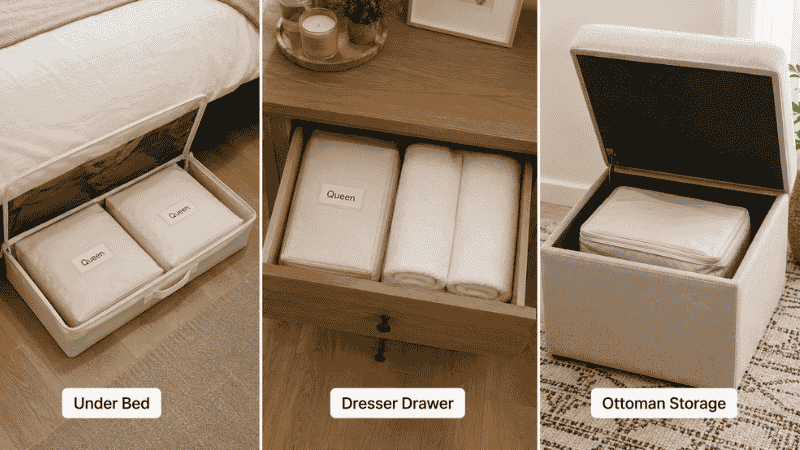
The most practical linen closet organization is by bed size, not by item type.
The conventional approach — all fitted sheets on one shelf, all flat sheets on another, all pillowcases on a third — requires selecting from three different locations every time you make a bed, and distinguishing between sizes is difficult without opening every folded bundle.
The bed-size approach assigns one shelf section or one bin per bed in the house:
- Shelf 1: All queen bed sheets (bundled in pillowcases, stacked or in a bin)
- Shelf 2: All twin/full sheets
- Shelf 3: Guest bed sheets
Making any bed requires going to one location, grabbing one bundle. Putting sheets away requires identifying the size and returning to that section. The linen closet is self-organizing because the logic is intuitive for everyone in the household.
Linen Closet Storage Ideas by Frequency
Within each shelf section, organize by how often items are used:
Front of shelf / eye level: Active, regularly used sets — the sheets currently in rotation, the towels used daily.
Back of shelf / higher shelves: Guest bedding and towels, seasonal extras (heavy blankets for winter), backup sets.
Bottom shelf or floor: Bulky items — extra pillows, duvet inserts, mattress pads.
How to Organize a Linen Closet: The Practical Setup
Step 1: Empty the entire closet. Wash anything that’s been sitting unused long enough to smell musty.
Step 2: Inventory what you have. For most households, 2 complete sets per bed is sufficient — one on the bed, one in the closet. More than that is excess that’s taking up space.
Step 3: Fold everything using the methods above. Bundle each sheet set into a pillowcase.
Step 4: Assign shelf sections by bed size or use. Label shelves if multiple people use the closet.
Step 5: Return items to their sections, frequency-organized within each section.
Linen Storage Ideas Without a Linen Closet
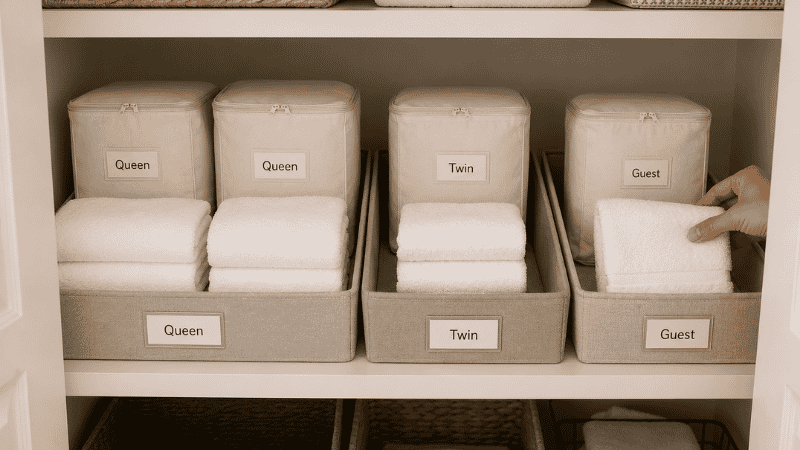
Not every home has a dedicated linen closet. Practical alternatives:
Under-bed storage boxes: Sheet sets store flat in shallow under-bed containers — effectively keeping the set for a specific bed directly under that bed, which is arguably the most logical storage location possible.
Bedroom dresser top drawer: If drawer space allows, a dedicated drawer per bed for that bed’s sheet sets keeps everything closest to where it’s used.
Ottoman storage: An ottoman at the foot of a bed holds one or two sheet sets inside while serving as seating.
Labeled bins on closet shelves: If the linen closet is shared with other items, clear labeled bins per bed size create defined sections within a mixed-use closet.
If You Only Have 10 Minutes Right Now
10 minutes: Pull all the sheets out of the linen closet. Do a quick size sort — queen together, twin together, guest bed together. Put them back in sections. Even without re-folding, this spatial organization immediately makes finding sets faster.
20 minutes: Fold one complete sheet set using the methods above and bundle it into a pillowcase. Use this bundle as a reference and motivation for doing the rest.
30 minutes: Fold and bundle every sheet set in the house. The linen closet, now organized by bed size and using the bundle method, will be functionally transformed.
FAQ: How to Fold Bed Sheets and Organize Linens
Why is it so hard to fold a fitted sheet? The elastic corners continuously pull the fabric out of shape during folding, making it impossible to create a flat rectangle using a standard folding approach. The solution is to nest all four corners into each other first — neutralizing the elastic’s pull — before laying the sheet flat. Once the corners are nested, the sheet folds like any other fabric rectangle.
What is the easiest way to fold a fitted sheet? The corner-nesting method: hold two adjacent corners inside out, nest one into the other, then gather the remaining two corners and nest them into the same pocket. Once all four corners are nested, lay the sheet flat and fold in thirds in both directions. The first few attempts take time; after 5-6 times, it takes under 90 seconds.
How do I keep bed sheet sets together in the linen closet? The pillowcase bundling method: fold the fitted sheet, flat sheet, and one pillowcase, stack them together, and slide the entire stack into the remaining pillowcase. Every complete set lives in one self-contained bundle, labeled by bed size if needed. Grabbing fresh sheets means grabbing one bundle — no matching required.
How do I organize a linen closet without it reverting to chaos? Organize by bed size rather than by item type. Assign one section per bed in your home. Use the pillowcase bundling method so sets go in and out as complete units. Store by frequency of use within each section. These three principles together create a system that works for everyone in the household and maintains itself with minimal ongoing effort.
How should towels be folded and stored? The thirds method produces the most uniform, storage-efficient towel fold: fold in thirds lengthwise, then in thirds widthwise. Store with folded edges facing out. For maximum accessibility, file vertically in a basket or bin so every towel is individually accessible. For minimal visible mess, stack flat on open shelves with folded edges forward.
How many sheet sets should I keep per bed? Two complete sets per bed is the functional standard for most households: one on the bed, one clean and ready in the linen closet. Three sets gives a buffer for washing day. More than three per bed is typically excess that takes up storage space without adding practical value.
When is the best time to fold sheets? Immediately after removing from the dryer, while still warm. Warm sheets are pliable and wrinkle-free — the fabric cooperates with folding in a way that cold, set-wrinkle sheets don’t. If you can’t fold immediately, run the dryer for another 5-10 minutes to warm them before folding.
Start With the Fitted Sheet Tonight
The next time you do laundry, try the corner-nesting method on the fitted sheet before doing anything else. Set aside the extra time — the first attempt might take 3-4 minutes instead of 90 seconds. That’s fine. The method works, and it gets faster with each attempt.
Then bundle the complete set into a pillowcase and find it a section in the linen closet. That one bundle, properly folded and organized, demonstrates everything this system can feel like — and makes it easy to do the next set the same way.
Explore more on Vomoxs:
- How to Fold Shirts, Pants, Sweaters and Jeans: Space-Saving Folding Methods
- Bedroom Organization Ideas: How to Organize Your Bedroom for Good
- How to Organize a Small Closet (Even If It’s Stuffed With Clothes)
References
- Hord, J. (2024). Professional Organizing: Linen Closet Systems. Horderly Professional Organizing. Expert organizer methodology for sheet folding and linen storage.
- Roster, C. A., Ferrari, J. R., & Jurkat, M. P. (2016). The dark side of home: Assessing possession ‘clutter’ on subjective wellbeing. Journal of Environmental Psychology, 46, 32–41.
- Saxbe, D. E., & Repetti, R. (2010). No Place Like Home: Home Tours Correlate With Daily Patterns of Mood and Cortisol. Personality and Social Psychology Bulletin, 36(1), 71–81.
Category: Room Organization | Reading time: 10 min | Last updated: 2026