
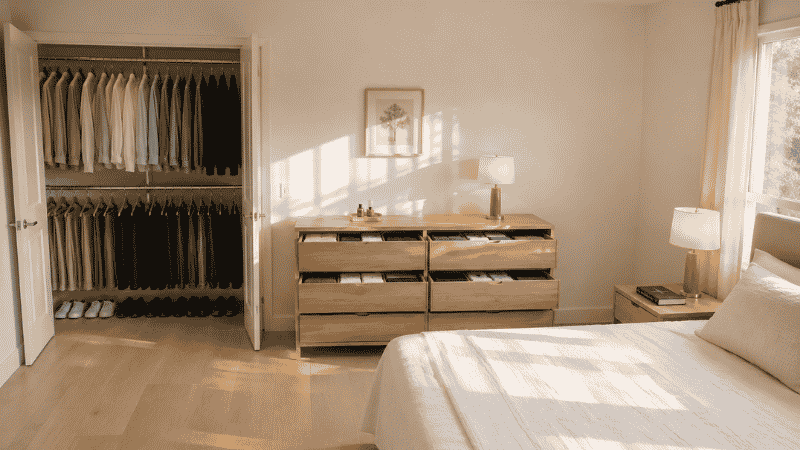
Walk into a well-organized bedroom and you feel it immediately — a kind of calm that has nothing to do with how expensive the furniture is or how large the room is. It’s the absence of visual noise. The closet doors close properly. The dresser surface has room to breathe. You can open any drawer and find what you’re looking for in under ten seconds.
Most people think this requires a big closet, a custom system, or a complete weekend overhaul. It doesn’t. It requires a system — one that’s designed around how you actually live, not how an idealized version of yourself might live. A system where every item of clothing has a real home, where putting things away is as easy as taking them out, and where the order you create on Sunday still exists on Friday morning.
This guide covers everything in the bedroom and closet organization ecosystem: how to organize the bedroom itself, how to build a closet system that works for small spaces, how to fold and store clothing efficiently, how to manage shoes, and how to maintain all of it without a weekly reset session that takes hours. Each section links to a complete deep-dive guide when you’re ready to go further.
Start with the area that frustrates you most. Do that one well. Then come back for the next.
Key Takeaways
- The single most impactful change in any bedroom is surface clearing — a bedroom with clear surfaces feels organized even when the closet isn’t perfect yet.
- Small closets don’t need expensive custom systems. A double hang rod ($15–$20) and shelf risers ($10–$20) can double the functional capacity of most standard closets without any installation.
- Organizing clothing by frequency of use — daily items most accessible, seasonal items least accessible — reduces the daily friction of getting dressed more than any organizational product.
- The file-folding method (clothes stored vertically like files rather than stacked flat) increases drawer capacity by up to 50% and makes every item visible simultaneously.
- Maintenance takes 5–10 minutes per week when the right systems are in place. The missing system — not the missing time — is what causes most bedrooms to revert to chaos.
Bedroom Organization: Building the Foundation
The bedroom is the room where the day begins and ends. When it’s organized, mornings run smoother and evenings feel genuinely restful. When it’s not, the low-level background stress of visual clutter follows you into sleep and back out again.
The bedroom has two distinct organizational challenges that need different approaches: the visible surfaces (nightstands, dresser top, any shelving) and the storage systems (closet, under-bed space, drawers). Tackling surfaces first produces the fastest visible result and gives you the momentum to tackle storage systems next.
The Surface Rule
Every horizontal surface in the bedroom — the nightstand, the dresser top, the bench at the foot of the bed — should hold only items used in the bedroom daily. A nightstand earns a lamp, a book, a phone charger, and water. A dresser top earns a small tray with a few items. The chair in the corner earns nothing — its existence as a clothing pile is a system problem, not a habit problem, and the fix is giving “worn but not done” clothes a real home (three hooks on the back of the door works for most households).
The Zone System
A functional bedroom is organized into four zones:
Sleep zone — the bed and immediate surroundings. Only items used at bedtime or upon waking belong here.
Clothing zone — the closet, dresser, and any clothing storage. This zone has its own complete logic covered below.
Surface zone — dresser top, nightstands, shelving. Items here must be used in the bedroom daily; everything else finds a home elsewhere.
Floor zone — the floor is not a storage zone. A clear floor makes a bedroom feel dramatically larger and calmer, regardless of what else is happening in the room.
For the complete bedroom organization system, step-by-step: → Bedroom Organization Ideas: How to Organize Your Bedroom for Good
Closet Organization: How to Organize a Small Closet
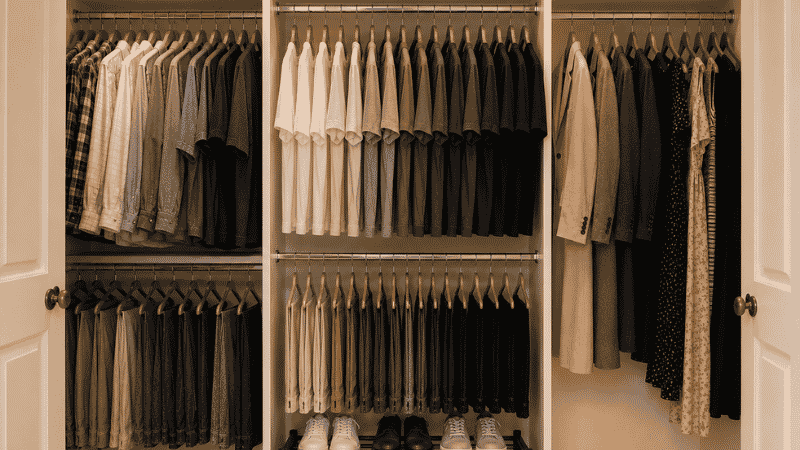
The standard closet — one rod, one shelf — was designed for a fraction of what most people actually own. The result is a packed rod where finding anything requires sliding a dozen hangers, a top shelf that’s become a storage zone for things you’ve forgotten you own, and a floor covered with shoes that don’t have anywhere else to go.
The good news: you don’t need a custom system or a renovation to fix this. The two highest-impact changes in any small closet cost under $30 combined and require no tools.
Double Hang Rod: The Highest-Impact Upgrade
Most items in a wardrobe are shorter than 40 inches when hanging — shirts, folded pants, jackets, blazers. A double hang rod that hooks over the existing rod creates a complete second hanging level for all shorter items, effectively doubling hanging capacity in those sections. Long items (dresses, full-length trousers, long coats) get one dedicated section; everything else gets doubled.
Frequency Organization: The Principle That Changes Everything
Most people organize closets by category — all shirts together, all pants together. The more functional approach is by frequency: daily-wear items at center and eye level, occasional items at the sides or slightly higher, seasonal items on the top shelf or in another storage location entirely.
This single change — reorganizing what’s already there by how often you reach for it — reduces morning friction more than any new product.
The Closet Audit
Before organizing anything, the closet needs a realistic assessment of what belongs there. The 12-month rule: anything unworn in the past year (accounting for seasons) is a candidate for removal. The fit rule: clothes that don’t fit right now, not “when I lose a few pounds,” don’t need prime closet space. The duplicate rule: three pairs of black jeans is one too many.
Most closets contain 20–30% of items that shouldn’t be there — and removing them often solves the “not enough space” problem without any additional storage purchases.
For the complete small closet organization system, including no-drill rental options: → How to Organize a Small Closet (Even If It’s Stuffed With Clothes)
Clothing Storage Ideas: Folding, Filing, and Drawer Organization
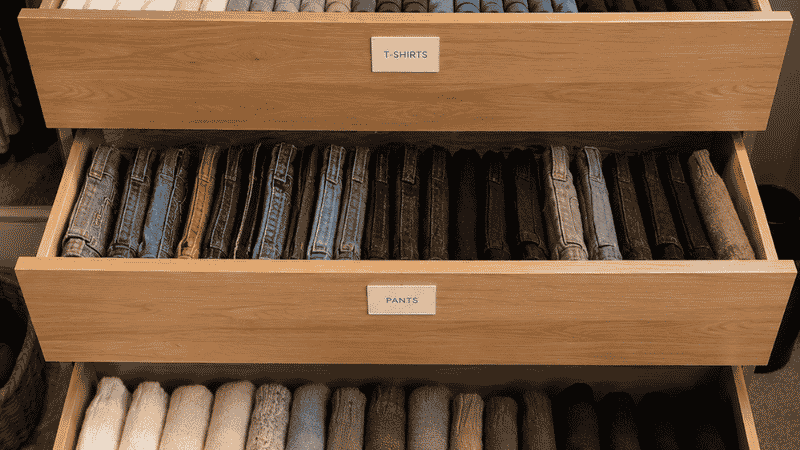
The drawer is where clothing organization most commonly breaks down. Traditional flat stacking — one shirt on top of another — means the clothes at the bottom are effectively invisible, the stack collapses every time someone reaches into the middle, and the same top few items get worn while everything else goes unworn.
The solution is vertical filing: folding each item into a compact rectangle that stands upright in the drawer, like files in a filing cabinet. Every item is visible at a glance. Every item is individually accessible. Pulling one out doesn’t disturb anything around it.
How to File Fold Every Clothing Type
Shirts and t-shirts: Fold in thirds horizontally (both sides to center, sleeves tucked), fold the bottom third up, fold in half. The resulting rectangle should stand upright on its own — this is the quality test for a correct fold.
Pants and jeans: Fold one leg onto the other, optionally fold the waistband down 3 inches for even thickness with denim, fold in thirds from bottom to waist. File vertically.
Sweaters: Fold sleeves across the back (one at a time, cuff to hem), fold body in thirds. Store vertically for lighter knits; store in a single flat layer on a shelf for heavy wool and chunky knits.
Hoodies: Tuck the hood flat against the body first, then fold sides in and body in thirds. The hood, now tucked inside, creates a slightly thicker rectangle — this is normal.
The file-folding system works for the entire wardrobe. The first drawer takes 10–15 minutes to convert; subsequent drawers take less time as the method becomes automatic.
For complete step-by-step folding instructions for every clothing type: → How to Fold Shirts, Pants, Sweaters and Jeans: Space-Saving Folding Methods
Bedroom Storage Ideas: Maximizing Every Inch
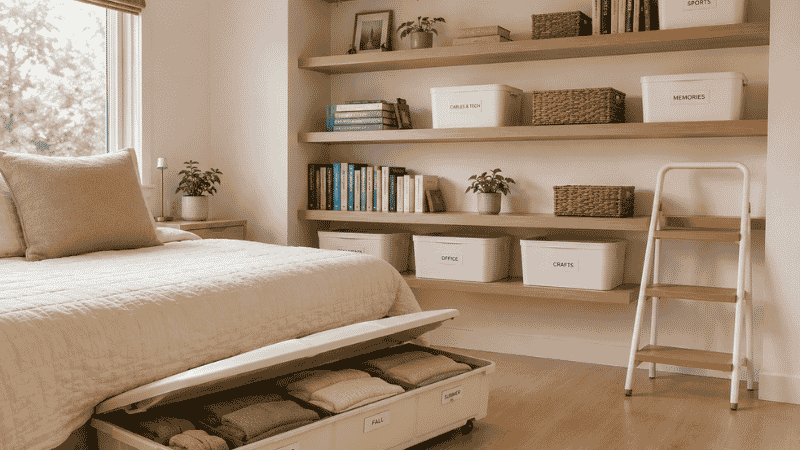
The bedroom has more storage potential than most people use. Two zones are almost universally underused: the space under the bed and the floor-to-ceiling vertical wall space.
Under-Bed Storage
A queen bed has approximately 20–24 square feet of floor space beneath it. With standard clearance, that space holds 4–6 large flat storage bins — enough for seasonal clothing, extra bedding, shoes worn occasionally, or anything that needs a home but doesn’t need daily access.
Bed risers ($15–$25) add 3–6 inches of clearance to any existing frame, creating enough space for flat bins where there was none before. A storage bed frame with built-in drawers holds the equivalent of a full dresser in footprint that’s already occupied.
Vertical Wall Space
The average bedroom has 8 feet of vertical space. Most storage uses 4 feet of it. Floating shelves installed from shoulder height to ceiling add meaningful storage without adding floor footprint — ideal for books, bins, and items accessed occasionally rather than daily.
The Nightstand Upgrade
A nightstand with at least one drawer holds significantly more than a surface-only table while keeping the surface clear. Inside the drawer: small bins or dividers prevent the nightstand drawer from becoming a small-item chaos zone. Daily-use items at front, occasional items at back.
For the complete bedroom storage system including small bedroom solutions: → Bedroom Organization Ideas: How to Organize Your Bedroom for Good
Shoe Storage: Every Pair in Its Right Place
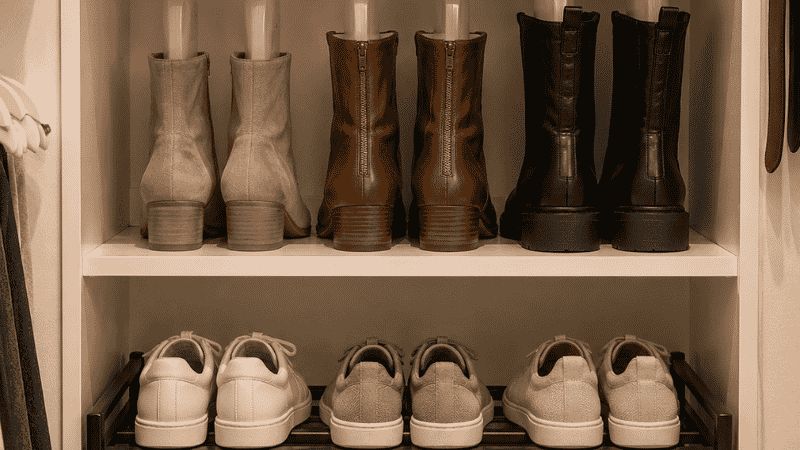
Shoes have a specific organizational challenge: they’re heavy, oddly shaped, and they tend to accumulate faster than storage capacity grows. The average person owns 19 pairs of shoes but regularly wears 4–5. This means most shoe storage problems are volume problems before they’re system problems.
The Shoe Audit First
Before any storage solution: the 12-month rule applies to shoes too. Shoes unworn in the past year, shoes that don’t fit comfortably, shoes in poor repair — these are occupying storage space without contributing anything. Most people remove 30–40% of their shoe collection in a shoe audit and discover they already have enough storage for what remains.
Storage by Location
In the closet: Organize by type and frequency. Daily shoes at floor level, occasional shoes on a low shelf, seasonal shoes on higher shelves or in clear boxes. Boots store vertically — never on their sides, which causes permanent shaft creasing. Clear stackable boxes protect heels and dress shoes while keeping them visible.
In the bedroom: Under-bed shoe organizers hold 12–24 pairs in space that’s otherwise unused. A small compact rack near the door holds the current week’s most-worn pairs.
In the entryway: Only actively-worn, current-season shoes belong in the entryway. A tiered rack or storage bench holds the daily rotation; everything else lives in the closet or under the bed.
For the complete shoe storage system by location and shoe type: → Shoe Storage Ideas: How to Organize Every Pair (Even When You Have Too Many)
Small Space Storage: When the Bedroom Has to Do More
Small bedrooms — especially those in apartments, shared households, or homes without dedicated storage — require a fundamentally different approach than larger rooms. The priority shifts from organizing what you have to maximizing every available inch.
The Multi-Function Furniture Principle
In a small bedroom, every large piece of furniture should earn its footprint in two ways: its primary function and its storage capacity. A storage ottoman replaces a bench while holding extra bedding. A bed frame with drawers replaces a dresser. A floating nightstand shelf takes zero floor space. A wardrobe without a built-in closet creates closet-equivalent storage in any room.
Vertical Thinking
Small bedrooms benefit most from storage that goes up rather than out. Tall, narrow wardrobes hold as much as wide, low dressers while using a fraction of the floor footprint. Floating shelves above the bed or desk create storage that doesn’t compete with floor space. Wall-mounted hooks for bags, accessories, and frequently worn items move storage entirely off the floor.
The No-Closet Bedroom
Bedrooms without closets aren’t rare — older homes, studio apartments, and converted spaces often have no dedicated clothing storage. The solutions, in order of capacity: a freestanding wardrobe for hanging items, a clothing rack with shelf above for curated wardrobes, curtained storage zones for hidden wardrobe areas (tension rod with floor-to-ceiling curtains), and distributed storage using under-bed bins and multi-function furniture for everything that doesn’t hang.
For the complete small space storage system including studio apartment solutions: → Small Space Storage Ideas: How to Organize a Small Apartment Room by Room
How to Fold Bed Sheets and Organize Bedroom Linens
Bed linens — sheets, pillowcases, duvet covers — present a specific storage challenge: they’re large, they’re difficult to fold neatly (especially fitted sheets), and when stored without a system they mix together into an indistinguishable pile that makes finding a matching set a frustrating exercise.
The Fitted Sheet
The fitted sheet defeats most people because they approach it like a flat sheet. The elastic corners continuously pull the fabric out of shape. The solution is corner nesting: tuck all four corners into each other before laying the sheet flat, which neutralizes the elastic’s pull and allows the sheet to fold into a clean rectangle.
The Pillowcase Bundle System
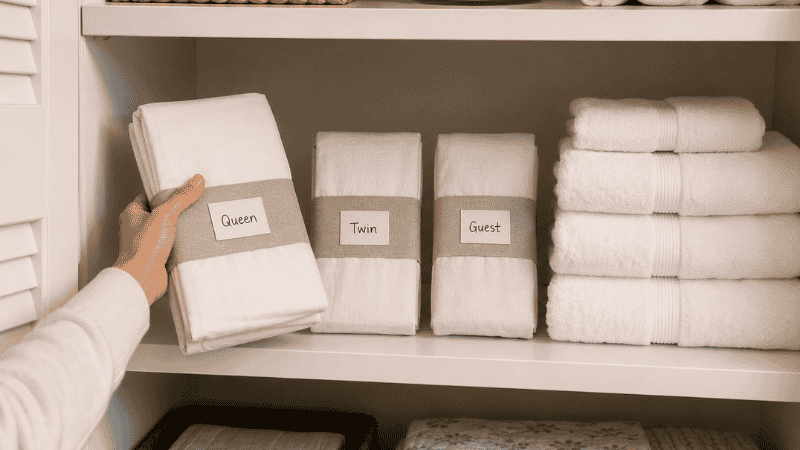
The most effective linen storage method stores each complete sheet set — fitted sheet, flat sheet, and pillowcase — inside the remaining pillowcase. The result is a self-contained bundle that holds everything needed to make one bed. Labeled by bed size (Queen, Twin, Guest), these bundles transform linen storage from a matching puzzle into a one-reach system.
Linen Closet Organization
Organize linens by bed size, not by item type. All queen sets together, all twin sets together, all guest sets together — each in its own section of the linen closet or shelf. This means making any bed requires going to one location and grabbing one bundle, rather than hunting for matching pieces across three different shelf locations.
For complete folding instructions and linen closet organization: → How to Fold Bed Sheets and Organize Your Linen Closet: A Complete Guide
How to Maintain an Organized Bedroom Long Term
Getting the bedroom organized is the easier half. Keeping it organized is where most systems fail — not because the organization was wrong, but because there was no maintenance habit built around it.
The Daily 2-Minute Reset
Before getting into bed each night: return everything to its zone. Clothes to hooks or laundry. Items from the nightstand surface that accumulated during the day. Water glass to the kitchen. Two minutes. This is the single habit that determines whether an organized bedroom stays organized or slowly drifts back to chaos.
The Weekly 10-Minute Reset
Once a week: return anything that’s migrated to the wrong zone, clear any surface that’s accumulated items, do a quick check of the closet floor and under-bed area. Ten minutes prevents the gradual accumulation that compounds over weeks into a full reorganization project.
The Seasonal Review
Twice a year — spring and fall work naturally — assess whether the organization system still reflects how you actually live. Wardrobes change. Seasons shift what’s needed. Children grow. The system should adapt, not stay frozen as a monument to how things were organized 18 months ago.
The One-In-One-Out Rule
For both clothing and shoes: when something new comes in, something old goes out. This keeps the overall volume stable without requiring ongoing willpower or periodic major declutters. The system does the work; the rule keeps the system sustainable.
FAQ: Closet Organization and Bedroom Storage
What is the best way to organize a small closet? Start with a declutter — remove anything unworn in the past 12 months. Then reorganize what remains by frequency of use, not category: daily items at center and eye level, seasonal items on higher shelves or elsewhere. Add a double hang rod for shorter items to double hanging capacity. These three steps solve most small closet problems before any storage products are purchased.
How do I organize my bedroom when I have no closet? A freestanding wardrobe for hanging clothes, under-bed storage for folded and seasonal items, wall hooks for bags and accessories, and an over-door organizer for small items create a complete closet equivalent. Curtained storage zones using tension rods are the most rental-friendly option and hide everything behind fabric for a clean look.
What is the best clothing storage idea for small spaces? The file-folding method in drawers and the double hang rod in closets together solve most small bedroom storage problems. File folding increases drawer capacity by up to 50% with no additional furniture. The double hang rod doubles hanging capacity for under $20. These two changes address the two most common small-space clothing storage problems.
How do I keep a bedroom organized with kids? Assign each child a specific zone within the shared bedroom for their clothing and personal items. Storage at child-accessible height — drawers they can reach, hooks at their eye level — enables independent maintenance. A clear, simple category system (one bin per toy type, one drawer per clothing category) removes the decision-making barrier that prevents kids from putting things away.
How often should I reorganize my closet? A full reorganization — complete empty-out, declutter, and rebuild — once or twice a year is sufficient for most households. Between full reorganizations, a weekly 10-minute reset and a seasonal rotation of clothing (moving off-season items to less accessible storage) keeps the system current. The daily 2-minute reset prevents the gradual drift that makes full reorganizations feel necessary every few weeks.
Where to Start
Every system in this guide is designed to be built one section at a time — not in a single overwhelming weekend session.
Pick the area that costs you the most daily friction. The closet that won’t stay organized. The drawer you avoid opening. The shoe pile by the front door. Start there, with the specific guide linked in that section. Do that one area properly before moving to the next.
An organized bedroom isn’t built in a day. It’s built one zone, one drawer, one system at a time — and maintained in five minutes a day once the right systems are in place.
Complete Guide Index — Bedroom & Clothing Organization
- Bedroom Organization → Bedroom Organization Ideas: How to Organize Your Bedroom for Good
- Small Closet → How to Organize a Small Closet (Even If It’s Stuffed With Clothes)
- Clothing Folding → How to Fold Shirts, Pants, Sweaters and Jeans: Space-Saving Folding Methods
- Shoe Storage → Shoe Storage Ideas: How to Organize Every Pair
- Small Space → Small Space Storage Ideas: How to Organize a Small Apartment Room by Room
- Bed Sheets & Linens → How to Fold Bed Sheets and Organize Your Linen Closet
Also explore:
- Home Organization Ideas: The Complete Room-by-Room Guide
- How to Declutter Your Home: A Room-by-Room Guide
References
- Saxbe, D. E., & Repetti, R. (2010). No Place Like Home: Home Tours Correlate With Daily Patterns of Mood and Cortisol. Personality and Social Psychology Bulletin, 36(1), 71–81.
- Roster, C. A., Ferrari, J. R., & Jurkat, M. P. (2016). The dark side of home: Assessing possession ‘clutter’ on subjective wellbeing. Journal of Environmental Psychology, 46, 32–41.
- American Apparel & Footwear Association (2023). Annual Statistical Report. Data on average American shoe and clothing ownership.
Category: Small Space Storage | Reading time: 12 min | Last updated: 2026