

You’ve started decluttering before. Maybe you got through one drawer, or one closet, or one ambitious Saturday afternoon that left you surrounded by piles you weren’t sure what to do with. Maybe you got further than that — a whole room, actually organized — and then watched it slowly return to its previous state over the following weeks.
The problem isn’t commitment. It isn’t willpower. And it almost certainly isn’t that you have too much stuff (though that might be part of it). The problem is that most decluttering advice treats the project as a single event rather than a system. You declutter once, feel great, and then the same accumulation process that created the clutter resumes — because nothing changed about how things enter the home or where they go when they arrive.
This guide covers the complete decluttering system: the mindset that makes decisions easier, the room-by-room approach that prevents overwhelm, the specific tips that work for different spaces and situations, and the habits that keep a decluttered home decluttered. It’s designed to be used as a whole system, or to send you to the specific deep-dive guide for whatever space you’re working on right now.
Key Takeaways
- Research published in the Journal of Environmental Psychology found that people in cluttered homes had higher cortisol levels throughout the day — clutter creates measurable physiological stress, not just aesthetic discomfort.
- Decision fatigue is the primary reason decluttering sessions stall: making hundreds of keep-or-discard decisions in sequence depletes cognitive resources, making later decisions harder. The solution is to set rules before you start, not during.
- The average American home contains over 300,000 items. Households that have completed a full declutter report spending an average of 40% less time on cleaning and tidying maintenance.
- Decluttering done in short sessions (20-45 minutes) produces better decision quality than marathon sessions — the decisions made in hour three are significantly worse than decisions made in hour one.
- The most effective long-term decluttering habit is the one-in-one-out rule: when something new enters the home, something old leaves. This prevents re-accumulation without requiring periodic major declutters.
Why Decluttering Always Seems to Fail (And What to Do Instead)

Before getting into the specific tips, it’s worth understanding why most decluttering attempts don’t produce lasting results — because if the root cause isn’t addressed, the same outcome keeps repeating.
The volume problem: Most people start decluttering without first stopping the inflow. New items continue arriving while existing items are being sorted. The declutter never catches up because the accumulation hasn’t paused.
The decision fatigue problem: Deciding what to keep and what to discard is cognitively expensive. Making 200 decisions in one session is exhausting in a way that’s easy to underestimate. By the third hour, “I’ll keep it just in case” becomes the default answer to every borderline item — which is exactly how the clutter accumulated in the first place.
The emotional attachment problem: Objects carry memories, guilt, and identity in a way that makes purely logical keep-or-discard decisions genuinely difficult. A shirt from a trip you barely remember is easy to discard. A shirt from a significant relationship is not — even if you haven’t worn it in four years.
The system problem: Decluttering removes the excess. But if the underlying organization system doesn’t change — if items still don’t have designated homes, if the pantry still works the same way, if the closet still has the same structure — the space will re-accumulate to its previous state within months.
The solution to all four: set rules before you start, work in short sessions, acknowledge the emotional weight without being governed by it, and pair every decluttering session with a small organizational improvement.
How to Declutter Your Home: The Room-by-Room System
The most effective approach to a whole-home declutter is room by room, in order of emotional difficulty — not in order of size or visibility.
Start with the easiest spaces: the bathroom cabinet, the kitchen junk drawer, a single bookshelf. These spaces have the fewest emotionally loaded items, produce the fastest visible results, and build the decision-making momentum needed for harder spaces. Save the attic, the storage unit, the childhood memorabilia for after you’ve developed fluency with the keep-or-discard decision.
The recommended sequence for most households:
- Bathroom (lowest emotional attachment, highest hygiene motivation)
- Kitchen (high functional motivation, moderate emotional attachment)
- Living areas (moderate complexity, high visibility payoff)
- Bedroom and closet (higher emotional attachment, significant impact on daily life)
- Home office and paperwork (lowest urgency, highest complexity)
- Sentimental storage (highest emotional difficulty, save for last)
For the complete room-by-room guide with specific instructions for every space: → How to Declutter Your Home: A Room-by-Room Guide
Decluttering Tips That Actually Work
These are the specific techniques that professional organizers and people who have successfully decluttered whole homes consistently recommend — not because they’re clever, but because they address the real reasons decluttering stalls.
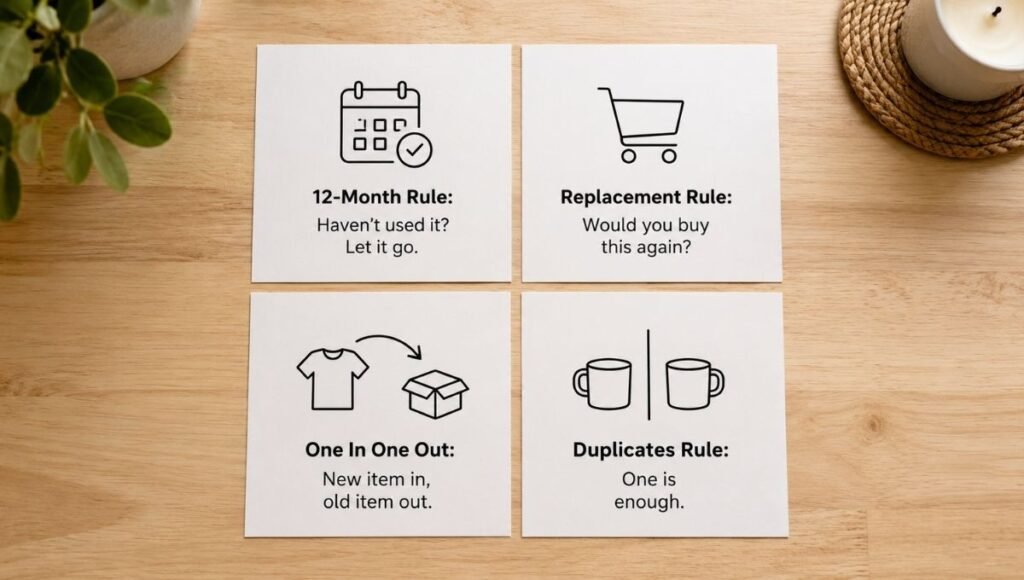
Set Your Rules Before You Touch Anything
The most important decluttering tip isn’t a technique for sorting — it’s deciding your criteria before you start, so you’re applying rules rather than making fresh decisions for each item.
Common decluttering rules that work:
The 12-month rule: If you haven’t used it in the past 12 months (accounting for seasonal items), it’s a candidate for removal. This is the most widely applicable rule and the one professional organizers most consistently recommend.
The replacement rule: If this item broke or was lost tomorrow, would you replace it? If the honest answer is no, it’s not serving a real need.
The one-in-one-out rule: When something new enters the home, something must leave. Applied consistently, this prevents re-accumulation without requiring ongoing active decluttering.
The duplicates rule: For most household items, one is enough. Two is sometimes useful. Three or more is accumulation. Identify your most duplicated categories (cooking utensils, charger cables, reusable bags, scissors) and reduce to the number you actually use.
Work in Short Sessions
Twenty to forty-five minutes is the optimal decluttering session length for most people. Beyond that, decision quality drops significantly and the session becomes more about exhaustion than progress.
Set a timer. Work until it goes off. Stop. This prevents both the burnout that makes people avoid starting future sessions and the poor-quality decisions made when cognitive resources are depleted.
Editor’s note: The single biggest behavioral change that makes decluttering sustainable is accepting that it happens in many short sessions rather than one heroic effort. A 30-minute session three times a week produces better results — and significantly better decisions — than a single 8-hour Saturday.
Start With Trash and Obvious Discards
Before making any keep-or-discard decisions, do a pass for items that require no decision at all: expired food, broken items that will never be repaired, empty containers, duplicates of things you clearly have too many of. This creates immediate visible space and momentum without any emotional cost.
In most rooms, this pass alone removes 10-20% of the volume.
The “Someday” Box
For items you genuinely can’t decide about — the equipment for the hobby you haven’t done in two years but want to return to, the clothes that don’t fit right now but might, the items with emotional weight that you’re not ready to discard — put them in a labeled box with today’s date. Store the box somewhere out of the way. In six months, if you haven’t opened the box for anything, that’s your answer.
This technique removes the pressure of making a permanent decision immediately, while building a realistic picture of what you actually use versus what you keep “just in case.”
Handle the Emotional Items Honestly
Objects carry emotional weight. Acknowledging this directly — rather than pretending decluttering is purely logical — makes it easier to work through.
The question isn’t “is this item valuable?” It’s “does keeping this item serve me, or does it serve a version of the past I’m holding onto?” A gift you feel guilty about discarding is still taking up space. A sentimental item you never look at is providing no actual comfort.
Photographing sentimental items before discarding them is a practical middle path: the memory is preserved, the physical object is released. For genuinely important sentimental items — the things you’d save in a fire — keep them. Create a dedicated, bounded sentimental storage space, and let it define what stays.
Declutter Checklist: Quick Reference by Room
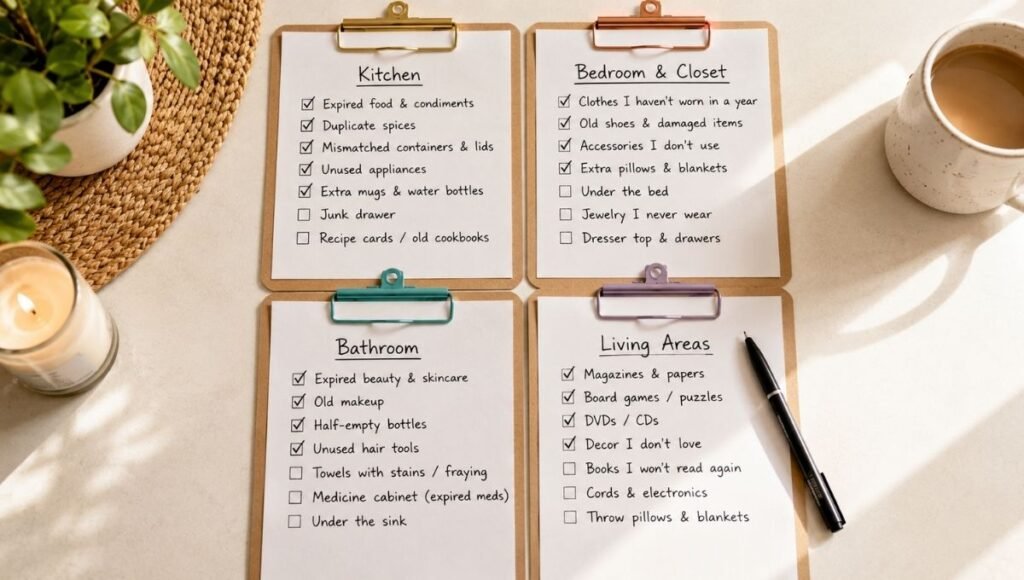
Kitchen Declutter Checklist
- Expired pantry items and duplicated partial packages
- Appliances not used in the past 12 months
- Duplicate cooking utensils (how many spatulas do you need?)
- Mismatched food storage containers without lids
- Chipped, stained, or broken dishes
- Reusable bags accumulated beyond what you actively use
- Expired spices (most lose potency after 1-2 years)
- Cookbooks not opened in 12 months
Bedroom and Closet Declutter Checklist
- Clothing unworn in 12 months (accounting for seasons)
- Clothing that doesn’t fit currently
- Shoes in poor repair or worn fewer than 3 times in a year
- Duplicate items (how many black t-shirts do you need?)
- Bedding sets beyond 2 per bed
- Items stored under the bed that haven’t been accessed in 6+ months
Bathroom Declutter Checklist
- Expired medications (dispose of properly — many pharmacies accept them)
- Expired skincare, makeup, and personal care products
- Products you’ve tried and don’t use
- Duplicate products (multiple open bottles of the same thing)
- Hotel toiletries accumulated beyond what you’ll realistically use
- Towels in poor condition
Living Area Declutter Checklist
- Books not reread and not likely to be
- DVDs, CDs, and physical media replaced by streaming
- Decorative items you keep out of habit rather than genuine enjoyment
- Magazines and catalogs older than one month
- Electronic equipment that no longer functions or is no longer used
- Games and puzzles with missing pieces
For the complete room-by-room declutter checklist with seasonal and spring cleaning additions: → House Cleaning Checklist: The Complete Daily, Weekly, and Monthly Guide
How to Declutter Fast When You’re Overwhelmed
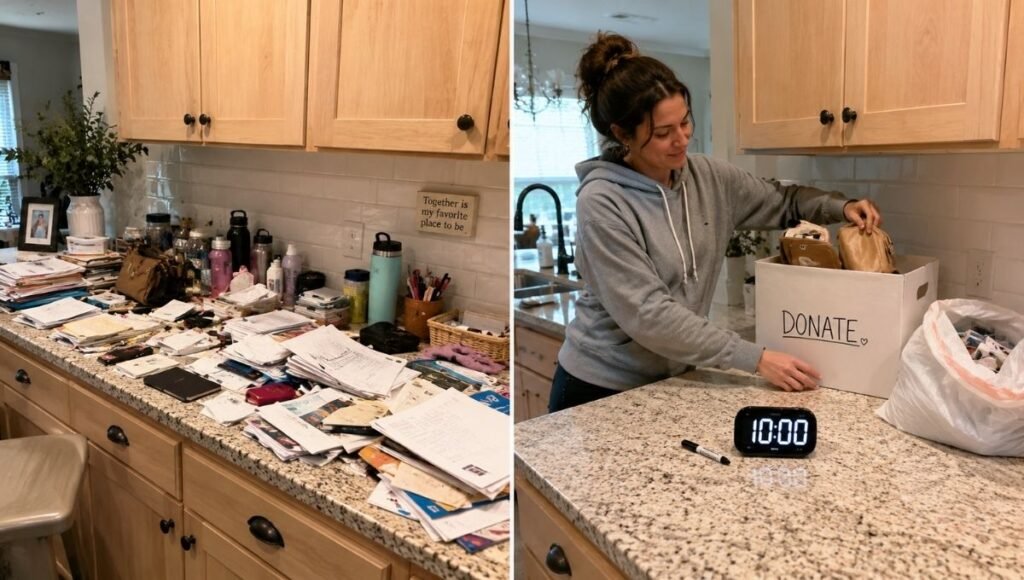
Sometimes the starting point isn’t a methodical room-by-room approach — it’s a state of overwhelm where the whole project feels impossible and you just need to make some visible progress.
The 10-minute trash pass: Walk through the entire home with a garbage bag. Collect only obvious trash — expired things, clearly broken things, empty containers. Don’t make any other decisions. Stop after 10 minutes. This creates visible change with zero decision cost.
The one-surface method: Pick one surface — the kitchen counter, one nightstand, one desk — and clear it completely. Return only items that actively belong there. Find real homes for the rest or put them in a temporary box. One clear surface changes how a room feels and proves that the project is possible.
The donation box method: Put an open box in a visible location. For one week, add any item you pick up, use, and immediately think “I don’t need this.” At the end of the week, seal the box and donate it. No sorting session required — the decisions happen naturally as you move through the house.
The 15-minute daily habit: Set a timer for 15 minutes every day and work on one small area — one drawer, one shelf, one section of a closet. At this pace, a full home can be decluttered in 30-60 days without any single overwhelming session.
How to Keep a Clutter-Free Home Long Term
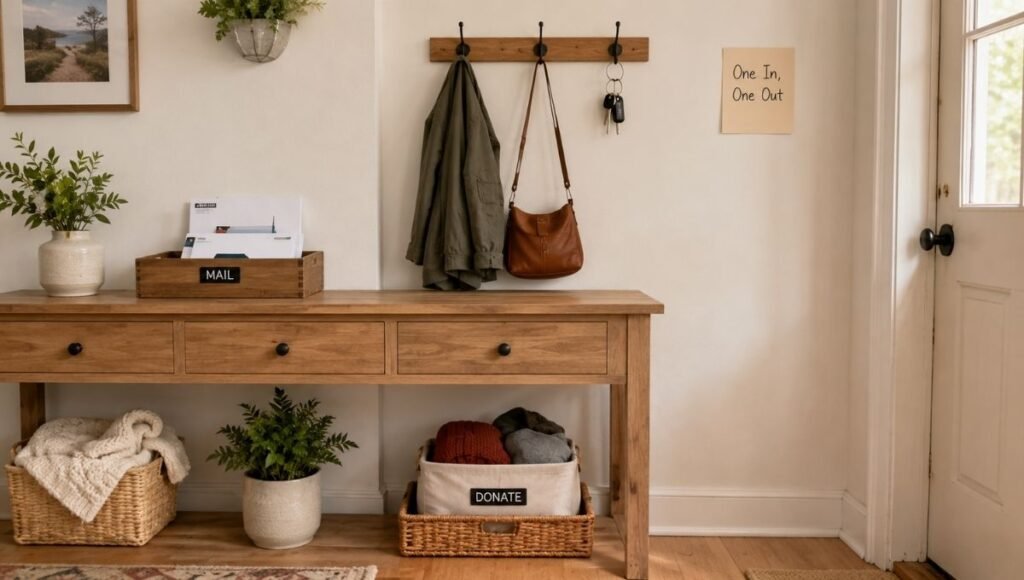
Decluttering is a project. Staying decluttered is a system.
The most reliable system has three components:
1. The one-in-one-out rule. Applied to clothing, books, kitchen equipment, and home goods: when something new comes in, something old goes out. This prevents the gradual accumulation that makes major declutters necessary in the first place.
2. The landing zone system. Clutter accumulates where items arrive without a designated home. The counter, the chair, the entry table — these become accumulation zones because incoming items don’t have a defined next step. Creating specific landing zones with specific purposes (a mail tray for incoming paper, hooks for bags and coats, a basket for items that need to go upstairs) prevents the undefined accumulation that slowly expands into full clutter.
3. The monthly 20-minute scan. Once a month, walk through the home and look for items that have migrated from their homes, items that have been sitting untouched for a month, and items that need to move to their next destination (to be returned, donated, or discarded). Twenty minutes prevents the gradual drift that compounds into a major project.
A decluttered home maintained by these three habits requires far less ongoing effort than a cluttered home maintained by constant reactive cleaning. The initial investment pays back quickly.
Minimalist Home: Creating a Home That Supports How You Live
Decluttering isn’t necessarily about minimalism — you don’t have to own fewer things than feels natural, or create a spare aesthetic that doesn’t reflect your personality. It’s about owning things intentionally: keeping what you use, what you genuinely enjoy, and what serves the life you’re actually living rather than the life you imagine having.
The practical result of intentional ownership is a home that’s easier to clean, easier to navigate, and easier to maintain. Surfaces have breathing room. Storage works because it’s not overcrowded. You can find things when you need them.
For a complete guide to creating a calm, intentional bedroom environment: → Minimalist Bedroom Ideas: How to Create a Calm, Clutter-Free Space
If You Only Have 10 Minutes Right Now
10 minutes: Do the trash pass in the room that bothers you most. Grab a bag, collect only obvious trash and clearly unwanted items, don’t make any other decisions. See what the room looks like when it’s done.
20 minutes: Clear one surface completely. The kitchen counter, the coffee table, one nightstand. Return only what belongs there. Put everything else in a temporary box.
30 minutes: Work through one small category end-to-end. All the expired items in the bathroom. All the duplicated containers in the kitchen. The decision is already made by category — you just execute it.
FAQ: Decluttering Tips
Where should I start when decluttering my home? Start with the bathroom — it has the fewest emotionally loaded items, the most objective keep-or-discard criteria (expired products, broken items), and produces visible results quickly. The momentum from a completed bathroom makes the next space easier to approach. Save sentimental storage and paperwork for after you’ve developed fluency with the decluttering decision.
How do I declutter when I’m overwhelmed and don’t know where to start? Don’t start with a full room. Start with one surface, one drawer, or a single category (all expired products, all broken items). The goal of the first session isn’t significant progress — it’s demonstrating to yourself that the project is possible. One clear surface changes how a space feels and makes starting the next session easier.
How do I get rid of sentimental items? Acknowledge that these decisions are genuinely hard — they’re not a logical exercise, and treating them as one doesn’t work. Create a bounded sentimental storage space (one box, one shelf, one bin) and keep what fits within it. Photograph items before discarding them as a middle path that preserves the memory without the physical object. For the most difficult items, give yourself a “someday box” with a date — if you haven’t retrieved it in six months, you have your answer.
How do I stop clutter from building back up after I declutter? Three habits: the one-in-one-out rule (when something comes in, something leaves), designated landing zones for incoming items (so things don’t accumulate on whatever surface is closest), and a monthly 20-minute scan to catch drift before it compounds. These three habits together take less than 30 minutes per month and prevent the re-accumulation that makes decluttering feel like an endless cycle.
How long does it take to declutter a whole home? For an average home: 20-30 hours total, which is why spreading the work across multiple sessions (rather than attempting it all at once) is consistently more effective. At 30 minutes per day, a full home can be decluttered in 6-8 weeks. At 15 minutes per day, 3 months. The pace matters less than the consistency.
What’s the best decluttering method? The KonMari method (organizing by category rather than room, keeping only items that “spark joy”) works well for clothing and books. The room-by-room method works better for households with complex storage situations or multiple residents. The category-by-category approach is the most practical for most households: complete one category (all clothes, all books, all kitchen equipment) before moving to the next. The best method is the one that produces decisions you can act on.
How do I declutter with a partner or family who doesn’t want to? Focus on your own belongings only. Shared spaces can be addressed by decluttering your contribution to the clutter without touching items belonging to others. Create the organizational systems in shared spaces that make it easier for everyone to keep things tidy. Model the outcome rather than mandating the process — a partner who sees the functional benefit of a decluttered shared space is more likely to engage than one who feels their belongings are being managed.
Start With One Room, One Session
The most important decluttering tip isn’t a technique or a rule — it’s starting. Not planning to start, not reading one more guide, not waiting for the right weekend.
Pick the room that bothers you most right now. Set a timer for 30 minutes. Do the trash pass. Clear one surface. Stop when the timer goes off.
That session, imperfect and incomplete, is the beginning of the system that keeps working.
Complete Guide Index — Decluttering & Reset
- Room-by-room declutter → How to Declutter Your Home: A Room-by-Room Guide
- Cleaning system → House Cleaning Checklist: The Complete Daily, Weekly, and Monthly Guide
- Calm bedroom → Minimalist Bedroom Ideas: How to Create a Calm, Clutter-Free Space
Also explore:
- Home Organization Ideas: The Complete Room-by-Room Guide
- Closet Organization: The Complete Bedroom & Clothing Storage Guide
References
- Roster, C. A., Ferrari, J. R., & Jurkat, M. P. (2016). The dark side of home: Assessing possession ‘clutter’ on subjective wellbeing. Journal of Environmental Psychology, 46, 32–41.
- Saxbe, D. E., & Repetti, R. (2010). No Place Like Home: Home Tours Correlate With Daily Patterns of Mood and Cortisol. Personality and Social Psychology Bulletin, 36(1), 71–81.
- Vohs, K. D., Redden, J. P., & Rahinel, R. (2013). Physical Order Produces Healthy Choices, Generosity, and Conventionality, Whereas Disorder Produces Creativity. Psychological Science, 24(9), 1860–1867.
Category: Decluttering & Reset | Reading time: 12 min | Last updated: 2026