

There’s a moment in every move — usually around week three of packing — where you open a box you packed in week one and find things you don’t recognize. A cable for a device you no longer own. A gift from someone you can’t remember. Three bottle openers. A small figurine with no obvious origin. You tape the box back up and put it on the moving truck, and those same things will sit in a box in your new home for another year before you open it again.
This is how most people move: they pack everything, move everything, and hope the chaos of the new space will somehow be less chaotic than the old one. It’s not. Clutter moves with you. The disorganized kitchen becomes a disorganized kitchen in a new address. The bedroom where things end up on the floor still produces clothes on the floor. The move itself changes nothing about the system — or lack of one.
The smarter approach: use the move as the forced declutter and organizational reset it actually is. Moving is one of the few moments in life when you have to touch every single thing you own. That creates an enormous opportunity to decide, deliberately, what comes with you — and to set up your new home with the organizational systems you always meant to have but never got around to.
This moving checklist is built around that opportunity. It covers what to do 6-8 weeks out, how to pack room by room, what to declutter before you move (and what to just get rid of now), and how to set up your new home so the first weeks don’t feel like starting from chaos again.
Key Takeaways
- Moving companies report that the average household moves approximately 7,400 pounds of belongings — most families significantly overestimate how much of that is worth paying to transport. Decluttering before packing reduces moving costs directly.
- A 2022 study by Hire a Helper found that moving costs increased 9% year-over-year — the fastest way to reduce this cost is to move fewer boxes. Every box decluttered before moving day saves money, not just space.
- Research consistently shows that the stress of moving peaks in the final two weeks before the move — starting 6-8 weeks out reduces this stress by distributing decisions across time rather than compressing them into a final rush.
- The “First Night Box” — a single box or bag containing everything needed for the first 24 hours — is the single most useful moving preparation that most people don’t do until they’ve had a miserable first night without it.
- Unpacking in the first week into a planned organizational system is dramatically easier than unpacking into an unplanned space and then reorganizing later. The room-by-room organization plan for the new home should be made before moving day, not after.
The Pre-Move Principle: Declutter First, Pack Second

The most important thing in any moving checklist comes before a single box is packed: decluttering.
Organizing without decluttering is like trying to steer a canoe with one paddle. You just end up going in circles. The same is true if you pack before you purge — you feel great checking packing off your list, but when you arrive at your new home you’ll be overwhelmed with the same clutter you encountered in the old one. You can’t outrun clutter.
The financial case for decluttering before moving is concrete: moving companies charge by weight and volume. Every box you don’t pack is money you don’t spend on the move. A typical household that declutters seriously before a move eliminates 20-30% of its boxes — a meaningful reduction in cost for anyone using professional movers or renting a truck.
The practical case is even stronger: items you haven’t opened in years don’t become useful after they’re moved. They just become boxes you’re storing in a new location.
The pre-move declutter framework:
Go room by room with three containers — one for packing, one for donating, one for discarding. The goal is to make one decision per item, quickly, without deliberation. Set a 20-minute timer per section. The timer prevents decision paralysis and forces forward momentum.
Items that should not move with you:
- Anything broken, worn out, or damaged beyond reasonable use
- Clothing not worn in the past 12 months (the move is an ideal time to apply this rule ruthlessly)
- Duplicate items — three bottle openers, two of the same kitchen tool, backup supplies you’ve been accumulating
- Boxes not opened since the last move (if you haven’t needed it in however long you’ve been at your current address, you won’t need it at the new one)
- Items with high emotional weight but low actual use — kept out of guilt rather than genuine value
High-value declutter opportunities by category: Books (sell or donate heavy books rather than paying to move them), kitchen appliances used rarely (a waffle iron used twice a year doesn’t need to travel), furniture that won’t fit the new space (sell before moving day rather than moving and then selling), and tools and garage items accumulated over years (be ruthless — most households have significant duplication).
Editor’s note: The hardest decluttering decisions are the sentimental ones. The most useful question isn’t “do I want this?” but “would I buy this today if I didn’t own it?” For items where the answer is clearly no, the move is the right time to let them go.
Moving Checklist: 8 Weeks Before Moving Day
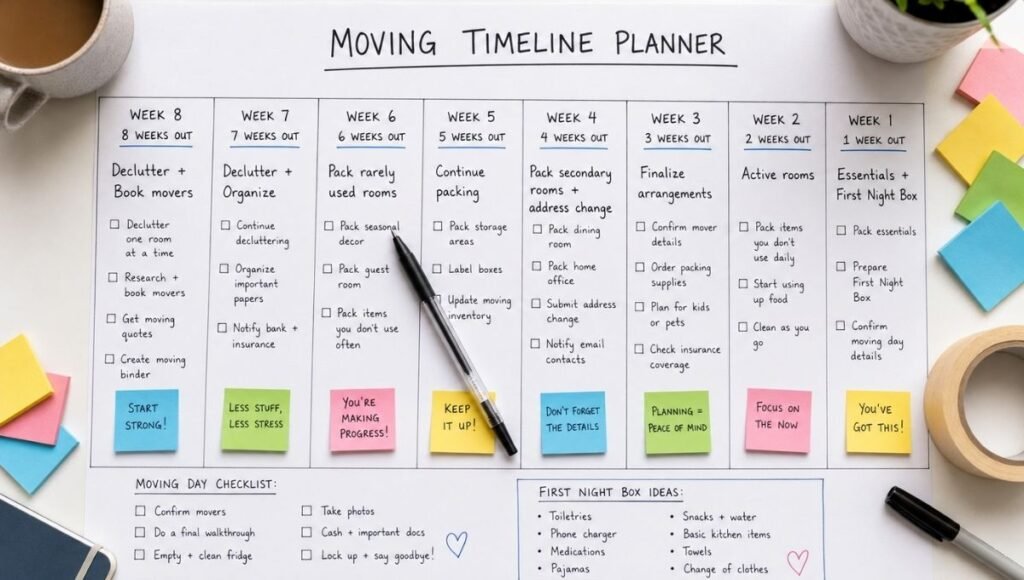
Eight weeks is enough time to make the move feel manageable. Fewer weeks means compressing decisions; more weeks means easier pacing with less final-week stress.
8 weeks out — Planning and decluttering:
- Confirm your move date and book movers or truck rental
- Begin the room-by-room declutter (start with rooms used least — attic, basement, garage, guest room, formal dining)
- Research donation pickup options — Habitat for Humanity ReStore, local thrift stores, furniture banks — and schedule pickups for larger items
- List items to sell on Facebook Marketplace, neighborhood apps, or garage sale
- Begin gathering moving supplies: boxes in multiple sizes, packing tape, bubble wrap, packing paper, markers, color-coded stickers or tape
6 weeks out — Active packing begins:
- Start packing items from rooms you rarely use that are now decluttered
- Pack seasonal clothing, books, decorative items, and anything used less than monthly
- Label every box with: room name, brief content description, and any handling notes (fragile, heavy, this side up)
- Consider a color-coding system — one color per room — and mark both the box and the corresponding room doorway or wall in the new home’s floor plan
4 weeks out — Mid-packing push:
- Pack secondary bedrooms, home office non-essentials, guest bathroom
- Begin researching your new home’s layout — measure rooms if possible, plan where major furniture pieces will go
- Notify relevant parties of address change: banks, subscriptions, employer, doctor, insurance, USPS mail forwarding
- Confirm utility transfer or setup at new address
2 weeks out — Active rooms:
- Pack all but daily-use items from the kitchen, master bedroom, main bathroom
- Pre-pack children’s toys down to a small selection of favorites for the final days
- Begin assembling the First Night Box (see below)
Final week — Essentials only:
- Pack daily-use items as late as possible
- Complete the First Night Box
- Create a room-by-room floor plan for the new home showing where furniture goes
- Confirm all moving logistics: timing, access, parking at both locations
Packing Tips for Moving: Room by Room
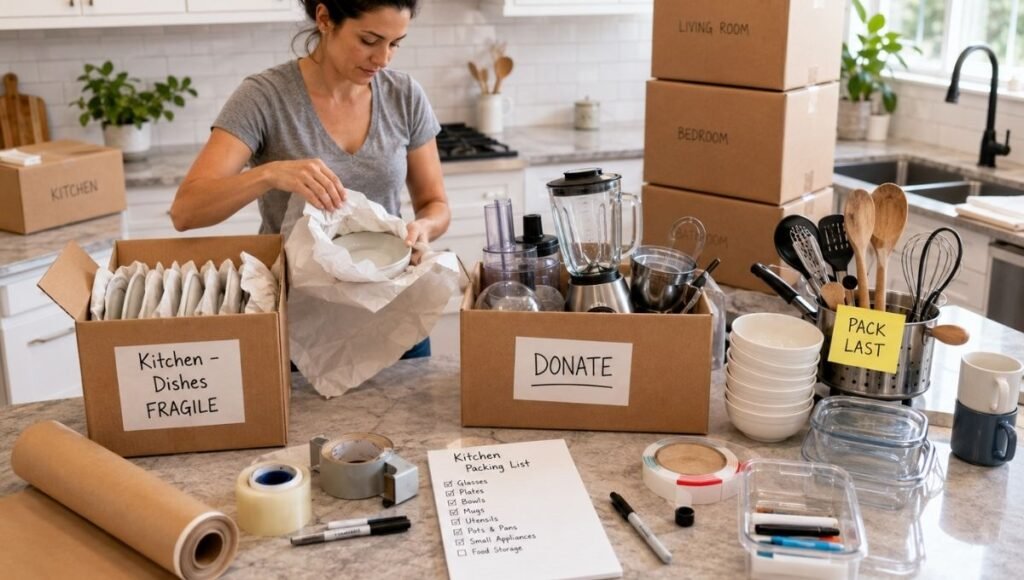
The Declutter-Then-Pack Rule
Before packing any room, do the declutter pass first. Packing room by room only works when each room is first reduced to what’s actually coming. An unpacked room doesn’t show you what needs organizational attention; a decluttered-then-packed room does.
Kitchen
The kitchen is the hardest room to pack and the one where the most useful decluttering happens. Start with items used less than once a month — special occasion dishes, duplicate tools, appliances that haven’t come out in a year.
Pack in this order:
- Rarely-used appliances and specialty tools
- Seasonal items (holiday baking supplies, large roasting pans)
- Extra pantry stock (donate non-perishables to a food bank rather than moving them if they’re unlikely to be used)
- Everyday dishes and cookware — leave one complete setting per person until moving day
- Daily-use items (coffee maker, one pot, one pan) — pack last
Packing notes: Dishes wrapped in packing paper, packed vertically like records rather than stacked flat — vertical stacking survives transit better. Small boxes for kitchen items; kitchen boxes get heavy quickly. Label fragile boxes on all four sides.
For a complete kitchen organization system in your new home: → How to Organize Kitchen Cabinets: A Step-by-Step Zone System
Bedroom
Pack in this order:
- Off-season clothing and shoes
- Extra bedding beyond what you need for the final nights
- Books, decor, non-essentials
- Daily-use clothing — pack last, into suitcases rather than boxes where possible for easier access on arrival
- Bedding — strip and pack the day of the move; one set per bed stays out until the last moment
Declutter opportunity: The 12-month clothing rule works perfectly here. If it hasn’t been worn in a year, it doesn’t make the move. This single pass typically removes 20-30% of most bedroom closets.
For setting up bedroom storage in your new home: → Bedroom Organization Ideas: How to Organize Your Bedroom for Good
Bathroom
Pack most bathroom items relatively late — you use this space daily. Exception: duplicate or backup items accumulated over time are worth decluttering before packing.
Declutter first: Expired medications (dispose of at a pharmacy take-back program, not in the trash), expired or unused personal care products, duplicate items, hotel toiletries accumulated beyond realistic use.
Pack in this order:
- Non-daily products and backstock
- Medications (check expiration dates before packing)
- Towels and linens beyond what you’ll use until moving day
- Daily toiletries — pack the morning of moving day into a clearly labeled bag that travels with you
Home Office
The home office has two specific decluttering opportunities that don’t apply elsewhere: paper documents and technology.
Paper: Shred outdated financial records (keep 7 years of tax documents; most other financial paperwork beyond that can go). Recycle magazines, old manuals for items you no longer own, general paperwork accumulated without a clear reason to keep it. Scan important documents before moving to reduce the physical paper you’re transporting.
Technology: Cables and chargers for devices you no longer own, duplicate accessories, outdated tech that won’t be used in the new home — moving is the right time to let these go rather than moving them to a new drawer where they’ll sit for another two years.
Garage and Storage Areas
The garage is where the most significant decluttering opportunity lives in most households. It’s also where the most things get packed and moved that should have been discarded years ago.
Be ruthless here: Tools duplicated or unused, sports equipment for activities no longer practiced, seasonal items that haven’t been touched in multiple seasons, boxes from previous moves that were never unpacked.
Critical note: Hazardous materials cannot go on a moving truck — old paint, pesticides, automotive fluids, propane tanks. These need to be disposed of through your municipality’s hazardous waste program before moving day, not packed.
The First Night Box: The Most Important Thing You’ll Pack
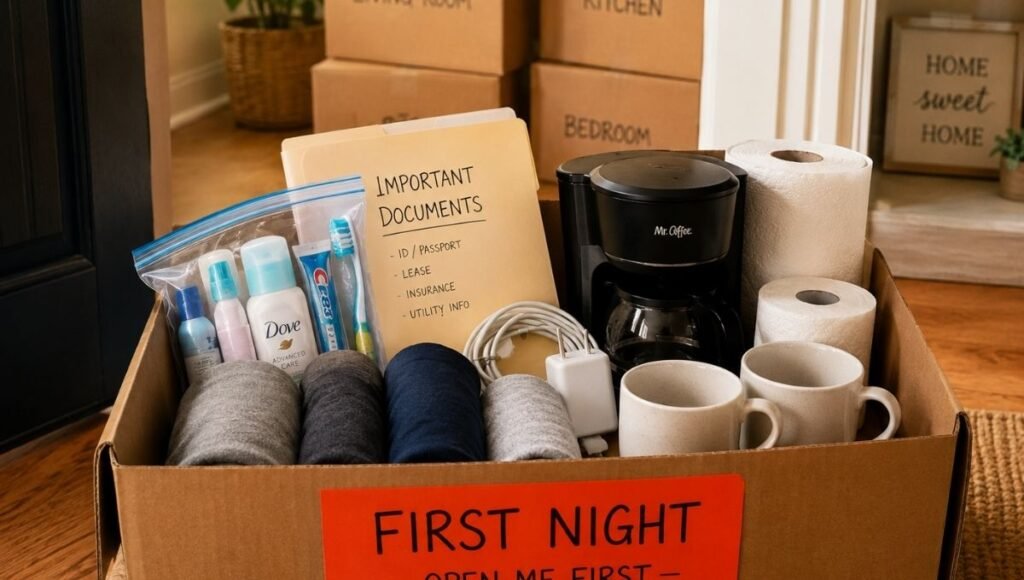
The First Night Box is a single clearly-labeled box or bag containing everything you need for the first 24 hours in your new home without unpacking anything else. Most people don’t prepare this and spend their first night in a new home searching through boxes for a toothbrush at 11pm.
What goes in the First Night Box:
- Toiletries: toothbrush, toothpaste, soap, shampoo, any medications taken daily
- A complete change of clothes per person
- Pajamas and basic sleep items
- Phone chargers and any essential electronics
- Important documents: IDs, insurance cards, moving paperwork, new lease or closing documents
- Basic kitchen: coffee maker (if you use it daily), one mug per person, a simple breakfast item, a few utensils
- Children’s items: a favorite toy or comfort item, any sleep aids, a small activity for the first evening
- Cleaning supplies: paper towels, all-purpose spray, toilet paper — you’ll need to clean before unpacking
The First Night Box travels in your car, not on the truck. It’s the first thing you know the location of when you arrive.
Downsizing Tips for Moving: When You’re Moving Smaller
Moving to a smaller space requires a more significant declutter than a standard move — because the new space simply won’t hold everything the old space did. The earlier this reality is accepted, the less painful the declutter process.
The floor plan approach: Get the measurements of the new space as early as possible. Map out where existing furniture will go. Anything that doesn’t have a place in the new floor plan should be sold or donated before moving day — not moved and then sorted.
The volume calculation: If your new home is 30% smaller, you need to reduce your belongings by at least 30% before moving. This sounds dramatic until you calculate it room by room, at which point it usually becomes clear where the reduction can happen with the least impact on daily life.
The financial opportunity: Furniture sold before a move rather than moved then sold nets significantly more — buyers can pick it up directly, avoiding moving costs. Facebook Marketplace, Craigslist, and neighborhood apps are the fastest channels.
For organizing a small space after downsizing: → Small Space Storage Ideas: How to Organize a Small Apartment Room by Room
How to Organize a Move: Setting Up Your New Home Right
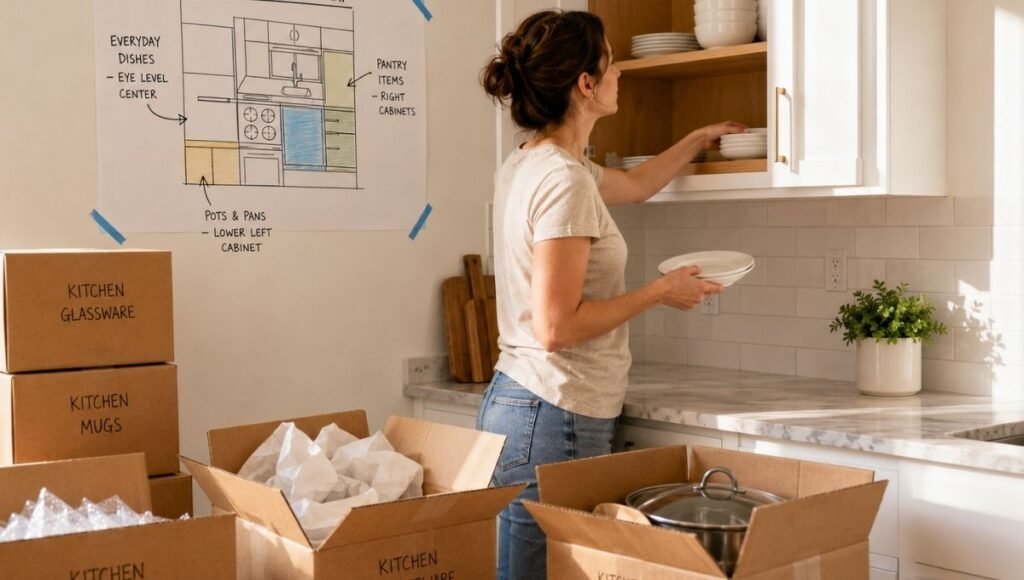
The new home is a blank slate. Every organizational system you’ve meant to have but never implemented becomes possible here — because nothing has settled into a default position yet.
The first 48 hours — essentials only: Unpack the First Night Box and the kitchen essentials. Beds should be set up and made with fresh sheets before anything else is unpacked. Functional sleeping and eating capability takes priority over everything else.
Week one — room by room, systems first: Before unpacking any room, decide on the organizational system for that room. Where will the kitchen items live — which cabinet for which category? Where will the closet be organized — hanging by type, by color, by frequency? Making these decisions before unpacking means items go directly to their permanent home rather than being placed temporarily and then reorganized later.
For building the organizational systems in each room: → How to Organize Kitchen Cabinets → How to Organize a Small Closet → How to Organize a Garage
The new home rule: Nothing gets its home because it’s convenient to put it there. Everything gets its home because that’s the right place for it given how you actually use it. Moving is the one moment when this intentional placement is easier than at any other time.
If You Only Have 10 Minutes Right Now

10 minutes: Identify the one room you use least and do a trash pass — walk through with a garbage bag and discard only obvious trash, clearly broken items, and anything expired. Just that category, no other decisions. In most households this removes 10-20 items from a single room and creates immediate visible progress.
20 minutes: Begin the First Night Box. Find a box or large bag and label it clearly. Start filling it with the items on the list above — you don’t have to complete it now, but starting it early means it builds gradually rather than becoming a frantic last-minute assembly.
30 minutes: Make a floor plan for your new home. Even a rough sketch showing where major furniture pieces will go gives you the framework for deciding what makes the move and what doesn’t.
FAQ: Moving Checklist
When should I start packing for a move? Start 6-8 weeks before moving day. Begin with rooms used least — basement, attic, garage, guest room — and progress toward daily-use rooms in the final two weeks. The final 48 hours should involve only essentials. Starting early distributes decisions over time rather than compressing them into a stressful final rush.
What should I declutter before moving? Anything not used in the past 12 months is a strong candidate. Duplicate items, broken or damaged things, clothing that doesn’t fit, boxes from previous moves that were never opened, furniture that won’t fit the new space, and any items kept from guilt rather than genuine use. The move is the ideal moment to apply the 12-month rule ruthlessly because you have to touch everything anyway.
What goes in a First Night Box? Daily toiletries, a change of clothes per person, phone chargers, important documents, basic kitchen items (coffee maker, a few utensils, a simple breakfast), children’s comfort items, and cleaning supplies (toilet paper, paper towels, all-purpose spray). This box travels in your car rather than on the moving truck.
How do I pack efficiently for a move? Pack room by room and label every box with the destination room and a brief content description. Use color-coded tape or stickers per room. Keep boxes under 50 pounds — kitchen items get heavy quickly. Pack heavier items in smaller boxes. Wrap fragile items individually. Pack least-used items first and daily essentials last.
What is the order to pack rooms for moving? Start with storage areas (basement, attic, garage), then rarely-used rooms (guest room, formal dining), then bedrooms and living areas, then the kitchen. Pack daily-use bathrooms and kitchen essentials in the final 48 hours. This order keeps your home functional until the last possible moment while maintaining packing progress.
How do I organize a new home efficiently after moving? Make organizational decisions before unpacking each room — where each category of items will live — so things go directly to their permanent location rather than requiring reorganization later. Set up sleeping and eating capability first, then work room by room with a system already decided. A new home is the ideal time to implement the organizational systems you’ve always meant to have.
Start With What You Won’t Take
The most useful thing to do today — whether you’re moving in two months or two years — is to identify one category of items in your home that you know shouldn’t make the next move. The too-small clothes, the kitchen appliances never used, the boxes still sealed from the last move.
You don’t have to act on it today. But deciding what shouldn’t come with you is the first and most important step in any move. Everything else — the packing, the labeling, the truck, the first night — is easier when you’ve already made the decision about what actually matters.
Explore more on Vomoxs:
- How to Declutter Your Home: A Room-by-Room Guide
- Small Space Storage Ideas: How to Organize Any Space
- House Cleaning Checklist: Daily, Weekly and Monthly Guide
- Home Organization Ideas: The Complete Room-by-Room Guide
References
- Hire a Helper (2022). Annual Moving Industry Survey. Research on moving costs, timing, and household moving patterns.
- Roster, C. A., Ferrari, J. R., & Jurkat, M. P. (2016). The dark side of home: Assessing possession ‘clutter’ on subjective wellbeing. Journal of Environmental Psychology, 46, 32–41.
- Saxbe, D. E., & Repetti, R. (2010). No Place Like Home: Home Tours Correlate With Daily Patterns of Mood and Cortisol. Personality and Social Psychology Bulletin, 36(1), 71–81.
Category: Decluttering & Reset | Reading time: 12 min | Last updated: 2026