
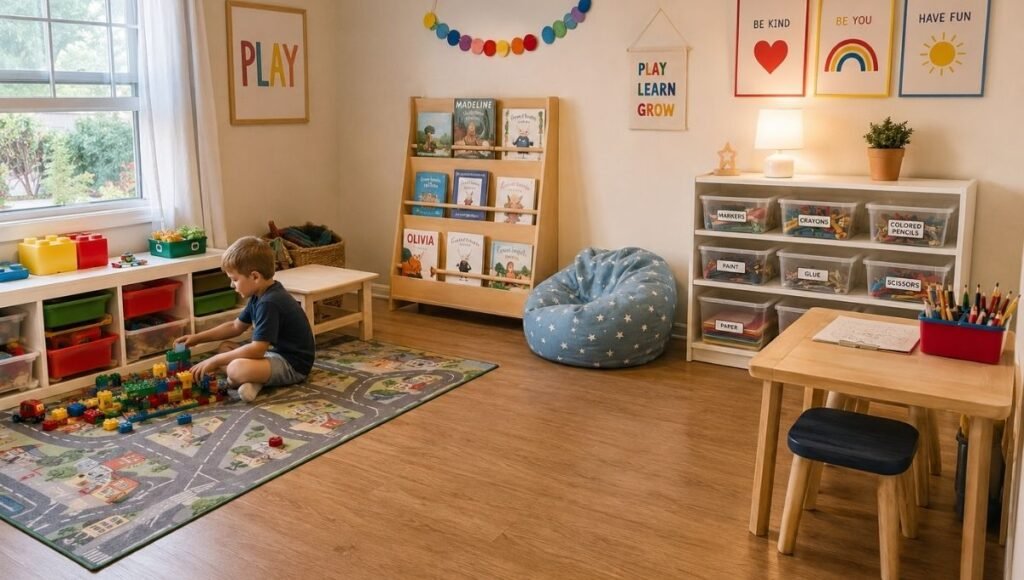
There’s a specific kind of defeat that comes with a playroom. You set it up carefully — organized bins, labeled shelves, a reading corner, everything in its place. You feel genuinely good about it. Then your children use it for approximately 45 minutes, and it looks like a toy store after an earthquake.
The toys are everywhere. The bins are overturned. The puzzle pieces are mixed with the Lego pieces. The books are on the floor. The art supplies have migrated to the couch. You stand in the doorway and wonder how this happened so quickly, and whether any organizational system could possibly survive actual children.
Here’s what most playroom guides miss: a playroom that children can destroy in 45 minutes and reset to chaos within a week isn’t organized — it’s tidied. The difference matters. A truly functional playroom is designed around how children actually play and clean up, not how it looks in the setup photos. It’s one where the organized state is easy to return to because the system is designed for the people who are supposed to maintain it — including the 4-year-old and the 7-year-old.
This guide covers kids playroom ideas for every space size, how to organize a playroom by activity zone, age-specific storage systems, and the cleanup habits that actually work when children are involved.
Key Takeaways
- Research from the University of Toledo found that children with fewer, more accessible toys demonstrate longer attention spans and more creative, engaged play — a decluttered playroom actively benefits child development, not just aesthetics.
- A 2023 study in Child Development found that organized, clearly defined play spaces increase children’s independent play duration and reduce the frequency of parent intervention needed to manage play transitions.
- When a playroom is messy and difficult to navigate, it’s hard for children to visualize play opportunities — disorganization directly reduces creative play quality.
- The most effective playroom storage is designed for the child’s ability to use it independently: open bins, low shelves, labeled categories, and clear visual organization that children can navigate without adult help.
- A playroom that children can clean up themselves in 10 minutes is a functional playroom. One that requires 45 minutes of parental effort to reset is a storage problem, not a habit problem.
Before You Design: The Playroom Audit
Children actually enjoy their playroom more and use it more frequently when there are fewer toys in it. When you pare down items to the toys that are actually loved and played with often, they become easier to find — children don’t have to search through “meh” toys to find the ones they want.
Before designing any playroom system, the toy audit determines what the system actually needs to hold.
The playroom audit process:
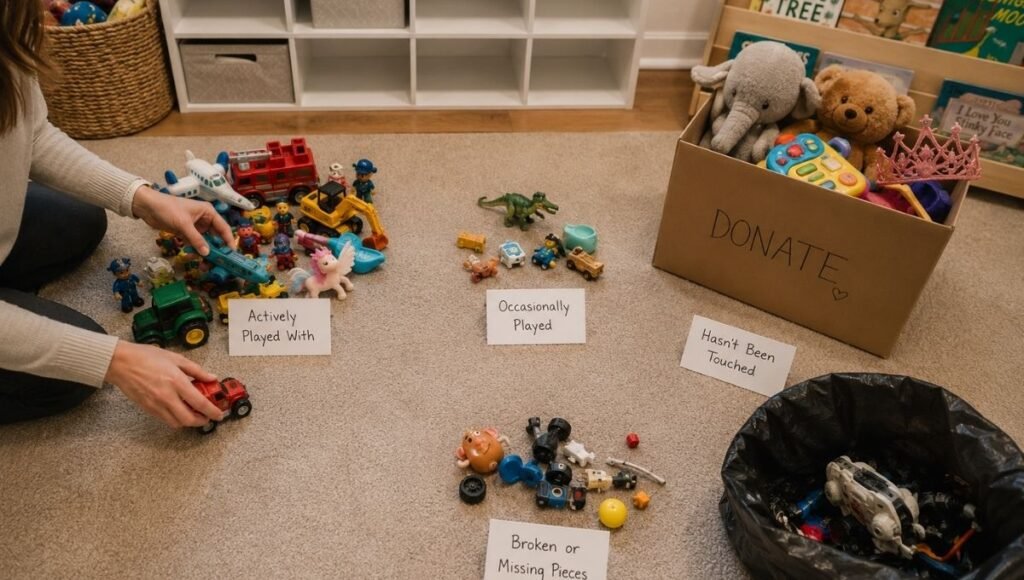
Pull every toy from every location in the room. Sort into four groups: actively played with in the past month, occasionally played with, haven’t been touched in three months or more, and broken or missing pieces. The third and fourth categories leave the room immediately — donate, discard, or move to a separate rotation bin.
The rotation principle: Items that are loved but not needed simultaneously go into rotation storage — a bin in a closet, under a bed, or in another storage location. A toy rotation system, where some toys are put away and others stay out with periodic switching, keeps children stimulated and makes toys feel new and exciting when they return — which further promotes independent play.
The age-appropriateness check: Children’s interests and developmental stages change rapidly. Toys appropriate for a 3-year-old may be frustrating or boring for a 5-year-old and create clutter rather than play value. Part of the audit is honestly assessing what still matches where your child is developmentally.
Editor’s note: The audit is where most of the real space is recovered. In almost every playroom I’ve seen reorganized properly, the storage solution wasn’t the problem — the volume was. After a proper audit, the system choices become obvious.
Kids Playroom Ideas: The Activity Zone System
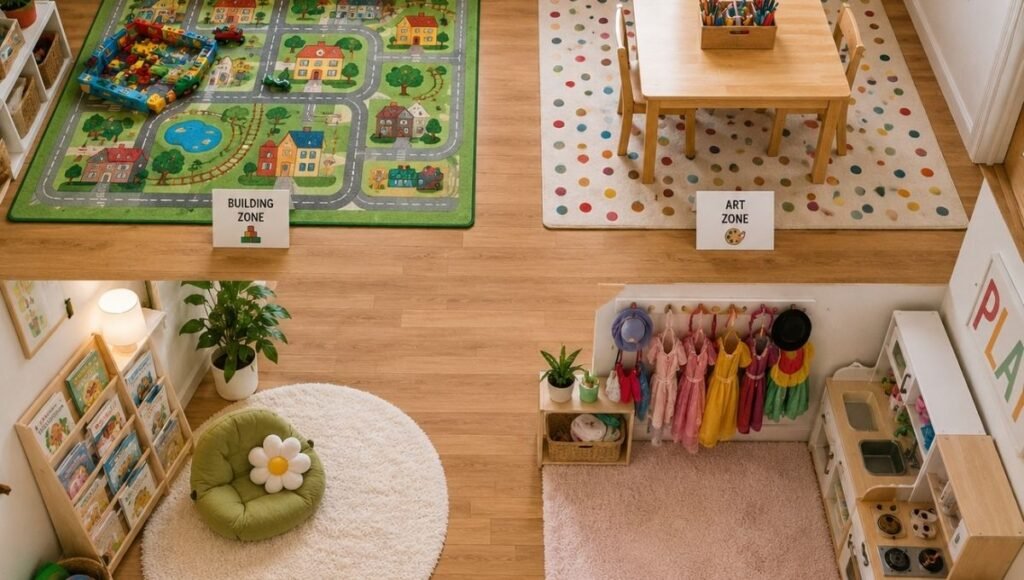
The most functional playrooms are organized by activity, not by toy category. Taking clues from a child’s classroom and creating stations for each type of activity — a reading nook, an area for arts and crafts, stations for special interests like building or dress-up — means that by storing categories together, kids are more likely to get into the habit of cleaning up as they go.
The zone system works because it matches how children actually play: they engage in one type of activity at a time, and when a zone is clearly defined, cleanup becomes returning things to one area rather than sorting through a mixed pile.
The Building and Construction Zone
Blocks, Lego, Magna-Tiles, train sets, and building toys need a flat surface for building and contained storage for pieces. This zone benefits most from low open bins — pieces need to be visible and immediately accessible when inspiration strikes, and contained when not in use.
Storage that works: Low open bins at floor level for blocks and large building pieces. Shallow trays or sectioned containers for Lego by color or type (for older children). A dedicated building surface — a low table or a section of floor with a defined boundary like a play mat.
The Lego-specific solution: Organizing Lego pieces by color works exceptionally well for children — it mirrors what the Lego Store does and makes finding specific pieces significantly easier than sorting by set or mixed storage.
The Creative and Art Zone
Art supplies need their own dedicated area, ideally near a table surface and away from upholstered furniture. This zone also benefits from being slightly contained — art supplies that spread through the entire room are the most consistent playroom chaos driver.
Storage that works: A tabletop art caddy or a section of low shelving holds supplies at child height. Clear containers so children can see what’s inside without opening everything. An over-door organizer on a nearby door or closet can hold individual supplies in separate pockets. A low shelf section specifically for paper, coloring books, and flat art materials.
The contained art supply principle: Every art supply lives in the art zone and returns to it after use. This zone can be slightly more adult-maintained than others — art supplies have the most cross-contamination potential when they migrate.
The Reading Nook
A defined reading area — even just a small rug with a bookshelf and cushion — creates a dedicated space for quiet independent reading that functions differently from the active play zones.
Storage that works: A forward-facing bookshelf at child height where book covers are visible (not spines) works best for younger children who select books by cover. A standard spine-out bookshelf works for children who can read titles. The bookshelf should hold only books actively being read or read regularly — seasonal and occasional books rotate out.
Why the nook matters: A physically defined reading space signals to children that this is where reading happens, distinct from where active play happens. Even a simple corner with a beanbag and a small bookshelf creates this signal.
The Pretend Play Zone
Dress-up clothes, play kitchen, doctor kits, construction tools, dollhouses — pretend play items benefit from grouped storage that enables immersive play. When all the kitchen supplies are in one accessible area, children can set up and sustain pretend play independently.
Storage that works: Open bins grouped by play scenario (all kitchen items together, all dress-up accessories together). Hooks at child height for dress-up clothes. A designated shelf section or cart for play kitchen supplies.
Playroom Storage Ideas: The Right Storage for Every Toy Type
Open Bins vs. Lidded Bins
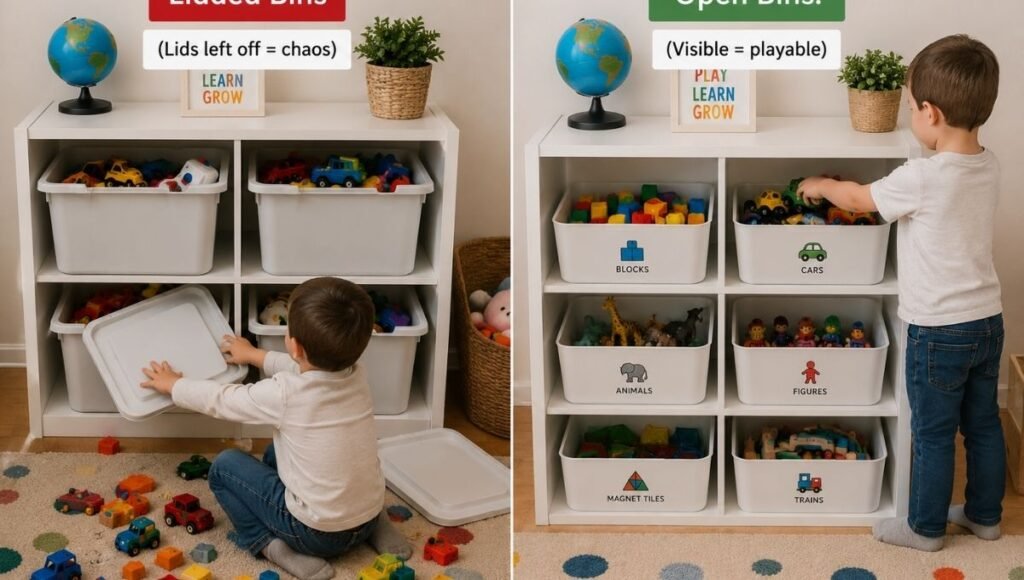
Open bins eliminate the struggle with lids and are great for blocks, toy cars, small gadgets, and stuffed animals. Being sure to place bins full of favorites on easy-to-reach shelves and labeling containers helps make it easy to find and put toys away.
The rule: open bins for most toys, lidded bins only for items that shouldn’t mix freely (puzzle pieces, game components, sets with many small pieces that need to stay together).
A child who has to remove a lid to access a bin will often leave the lid off permanently or simply not use the bin. Open bins have a lower compliance barrier — and compliance is what makes any playroom system actually work.
The IKEA Trofast System
The IKEA Trofast unit is a great option for kids — the drawers are not too big and you can have a place for everything. Even toddlers can learn that a row of three drawers holds all of the building sets, another has cars and trucks, one has musical instruments. The system grows with children and the bins can be repurposed throughout the home when children age out of the playroom.
The Trofast works because it puts everything at a consistent accessible height, creates visual categories through bin color and labeling, and is robust enough to handle daily child use.
Cube Organizers
A cube organizer — the kind with 12″ or 13″ cubes — is the most versatile playroom storage option because it works with both fabric bins (for hidden storage) and open fronts (for visible access), can be repositioned as the room’s needs change, and holds a wide variety of toy sizes.
The cube organizer rule: Lower cubes hold the most-used toys in open access. Upper cubes hold less-used items, art supplies, or items in fabric bins that can be out of sight.
Labeling for Children
Labels make the cleanup system work without adult direction — children can return items to their correct location independently if the location is clearly marked.
For pre-readers: Photo labels — an actual photo of the toys that live in that bin printed and taped to the front. A photograph of the Lego is more useful than the word “Lego” for a 3-year-old.
For early readers: Word labels, written clearly, at child eye level.
For older children: Category labels or even child-designed labels — children who helped create the labeling system are significantly more likely to follow it.
How to Organize a Playroom by Age
Playroom Organization for Ages 0-3
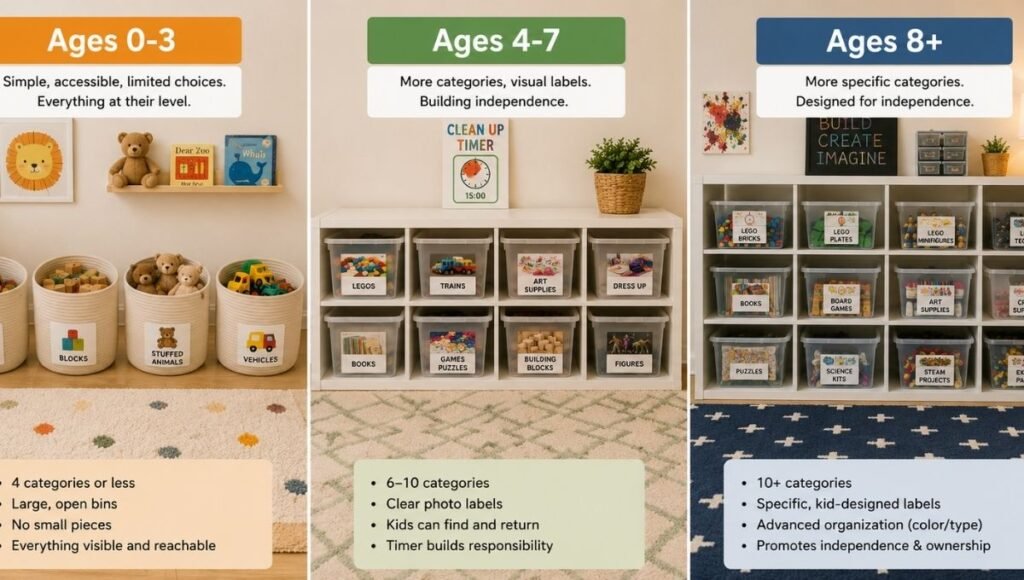
Young toddlers need the simplest possible systems: low shelves at floor level, large open containers, very few categories (4-6 toy types maximum), and nothing requiring fine motor skills to open or close.
At this age, the cleanup system is primarily parent-maintained — the goal is making cleanup fast and easy for the adult, while gradually teaching the concept. Toy rotation is especially valuable here because young children don’t distinguish between “new” and “returned from storage” toys.
Storage priorities: Safety first (no sharp edges, no small pieces accessible, no tipping-risk storage). Simplicity second (3-4 large open bins, toys visible from standing or sitting height).
Playroom Organization for Ages 4-7
This is the age range where the child can genuinely participate in and eventually lead cleanup — with the right system in place. Children in this range understand categories, can follow labeled systems, and can complete a 10-minute cleanup with guidance and eventually independently.
Storage priorities: Clear visual categories with photo or simple word labels. Bins sized to hold a single category without overflow. A defined cleanup routine (cleanup happens before a transition, not as a punishment or afterthought).
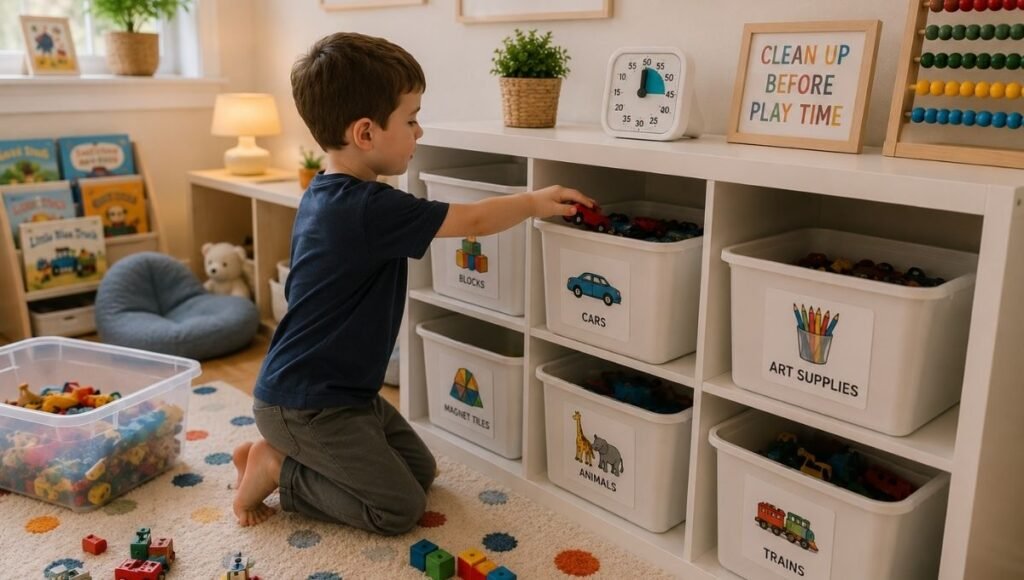
The cleanup routine: At this age, the most effective cleanup approach is a specific signal (a timer, a song, a verbal cue) followed by a structured sequence: everything off the floor first, then return to bins by category, then check each zone. Parents work alongside at first, then gradually step back as the sequence becomes familiar.
Playroom Organization for Ages 8+
Older children can manage more sophisticated storage systems and begin to have genuine ownership over their play space design. Involving them in the organization decisions — which bins go where, how categories are defined, what the labels say — dramatically increases their investment in maintaining the system.
Storage priorities: Child-designed systems that reflect their actual play habits. More nuanced categories that match their more specific interests. Increasingly responsibility-based maintenance, moving toward full independent management.
Playroom Ideas for Small Spaces and Shared Rooms
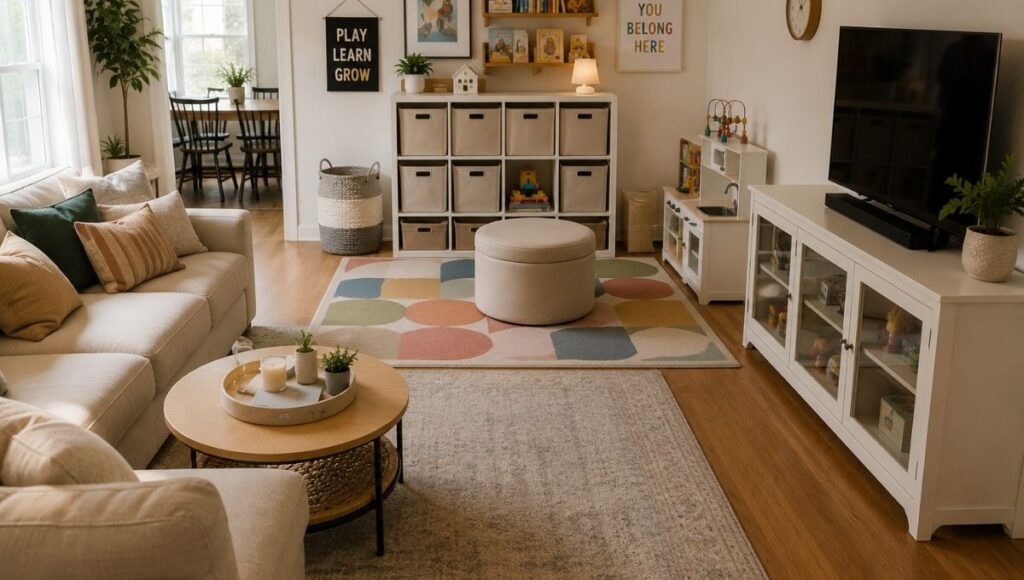
Not every household has a dedicated playroom. Many children’s play areas share space with a living room, a bedroom, or a multipurpose family space. The organizational principles are identical, but the physical implementation requires more intentional boundary-setting.
The defined play zone: Even in a shared space, a physical boundary — a rug, a specific corner, a section defined by furniture placement — creates a psychological and functional play area. Toys live within the boundary; when they migrate outside it, they return before the next play session.
Furniture that does double duty: Storage ottomans, coffee tables with lift-top storage, and media consoles with closed cabinet storage keep toys accessible but visually contained in shared spaces. When toys are out of sight, the shared space functions as a living room; when the storage is opened, it becomes a play area.
The one-basket rule for shared spaces: Each category of toy in a shared space gets one container. When the container is full, it’s full — something must leave before something new can stay. This naturally limits the volume in shared living spaces without requiring ongoing active curation.
How to Organize a Playroom: Making Cleanup Work
The most beautiful playroom system fails if children don’t use it. Cleanup compliance isn’t primarily a habit problem — it’s a system design problem.
The three principles of child-maintainable cleanup:
Everything has one obvious home. A child should never need to make a decision about where something goes. If the answer requires more than a second of thought, the system isn’t clear enough. One bin for cars. One bin for blocks. One hook for dress-up. The home is physically obvious, visually labeled, and consistent.
The system requires less effort than the alternative. If putting a toy away is harder than leaving it on the floor, it will stay on the floor. The bin needs to be within reach, open without a lid, and in the same general area where the toy is played with. Storage that requires crossing the room is storage that won’t get used.
Cleanup is a routine, not a response to mess. Cleanup that happens at a consistent time — before dinner, before screen time, before bedtime — becomes automatic faster than cleanup that happens reactively when things get out of hand. A consistent cue followed by a consistent sequence, repeated daily, becomes a habit within 2-3 weeks for most children.
If You Only Have 10 Minutes Right Now
10 minutes: Do the broken and unusable toy sweep. Walk through the playroom and remove everything broken, missing pieces, or clearly no longer played with. Just those categories, no decisions about things that are fine. In most playrooms this sweep removes 15-20 items and creates visible space immediately.
20 minutes: Pick the most chaotic category — the toys most often scattered — and give them a clearly designated, clearly labeled home at accessible height. One category, one bin, one label, in the right location. See if it gets used.
30 minutes: Define the activity zones with the toys currently in the room. Even using masking tape on the floor or moving furniture slightly to create a visual boundary creates the zone framework that everything else builds on.
FAQ: Kids Playroom Ideas
How do I organize a playroom when toys are everywhere? Start with the audit — remove broken, unused, and age-inappropriate items first. Then sort what remains by activity type (building, art, pretend play, reading). Assign each category a low, open, accessible bin with a visual label. Define physical zones in the room for each activity. The organization system only needs to hold what should actually be in the room.
What is the best storage for a kids’ playroom? Low open bins at child height for most toys — they’re accessible without adult help, no lid to wrestle with, and visually clear. The IKEA Trofast system works exceptionally well for younger children. Cube organizers with a mix of open fronts and fabric bins work well for mixed-age households. The consistent principle: whatever children can use independently is better than whatever looks best.
How do I get kids to clean up the playroom? Design the system so cleanup requires less effort than leaving things out. One obvious home for every item, at accessible height, in the zone where it’s played with. Establish a consistent cleanup signal and routine — same time, same sequence, every day. Participate alongside young children rather than directing from a distance. Children who helped design the system are significantly more likely to maintain it.
How do I organize a playroom in a small space? Define a physical boundary for the play zone even within a shared space. Use storage that does double duty (ottomans, closed cabinets, storage coffee tables). Apply the one-container-per-category rule strictly. Use vertical wall storage — low wall-mounted shelves, over-door organizers — to keep floor space for actual play. Toy rotation is essential in small spaces — only current toys are out.
How often should I declutter the playroom? Before Christmas and around the time school lets out works well — twice yearly for most families. When children were younger, three to four times per year. Whenever things start building up and feeling cluttered, that’s the signal it’s time for a good clean-out. A pre-holiday sweep is especially effective because incoming gifts replace outgoing items rather than simply adding to the existing volume.
Design the Room for How They Actually Play
The playroom you want isn’t the one in the setup photos — it’s the one your children actually use, that you can reset in 10 minutes when it inevitably gets messy, and that functions for the entire household without requiring constant adult maintenance.
Start with fewer toys. Define the zones. Label the bins at child height. Establish the cleanup routine. Everything else — the matching furniture, the coordinated colors, the aesthetics — is secondary to whether the system works for the people who live with it every day.
Explore more on Vomoxs:
- Toy Storage Ideas: How to Organize Toys So the Playroom Stays Tidy
- Bedroom Organization Ideas: How to Organize Your Bedroom for Good
- Home Organization Ideas: The Complete Room-by-Room Guide
References
- Dauch, C., Imwalle, M., Ocasio, B., & Metz, A. E. (2018). The influence of the number of toys in the environment on toddlers’ play. Infant and Child Development, 27(1), e2038. University of Toledo research on toy quantity and play quality.
- Lillard, A. S., et al. (2023). The impact of pretend play on children’s development. Child Development, 94(2), 341–358. Research on organized play environments and independent play duration.
- Saxbe, D. E., & Repetti, R. (2010). No Place Like Home: Home Tours Correlate With Daily Patterns of Mood and Cortisol. Personality and Social Psychology Bulletin, 36(1), 71–81.
Category: Room Organization | Reading time: 11 min | Last updated: 2026