
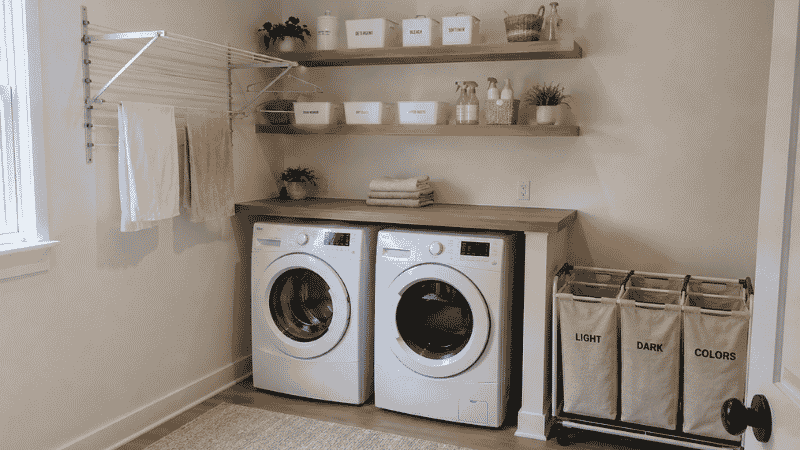
The laundry room is the most used and least loved room in most homes. You’re in there every day — sometimes twice — but it’s the last place that gets any organizational attention. Detergent bottles crowd the top of the machine. The sorting situation is three different piles on the floor with no labels and no logic. The folding surface doesn’t exist, so folded clothes live in a basket until someone needs something from the bottom and the whole pile collapses.
Meanwhile, laundry is never actually done. By the time you finish one load, two more have materialized from somewhere. If you have kids, multiply that feeling by whatever number of children you have.
Here’s what’s actually happening: the laundry room is disorganized not because it’s small or because there isn’t enough storage, but because it was never set up to support the full laundry workflow — sorting, washing, drying, folding, and putting away. When the space isn’t built around that sequence, every step creates friction. And friction, repeated daily across every load, adds up to a room you genuinely dread walking into.
This guide sets up your laundry room around the workflow. It works in a dedicated laundry room, a laundry closet, or a washer/dryer tucked in a corner of another room.
Key Takeaways
- The laundry room is used more frequently than almost any other room in the house — the average household does 8–10 loads of laundry per week, meaning laundry room friction compounds daily.
- The zone system — organizing the laundry room around the sequence of the laundry workflow rather than by product type — reduces time spent on each load and prevents the accumulation of mid-process clutter.
- The space between the washer and dryer, and the wall above them, are the two most consistently underused storage zones in any laundry room.
- A folding surface isn’t a luxury — it’s the organizational tool that prevents “clean laundry pile” syndrome, where folded clothes sit in a basket for days before being put away.
- Small laundry rooms and laundry closets can be fully functional with vertical storage, over-door organizers, and slim rolling carts — no renovation required.
Step 1: Map the Laundry Workflow Before Touching Anything
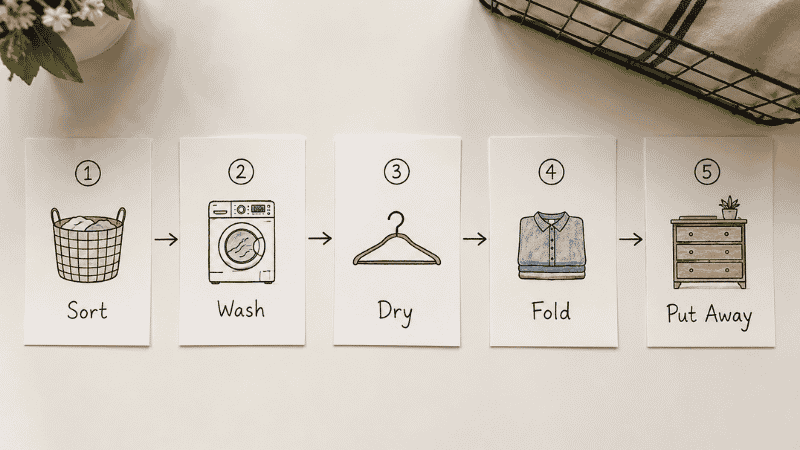
This is the step that makes everything else logical. The laundry room needs to support five distinct tasks — and the space should be organized around all five, in sequence.
The five laundry workflow stages:
Stage 1: Sorting — dirty clothes arrive and get divided by color, temperature, or family member. Where does this happen currently? Where should it happen? The sorting zone needs hampers or bags, ideally labeled or color-coded, positioned where dirty laundry naturally arrives (near the machines, or near the door the laundry comes through).
Stage 2: Washing — detergent, stain removers, and washing supplies need to be within arm’s reach of the machine, not across the room. This is the most obvious zone and usually the best-stocked one.
Stage 3: Drying — the dryer itself, plus air-drying space for delicates. Air-drying is the most neglected part of laundry room design — most rooms have no dedicated drying space, so delicates end up draped over chairs, doorknobs, and shower rods around the house.
Stage 4: Folding — this is where most laundry systems break down completely. Without a folding surface in or near the laundry room, clean laundry goes from the dryer to a basket and stays there. Creating even a small dedicated folding surface changes the entire flow.
Stage 5: Putting away — hangers, ironing supplies, and the path back to the rooms where clothes live. Often the longest step in the workflow, and the one most laundry rooms offer zero support for.
Walk through your current laundry space with these five stages in mind. Where does each stage happen? Where does it break down? The answer tells you exactly what your laundry room is missing.
How to Organize a Laundry Room: The Zone System
Once the workflow is mapped, assign each zone a physical location in the space. The goal is that each stage of laundry flows naturally into the next, with everything needed for that stage within arm’s reach.
Zone 1: The Sorting Zone
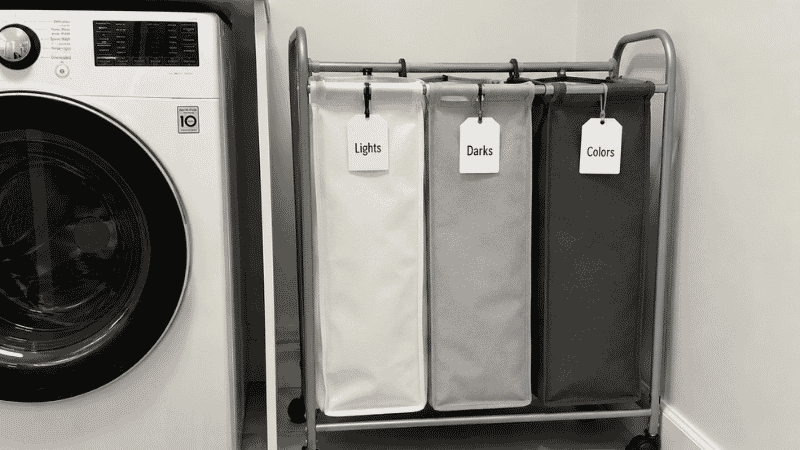
The sorting zone needs to be near the entrance — wherever dirty laundry arrives. Options by space available:
For a dedicated laundry room: A three-compartment laundry sorter (lights, darks, colors — or whatever sorting logic your household uses) on wheels so it can be repositioned as needed. The labeled compartments eliminate the “pile on the floor” system and make it immediately clear what’s ready to wash.
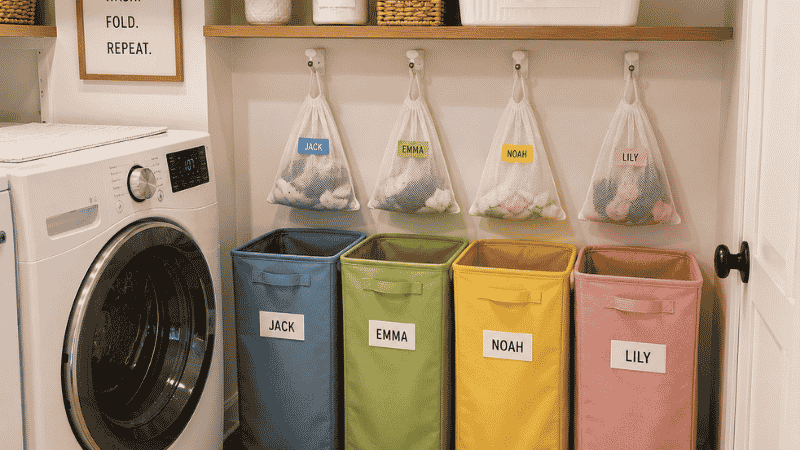
For a laundry closet: Hanging laundry bags on hooks inside the closet door — one per category. They fold flat when empty, take up no floor space, and can hold a full load per bag.
For a closet without door space: Two or three slim fabric bins stacked vertically in a tower unit beside the machine.
The labeling question: In single-person or couple households, sorting is intuitive. In family households with kids, labels become genuinely useful — especially if kids are old enough to sort their own laundry. A simple “lights / darks / colors” label on each compartment turns sorting into something a 7-year-old can do independently.
Zone 2: The Washing Supply Zone
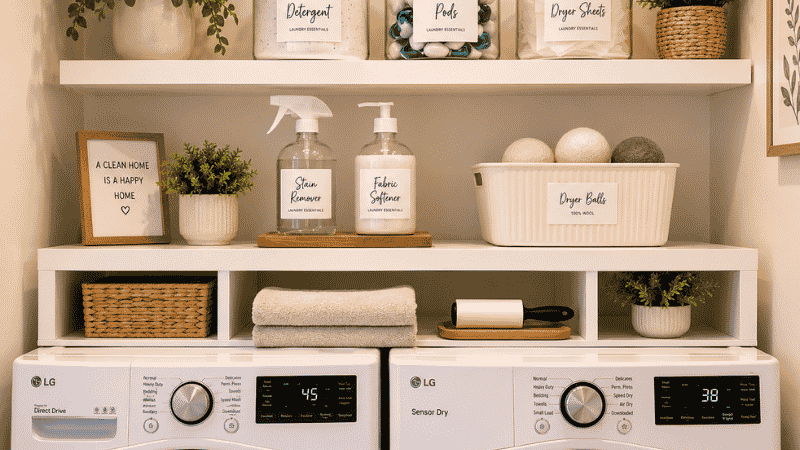
This zone is usually the most developed in most laundry rooms and the easiest to improve. Everything used in the washing process — detergent, fabric softener, stain remover, bleach, dryer sheets or wool balls — should live within arm’s reach of the machine.
Above the machines: Floating shelves or a shelf unit installed above the washer and dryer is the highest-impact addition to any laundry room without existing upper storage. One shelf for active supplies (the current detergent, the current stain remover), one shelf for backstock.
On the machines: A slim over-machine shelf unit that bridges the washer and dryer, sitting on top of both, creates a surface for supplies and often a small folding area simultaneously.
Decanting supplies: Decanting powdered detergent and laundry pods into clear labeled canisters isn’t just aesthetic — it prevents the half-open bag that spills, lets you see at a glance when you’re running low, and keeps the shelf looking intentional. One canister per product type. Tape the washing instructions from the original packaging to the back of the canister.
Zone 3: The Drying Zone
The dryer handles most drying, but a dedicated air-drying spot prevents delicates from ending up draped around the rest of the house.
Wall-mounted folding drying rack: The highest-impact addition for air-drying. Mounts flat to the wall, unfolds to hold 5–8 items, folds back completely flat when not in use. Takes up essentially zero space when stored. Position it near the door — delicates go there immediately coming out of the wash, dry while you continue laundry, and are ready to put away without moving through the rest of the house.
Retractable clothesline: For longer items — dress shirts, pants, delicate dresses — a retractable clothesline mounted between two walls extends across the laundry room when needed and retracts flush against the wall when not. Holds significantly more than a drying rack and works especially well in laundry rooms with parallel walls.
Over-door drying hooks: For a laundry closet, hooks on the inside of the door hold items that need to air dry without taking up any floor or wall space.
Zone 4: The Folding Zone
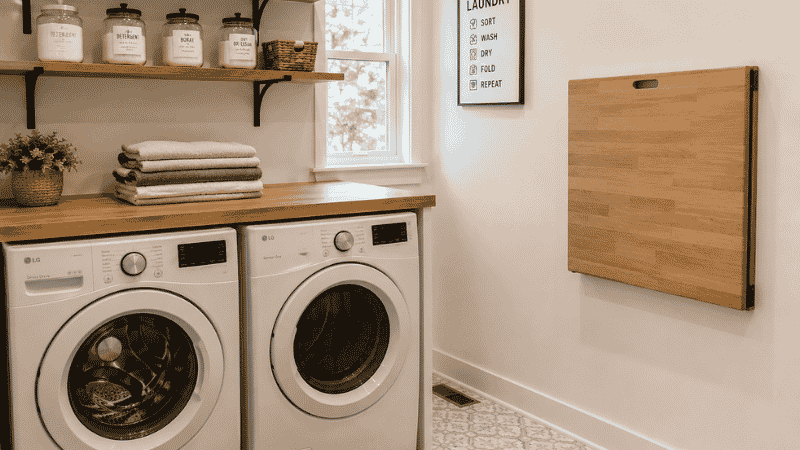
This is the zone most laundry rooms lack entirely — and its absence is responsible for most “laundry in a basket” situations.
Counter above front-loaders: Front-loading machines with a counter or butcher block installed above them create a built-in folding surface. This is the most space-efficient folding solution available and works without any additional floor space.
Pull-out folding shelf: For laundry closets, a pull-out shelf that slides out from between or below the machines creates a folding surface that retracts completely when not in use. Many are designed to hold 30–50 lbs and extend 18–24 inches — enough surface for folding a full load.
Wall-mounted folding table: A wall-mounted table that folds down flat against the wall when not in use creates a dedicated folding surface in any room without permanently occupying floor space. Fold one load, put it directly into baskets or onto hangers, fold the table back up.
Editor’s note: The folding surface is the single change that has the highest impact on ending the “basket pile” problem. When folding happens in the laundry room immediately after the dryer finishes, clean laundry doesn’t accumulate anywhere. It’s a behavioral change supported by a physical one.
Zone 5: The Putting-Away Zone
The putting-away zone is usually invisible in laundry room design — but small additions make the final step significantly faster.
A hanger bar: A rod mounted above the machines (or on the wall) where shirts come out of the dryer and immediately go on hangers holds 8–12 items ready to be carried directly to closets. Eliminates the folding-and-then-rehanging step entirely for items that live on hangers.
A lint roller and spot treatment station: A small hook or holder with a lint roller and a stain pen — items used at the putting-away stage — prevents the “I’ll deal with this later” items from circling back into the laundry pile.
A “return” basket per person or room: A basket per household member (or per bedroom) that clean, folded laundry goes into directly from the folding surface. Each person picks up their basket and puts their laundry away. This eliminates the “who does this belong to” sorting step at the end and works especially well in family households.
Laundry Room Storage Ideas for Small Spaces
Small laundry rooms and laundry closets require a different approach — not just “the same ideas but smaller,” but a genuine vertical-first mindset where every wall surface does real work.
How to Organize a Small Laundry Room Without Renovation
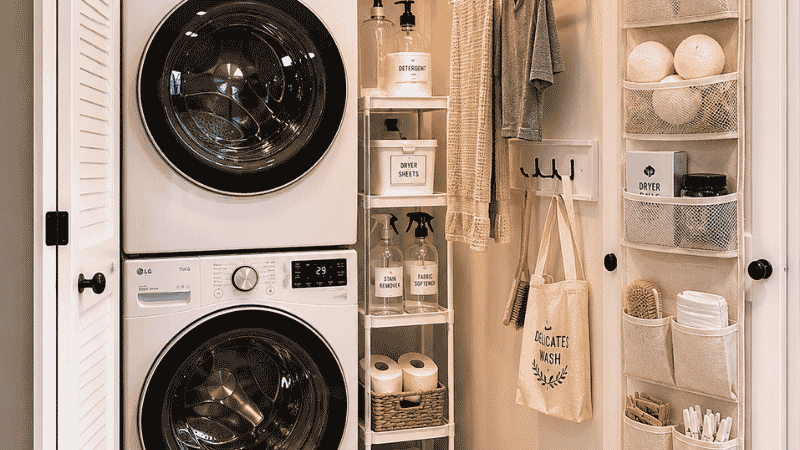
The wall above the machines is almost always underused. A single floating shelf above the washer and dryer adds meaningful storage without touching the floor plan. Two shelves, spaced 10–12 inches apart, creates a full supply station above the machines in 24 inches of vertical space.
The gap between the washer and dryer (or between the dryer and wall) is always wasted. A slim rolling cart sized to fit in that gap — typically 6–10 inches wide — holds detergent, fabric softener, dryer sheets, and other supplies in a space that currently collects lint and lost socks. The cart rolls out for access and rolls back in when not needed.
The back of the door holds more than you’d expect. An over-door organizer with pockets holds a full supply of laundry essentials — dryer sheets, stain remover sticks, wool dryer balls, small accessories — in a space that currently holds nothing. For a laundry closet, this is often the highest-capacity storage upgrade available.
Magnetic strips for small metal items. Safety pins, small scissors for loose threads, needle and thread for quick repairs — a magnetic strip on the wall or inside a cabinet door keeps these small items visible, accessible, and not lost in a drawer.
Laundry Room Organization for Families With Kids
Family laundry has specific challenges that single-household advice doesn’t address: the volume is 3–5x higher, sorting involves multiple people’s clothes, and the putting-away step requires getting things to multiple different rooms.
The sorting system has to be self-explanatory. Color-coded hampers (one per child, in their room or in the laundry room) eliminate the “whose shirt is this” question at every step. When each person’s laundry lives in their own designated hamper from dirty to clean, sorting and returning becomes a one-step process.
Lost sock solution: A small mesh bag per family member — safety-pinned or hung near their hamper — holds socks that need to be matched. Socks go into the mesh bag through the wash and come out together. The matching step happens at the bag level, not by sorting through a pile of 40 socks.
The “needs attention” station: A small bin or hook labeled for items that need repair, rewashing, or special treatment — the shirt with a stain that needs pre-treating, the sweater that needs hand washing, the pants that need a button reattached. Without a designated spot for these items, they circulate through the laundry cycle repeatedly without the issue ever being addressed.
Why Your Laundry Room Organization Keeps Failing
If you’ve organized the laundry room before and it reverted quickly, it’s almost certainly one of these:
The workflow wasn’t supported. An organized laundry room with supplies in pretty containers but no folding surface and no sorting system is still a laundry room that creates friction. The organization needs to support the full workflow, not just look tidy.
The space is overstocked. Laundry rooms accumulate products — multiple detergents, three kinds of stain remover, fabric softener and dryer sheets and wool balls and dryer spray — many of which are partial containers or backups that are actually done. A ruthless audit of what’s actually being used (one detergent, one fabric softener, one stain treatment) reduces the storage need significantly.
There’s no reset habit. The laundry room gets messy between laundry days: empty containers left on the shelf, items pulled out and not returned, the occasional non-laundry item that migrates in. A 3-minute reset at the end of laundry day — products back in place, empty containers recycled, surfaces cleared — prevents the gradual accumulation that compounds over weeks.
If You Only Have 10 Minutes Right Now
10 minutes: Clear the top of the machines completely. Return all products to their designated shelf or bin. Throw away empty containers. Wipe down the surface. A clear machine top immediately makes the laundry room feel more functional — and it’s the surface you interact with most during every load.
20 minutes: Set up a sorting system. Even three labeled bags hung on hooks is a complete sorting system. Once dirty laundry has designated compartments, the “pile on the floor” situation resolves immediately.
30 minutes: Install one wall shelf above the machines (if not already there) and move all supplies to it. Measure first, buy a bracket shelf that fits the width, install it at a comfortable reach height. This single addition adds functional storage without changing the floor plan.
FAQ: How to Organize a Laundry Room
How do I organize a laundry room from scratch? Start by mapping the five workflow stages: sorting, washing, drying, folding, and putting away. Then assign each stage a physical location in the space — a sorting area near the entrance, supplies within arm’s reach of the machine, a drying rack for delicates, a folding surface, and a hanger bar or per-person baskets for putting away. This sequence ensures the organization supports how the room is actually used, not just how it looks.
What is the most important laundry room storage idea? A dedicated folding surface. Without it, clean laundry goes from the dryer to a basket and stays there indefinitely. Even a small pull-out shelf, a counter above front-loaders, or a wall-mounted folding table changes the entire workflow — folding happens immediately, clean laundry doesn’t accumulate, and the “laundry in a basket” problem disappears.
How do I organize a small laundry room with no storage? Prioritize vertical storage: floating shelves above the machines for supplies, a wall-mounted folding drying rack for delicates, an over-door organizer for small items, and a slim rolling cart for the gap between the machines or wall. These four additions create a complete supply and drying station without adding to the floor footprint.
How do I organize laundry for a family with kids? Use color-coded hampers — one per child — so each person’s laundry stays separate from sorting through putting away. Small mesh bags per person solve the lost sock problem. A “needs attention” station (a bin or hook for items that require repair or special treatment) prevents the same problem items from cycling through the laundry indefinitely. Label everything at a height kids can read and reach independently.
What should be stored in the laundry room? Only items directly related to the laundry process: detergent, fabric softener, stain treatment, dryer sheets or wool balls, sorting hampers, hangers for air-drying, lint roller, and basic repair supplies. Non-laundry items — cleaning supplies, paper goods, general household overflow — take up premium space and should live elsewhere.
How do I keep a laundry room organized long term? A 3-minute reset at the end of laundry day keeps it functional: products back in place, empty containers discarded, surfaces cleared. A monthly supply audit prevents accumulation of partial containers and products that aren’t being used. The sorting system — once established — essentially maintains itself as long as it’s simple enough that everyone in the household actually uses it.
How do I create a folding station in a tiny laundry closet? A pull-out shelf that slides out from between or below the machines creates a folding surface that retracts completely when not in use. Alternatively, a wall-mounted folding table hinged to fold flat against the wall provides a full-size folding surface in zero permanent floor space. For the smallest closets, folding on top of the machines (especially front-loaders with a flat top) works with a simple anti-slip mat as a surface.
Start With the Zone That Breaks Down Most
You don’t have to redesign the entire laundry room at once. Look at the five workflow stages and identify which one causes the most friction in your specific space — where does laundry stall, where does clutter accumulate, where do you avoid going because it’s most chaotic?
Fix that zone first. Install the shelf, set up the sorter, create the folding surface. One zone working well is immediately noticeable in daily use. And once one stage flows, the next one becomes easier to address.
The laundry will never truly be done. But it doesn’t have to be dreaded.
Explore more on Vomoxs:
- How to Organize Kitchen Cabinets: A Step-by-Step Zone System
- Bedroom Organization Ideas: How to Organize Your Bedroom for Good
- How to Declutter Your Home: A Room-by-Room Guide
References
- American Cleaning Institute (2023). Laundry Habits in America Survey. Research on average household laundry frequency and load volume.
- Roster, C. A., Ferrari, J. R., & Jurkat, M. P. (2016). The dark side of home: Assessing possession ‘clutter’ on subjective wellbeing. Journal of Environmental Psychology, 46, 32–41.
- Saxbe, D. E., & Repetti, R. (2010). No Place Like Home: Home Tours Correlate With Daily Patterns of Mood and Cortisol. Personality and Social Psychology Bulletin, 36(1), 71–81.
Category: Room Organization | Reading time: 10 min | Last updated: 2026