
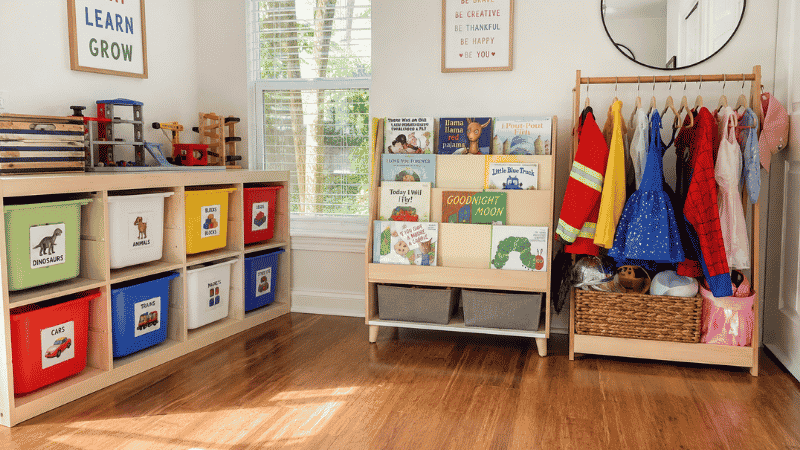
You spent Saturday afternoon organizing the playroom. Every toy in its bin, every bin labeled, the floor completely clear. It looked genuinely good. You took a photo.
By Monday evening, it looked exactly the way it did before Saturday. Bins overturned, Lego pieces distributed across a 6-foot radius, the dress-up clothes in a pile that somehow migrated to the living room. You stood in the doorway. You closed the door.
Here’s the thing about toy organization that most guides don’t say: the products aren’t the problem. Most parents have plenty of bins and baskets. The problem is the system — or the lack of one. When toys don’t have a logical home that makes sense to children, they don’t get put back. Not because kids are trying to make your life difficult, but because the system wasn’t designed for how they actually play and clean up.
This guide is about building a toy storage system that actually holds up past Monday. It works whether you have a dedicated playroom, a shared living space, or a small bedroom with too many toys for the space.
Key Takeaways
- Research from the journal Infant and Child Development found that children with fewer, more accessible toys engage in longer, higher-quality play — meaning a decluttered, well-organized toy space actively benefits development, not just aesthetics.
- The most common toy organization failure is buying storage containers before deciding on a category system — bins without assigned categories revert to mixed chaos within days.
- A rotation system — keeping only 30–40% of toys accessible at any time — reduces mess significantly, increases children’s engagement with the toys that are out, and eliminates the overwhelm that prevents kids from choosing what to play with.
- Toy storage that works long-term is designed around two users: the parent who sets it up and the child who has to maintain it independently.
- Labeled, categorized, low-to-the-ground storage is the difference between a system a child can maintain and one only adults can restore.
Before You Buy Anything: The Toy Audit
Every toy storage guide jumps straight to the products. This one starts with the audit — because no amount of bins will solve a toy volume problem.
The average child in a developed country owns approximately 238 toys. Research from the University of Toledo found that children with fewer toys demonstrate longer attention spans and more creative, engaged play. The audit isn’t about taking things away from your child — it’s about curating what’s accessible so they can actually find and enjoy what they have.
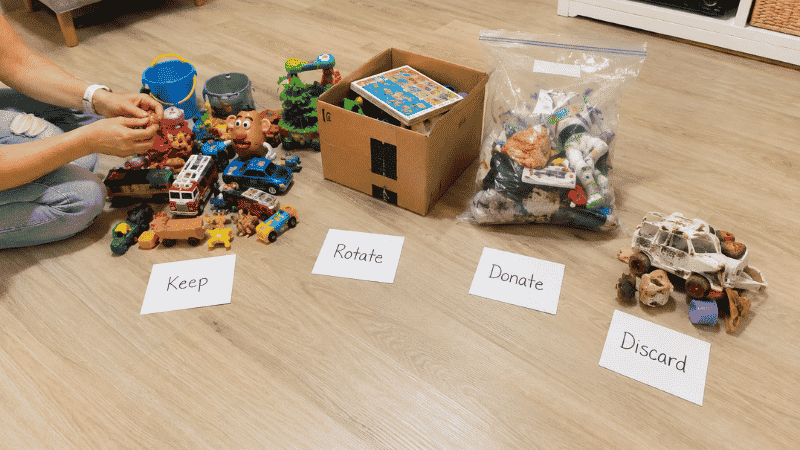
The four-pile toy sort:
Keep and display — toys actively played with in the last month, age-appropriate, complete with all pieces. These get organized in the main storage system.
Rotate — toys the child likes but doesn’t need access to daily. These go into rotation storage (a bin in a closet or under a bed) and swap with accessible toys every 4–6 weeks.
Donate or pass on — outgrown toys, duplicates, toys that never got played with. In good condition but no longer serving this child.
Discard — broken pieces, toys with missing parts that make them nonfunctional, items that have seen better days.
The hardest part of the audit: your child is probably attached to things they don’t actually play with. This is real and valid — objects carry meaning, especially for children. The rotation system is your best tool here. Instead of permanently removing something, rotate it out. If it comes back out after 6 weeks and goes unnoticed for another 6 weeks, that tells you something.
Editor’s note: Do the audit without your child if possible, especially for younger kids. For older children (5+), involving them in the decision-making builds autonomy and makes them more invested in the organizational system. There’s no universal right answer — know your kid.
Toy Organization Ideas: The Category System That Actually Works
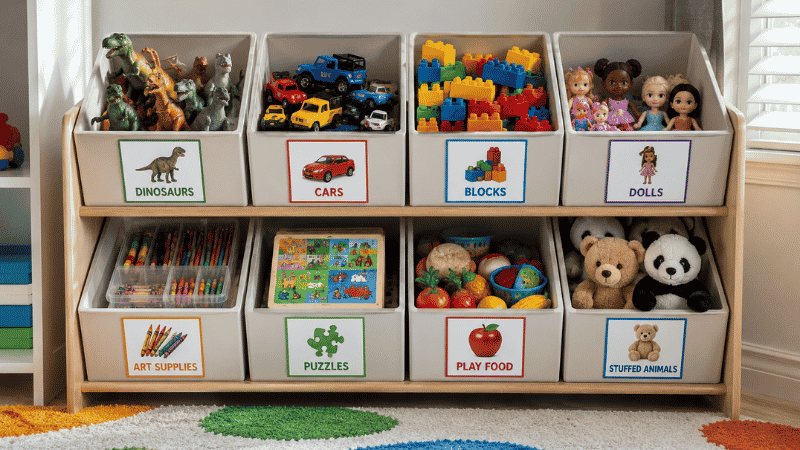
The category system is the foundation of every toy storage system that holds up. Before assigning bins or shelves, the categories have to be defined — and they have to make sense to the child who will use them.
Effective toy categories by play type:
Building and construction — Lego, Duplo, Magna-Tiles, blocks, linking toys. These need contained bins with lids or enclosed baskets because loose pieces are the primary floor hazard. Separate by brand or size if the child is old enough to sort that way.
Figures and characters — action figures, dolls, small animals, vehicles. These benefit from open-top bins sorted by character family or type — all dinosaurs together, all vehicles together. Clear or open bins work better than closed ones for this category because kids scan with their eyes to find the specific figure they want.
Pretend play — play kitchen food, doctor kit, tools, dress-up accessories. This category benefits from grouping by scenario: all “kitchen” items together, all “doctor” items together. When the setup matches how kids play, they can set up and clean up independently.
Arts and crafts — markers, crayons, paper, scissors, glue, stickers. This category needs to be either fully accessible or fully out of reach — half-accessible arts supplies are the fastest way to have markers on the carpet. A dedicated art supply organizer at child height with clear compartments works best.
Books — a separate category that benefits from a dedicated bookshelf at child height with forward-facing display for younger children (so covers are visible) or spine-out organization for older children who can read titles.
Puzzles and games — flat storage works best here. A dedicated slot system, vertical file storage, or puzzle rack keeps these from becoming a jumbled pile at the bottom of a bin.
Stuffed animals — the category that multiplies fastest and takes the most space relative to how often specific items are played with. A mesh hammock corner, a stuffed animal zoo cage, or a dedicated basket limits the physical volume and contains the spread.
Toy Storage Ideas by Space Type
Toy Storage Ideas for a Dedicated Playroom
A dedicated playroom has the most flexibility and the highest potential for a functional system. The organizing principles:
Low and accessible storage is non-negotiable for young children. If a child can’t reach the bin independently, they can’t put the toy back independently — which means every cleanup requires a parent. Storage at child height (floor to 36 inches for toddlers and preschoolers) is what enables independent cleanup, which is the whole point.
The IKEA Trofast system is consistently the most recommended modular toy storage for good reason: it’s low to the ground, the bins come in three sizes, they tilt forward for easy access, and the whole system is customizable. Assign each bin a category, add a photo label (for pre-readers) or word label (for early readers), and the system is self-explanatory to anyone who uses it.
Zone the playroom by play type. Building zone (rug, flat surface, building storage nearby). Pretend play zone (kitchen, doctor station, dress-up area). Reading zone (bookshelf, bean bag or soft seating). Art zone (table, art supply storage). When zones are physical and consistent, toys naturally return to their area because that’s where the play happens.
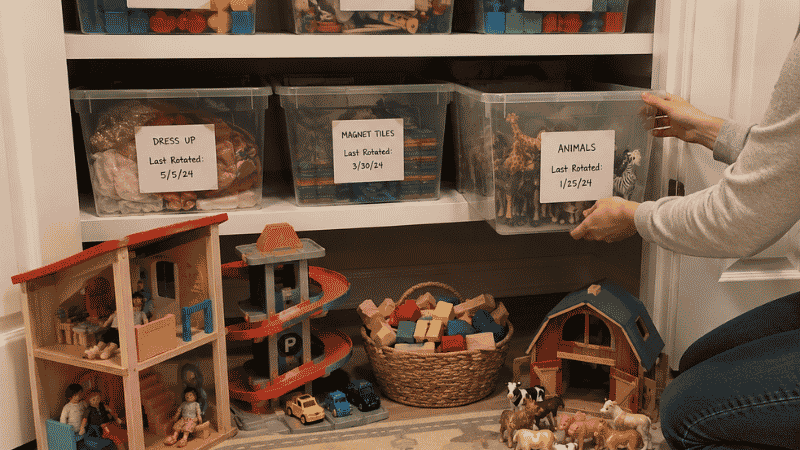
A toy rotation shelf or closet changes everything for playrooms with too many toys. Only 30–40% of toys are out at any time. The rest live in clearly labeled bins in a closet or under shelving, rotating every 4–6 weeks. Children engage more deeply with fewer options, and cleanup is dramatically easier when there’s less to put away.
Toy Storage Ideas for Living Rooms and Shared Spaces
When the playroom is also the living room, the storage system has to do double duty: keep toys accessible for children and aesthetically manageable for adults.
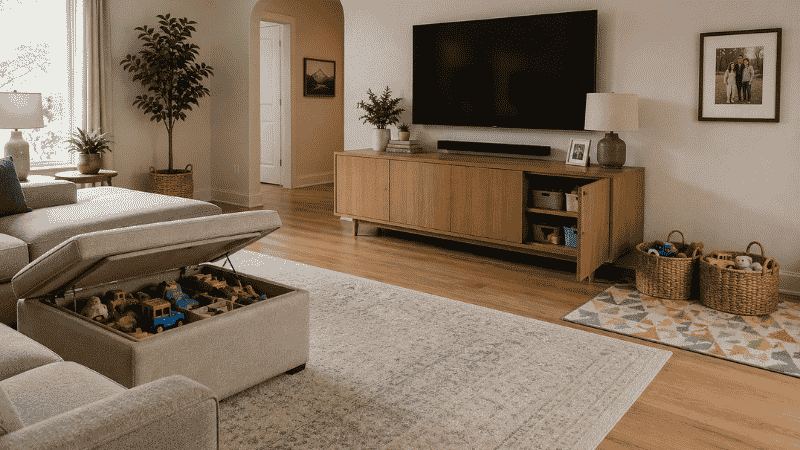
The hidden storage approach: Storage ottomans, baskets with lids, and TV consoles with closed cabinet doors keep toy storage invisible when not in use. The trade-off is that hidden storage requires children to open a container before they can access toys — which works for older children but often means younger children empty the entire container to find one item.
The designated toy corner: A single defined area of the living room designated as the toy zone — bounded by a rug, a bookshelf, or a corner placement — keeps toys contained to a specific area. The psychological boundary matters: toys stay in the toy corner, not spread across the whole room.
The “enough to fill one basket” rule: Each toy category in a shared living space gets exactly one basket or bin. When it’s full, it’s full — something has to come out before something new goes in. This naturally limits the volume without constant parental intervention.
Under-sofa storage for flat toys: Puzzles, activity books, and flat toys can live in shallow bins under the sofa — completely invisible, out of foot traffic, and surprisingly accessible for children who know where to look.
Playroom Organization Ideas for Small Spaces
Small bedrooms doing double duty as playrooms require vertical thinking and strict volume limits.
Wall-mounted storage maximizes floor space. A wall-mounted bookshelf at child height, pegboard with hooks and bins for art supplies, and mounted rails with baskets keep storage off the floor entirely — preserving the limited floor space for actual play.
A toy library system for small spaces. Keep only 3–4 toy categories in the room. Everything else lives in a storage bin elsewhere (closet, attic, garage, spare room). Each week, one category rotates in and one rotates out. The child always has variety, the room is never overwhelmed.
Vertical stuffed animal storage. A corner hammock or a stuffed animal cage that mounts vertically takes a fraction of the floor space of a basket or bin while holding significantly more. The vertical dimension is almost always underused in children’s rooms.
How to Organize Toys by Age
Different ages need fundamentally different storage approaches — the same system that works for a toddler will fail for a school-age child.
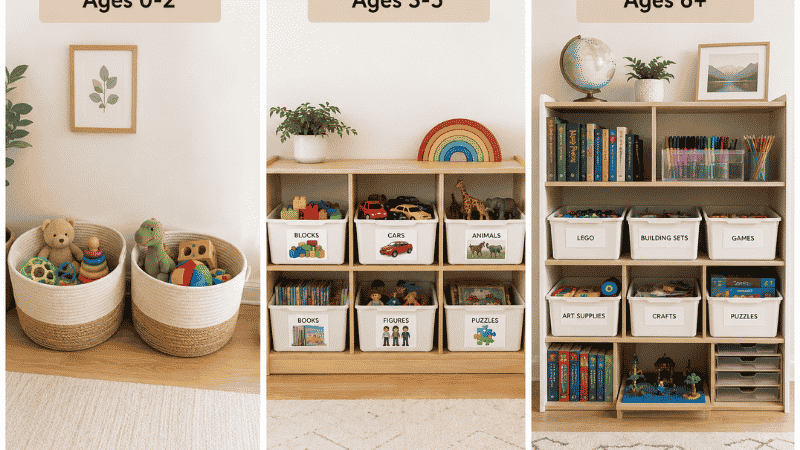
Toy Storage for Ages 0–2
Infants and young toddlers need the smallest category counts and the largest individual items. Storage priority: safety (no small parts accessible), visibility (open bins so caregivers can scan for hazards), and simplicity (2–4 toy categories maximum).
Open baskets at floor level, one category per basket, with a maximum of 8–10 items per basket. Everything else in rotation.
Toy Storage for Ages 3–5
Preschoolers are learning to sort, categorize, and follow simple rules — the storage system can start teaching these skills. Photo labels on bins work well for pre-readers. Category count can expand to 6–8 types. Size starts to vary more (small figurines, large blocks, dress-up clothes).
Low-to-ground open bins with clear photo labels. One toy out at a time before the next one comes out is a reasonable rule for this age — the storage system should make this rule easy to follow, not hard.
Toy Storage for Ages 6+
School-age children can manage a more sophisticated system: word labels instead of photos, more categories, and responsibility for the full cleanup independently. At this age, involving children in designing the system dramatically increases their investment in maintaining it.
Ask, don’t dictate: “Where do you think the Lego should go?” “What should we call this bin?” Children who help create the system follow the system. Children who have a system imposed on them work around it.
Why Toy Organization Fails (And How to Fix It)
If you’ve set up a toy organization system before and it collapsed within a week, it wasn’t a product failure. It was almost certainly one of these:
The categories didn’t match how the child plays. If toys are sorted in a way that’s logical to an adult but not to a child, the child will default to the closest available bin. Organizing by brand (all Lego in one bin) often works better than organizing by type (all building toys together) because children identify with brands more than abstract categories.
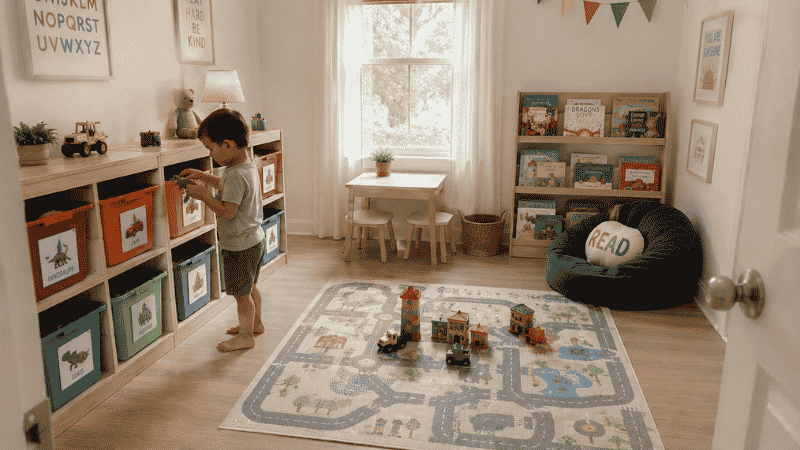
The storage required too many steps. If cleanup requires opening a lid, finding the right bin, and carefully placing items, most children will find the closest flat surface and leave things there. The easier path wins. Design the system so the correct path is the easy path — open-top bins, clearly visible labels, the bin physically located in the area where that toy is played with.
There were too many toys. Organization cannot solve a volume problem. If there are 400 toys and storage for 150, the system will always overflow. The audit and rotation system are the prerequisites, not the options.
There was no cleanup routine. A toy organization system is maintained by a daily cleanup habit, not by the storage products themselves. A 10-minute end-of-day cleanup routine — ideally at the same time each day, ideally with the child participating — is what keeps the system working week to week.
If You Only Have 10 Minutes Right Now
10 minutes: Walk through the playroom or toy area and remove everything broken, everything with missing pieces that make it nonfunctional, and everything the child has clearly outgrown. Just those items. The space immediately has more room and what remains is actually usable.
20 minutes: Group all toys currently out by category — even rough groupings on the floor. All figures together, all building items together, all art supplies together. This gives you a realistic picture of the volume per category before you commit to any storage product.
30 minutes: Assign one existing bin or basket per category and move toys into their bins with a temporary label (masking tape and marker works fine). Live with this rough system for one week before buying anything new. The week of observation tells you what size bins you actually need, which categories are the right size, and where the system breaks down in practice.
FAQ: Toy Storage Ideas
What is the best toy storage system for a playroom? The IKEA Trofast system is consistently the most functional modular option — low to the ground, customizable bin sizes, bins that tilt forward for easy access. Paired with a clear category system and photo or word labels, it enables independent child cleanup, which is the functional goal. The best system is always one the child can use without help.
How do I organize toys in a small room? Wall-mounted storage keeps the floor clear for play. Limit accessible toys to 3–4 categories maximum in a small room; everything else rotates in from elsewhere. Vertical stuffed animal storage (corner hammock or mounted cage) handles the category that takes the most floor space. The strict volume limit — one bin per category, bin determines maximum — is what keeps small rooms functional.
How do I get kids to put toys away? Make the correct path the easy path: open-top bins, labels at child eye level, bins located where the toys are played with (not across the room). Add a consistent cleanup time — same time each day — and participate alongside young children rather than directing from a distance. Children who helped design the system are significantly more likely to maintain it.
How do I deal with too many stuffed animals? A physical container that limits the volume — a corner hammock, a cage-style organizer, a large basket — establishes a natural limit. When the container is full, something comes out before something new comes in. For sentimental stuffed animals the child can’t part with but doesn’t actively play with, a separate “special” bin (displayed, not mixed with play items) honors the attachment without occupying prime playroom real estate.
What toy storage works best for Lego and small pieces? Enclosed bins with lids for storage (to prevent floor scatter when not in active play), open trays or sorted bins with multiple compartments for active play sessions. Color or type sorting works for older children; for younger children, all Lego in one large bin is manageable and appropriate. A dedicated Lego building mat (rolls up for storage) keeps pieces contained during active building.
How often should I rotate toys? Every 4–6 weeks is the most commonly recommended interval and tends to work well in practice. After 4–6 weeks, children genuinely treat returning toys as “new” — the re-engagement is real. Some households rotate seasonally; others rotate based on the child’s interest rather than a schedule. Any rotation is better than none.
How do I organize toys when everything is in a shared living space? Define one physical zone as the toy area and enforce the boundary. One basket per category, kept to that zone. Hidden storage (ottoman, closed cabinet) for the toys that need to disappear during non-play times. A daily cleanup routine that returns everything to the toy zone before the end of the day. The zone and the routine are what keep shared spaces functional.
Start With One Category Today
You don’t need to reorganize the entire toy collection to feel the difference. Pick the category causing the most daily chaos — the one that spreads the furthest, the one with the most pieces on the floor, the one that produces the most cleanup conflict — and solve that one first.
Assign it a bin, give the bin a label, put the bin where that toy is played with. That’s a complete toy storage solution for that category. Do it well, watch it work for a week, then do the next category.
The playroom that stays tidy isn’t built in one Saturday afternoon. It’s built one category at a time, adjusted based on what actually works for the specific children who live in your home.
Explore more on Vomoxs:
- Bedroom Organization Ideas: How to Organize Your Bedroom for Good
- Small Space Storage Ideas: How to Organize a Small Apartment Room by Room
- How to Declutter Your Home: A Room-by-Room Guide
References
- Dauch, C., Imwalle, M., Ocasio, B., & Metz, A. E. (2018). The influence of the number of toys in the environment on toddlers’ play. Infant and Child Development, 27(1), e2038. University of Toledo research on toy quantity and play quality.
- Roster, C. A., Ferrari, J. R., & Jurkat, M. P. (2016). The dark side of home: Assessing possession ‘clutter’ on subjective wellbeing. Journal of Environmental Psychology, 46, 32–41.
- Saxbe, D. E., & Repetti, R. (2010). No Place Like Home: Home Tours Correlate With Daily Patterns of Mood and Cortisol. Personality and Social Psychology Bulletin, 36(1), 71–81.
Category: Room Organization | Reading time: 10 min | Last updated: 2026