
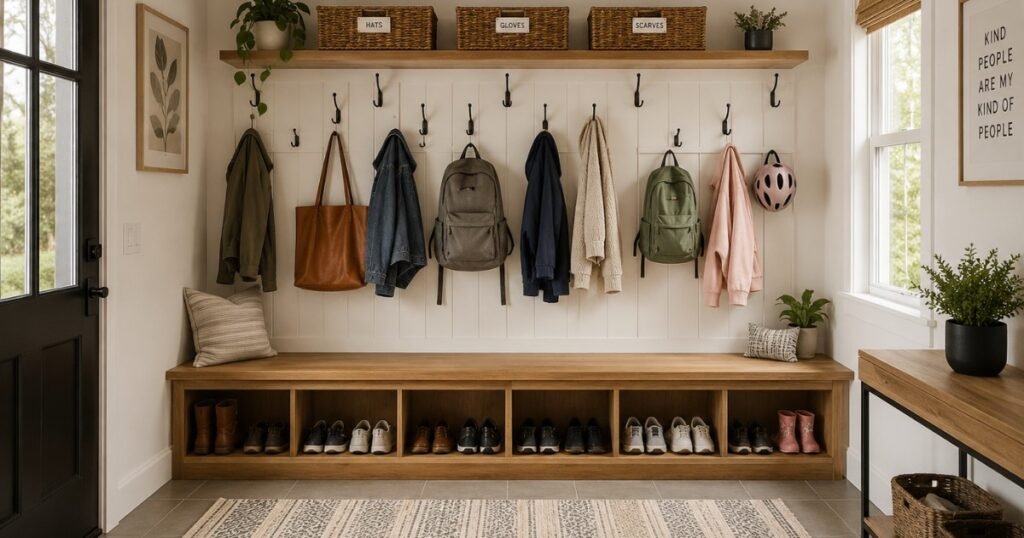
Walk through the front door, and within minutes shoes, bags, jackets, and mail have taken over the entryway. Sound familiar? The problem usually isn’t that your home is too small or that your family is messy. It’s that there’s no dedicated landing spot for everything coming in from outside.
That’s where a mudroom—or even a simple drop zone—makes all the difference. You don’t need a large, dedicated room to keep everyday clutter under control. With the right layout and a few smart storage solutions, even a hallway, closet, or empty wall can become an organized transition space that keeps the rest of your home cleaner and calmer.
This guide walks through what actually makes that pause point work, then gets into 25 real, copyable layouts organized by function rather than by decorating style. Along the way, you’ll find small-space solutions for apartments and hallways, realistic DIY and IKEA options, budget breakdowns, material picks that hold up to rain and mud, pet-friendly setups, and a simple system for rotating seasonal gear without losing your weekend to it.
Quick Overview
Whether you’re working with a dedicated mudroom, a narrow hallway, or just an empty wall near the front door, this guide will help you create a cleaner, more organized entryway.
Inside, you’ll find:
Materials, layouts, and organization tips that are easy to maintain.
25 practical mudroom ideas for every home size.
Budget-friendly DIY projects and IKEA hacks.
Storage solutions for families, pets, and small spaces.
Quick Mudroom Planning Guide
| If You Have… | Best Mudroom Idea | Budget | Difficulty | Best For |
|---|---|---|---|---|
| A small apartment | One-wall drop zone | $50–$150 | Easy | Renters & small spaces |
| No entryway | Hallway or closet conversion | $100–$300 | Easy–Medium | Homes without a dedicated mudroom |
| A busy family | Built-in lockers with hooks | $500+ | Medium | Families with kids |
| A garage entrance | Garage mudroom setup | $200–$800 | Medium | Active households |
| A laundry room | Laundry + mudroom combo | $300–$1,000 | Medium | Space-saving layouts |
| Pets | Pet-friendly mudroom | $100–$500 | Easy–Medium | Dog and cat owners |
| A tight budget | IKEA hack or DIY setup | Under $400 | Easy | Budget-conscious homeowners |
What Makes a Mudroom Work? (It’s More Than Just a Bench)
A mudroom isn’t defined by square footage or a farmhouse aesthetic. It’s defined by whether it actually intercepts clutter before it enters the house. A gorgeous bench with nowhere to put wet boots isn’t doing its job. A plain closet with the right storage inside it often works better.
Why every home needs a transition zone
Every household has a moment, several times a day, when outside gear meets inside space. Coats come off. Shoes come off. Bags get set down. Without a defined spot for that handoff, those items drift — onto the kitchen table, the stairs, the back of a chair. A transition zone simply gives that moment somewhere to land.
This matters just as much in a studio apartment as it does in a five-bedroom house with kids and a dog. The scale changes. The need doesn’t.
The everyday problems a mudroom actually solves
A functional mudroom quietly solves problems most people don’t think about until they’re gone:
- Shoes no longer pile up by the front door or migrate into the living room
- Keys, wallets, and masks have one home instead of three
- Wet coats stop dripping onto hallway floors
- Kids can hang up their own bags instead of dropping them mid-hallway
- Mail and school papers get sorted instead of turning into a countertop pile
None of this requires a dedicated room. It requires a system.
Mudroom vs entryway vs foyer
These terms get used interchangeably, but they’re not quite the same thing. A foyer is typically a formal, decorative entry space — think a console table and a mirror. An entryway is the general area just inside the door. A mudroom is functional by design: built specifically to catch mess, hold gear, and organize the daily in-and-out of a household. In many homes, the entryway and mudroom are the same physical space — it’s just a matter of whether that space has been set up to do the job.
25 Mudroom Ideas You Can Actually Copy
These are grouped by function, not by decorating trend, because the right mudroom idea depends on what your household actually needs — not what looks best on a mood board.
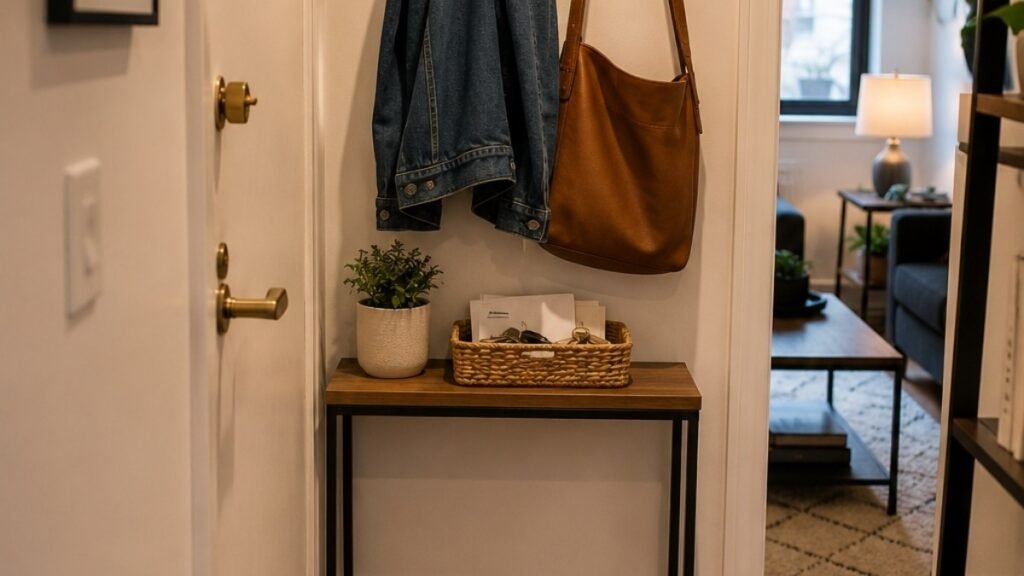
Small apartment drop zone
A single narrow console table with two or three wall hooks above it and a basket underneath can do almost everything a full mudroom does, just in miniature. The key is picking one wall near the door and committing to it, rather than letting gear scatter across the apartment.
Closet mudroom conversion
An underused hall closet, stripped of its rod and shelves, can be rebuilt with hooks, a slim bench, and stacked bins. This works especially well in older homes where the coat closet sits right next to the front door but rarely gets used efficiently.
Hallway mudroom
A run of hooks and a slim shoe bench along one wall of a hallway creates a functional stretch without needing a dedicated room. Runners or washable rugs help protect flooring in this kind of setup, since hallways see constant foot traffic.
Garage entry mudroom
For homes where the garage is the main entry point, a mudroom setup near that door matters more than one by the front door. This is often where boots, sports gear, and yard shoes actually belong, since it keeps the dirtiest items away from main living spaces entirely.
Laundry + mudroom combo
Combining laundry and mudroom functions makes sense in homes with limited square footage. A bench next to the washer, hooks on the adjacent wall, and a hamper built into the transition path mean dirty gear can go straight from “just came inside” to “already being washed.”
Family command center
A wall-mounted organizer near the entry — with a calendar, a mail slot, a key rack, and a small chalkboard or whiteboard — keeps the household’s daily logistics out of the kitchen and out of your head. This is one of the simplest upgrades with a disproportionately large payoff.
Pet-friendly mudroom
Pet owners have needs that most mudroom guides skip entirely. A pet-friendly setup benefits from:
- Leash hooks at a height where they’re easy to grab on the way out the door
- A dedicated towel drawer for wiping down wet or muddy paws
- A small paw-washing station, even something as simple as a low basin near a hose bib or utility sink
- Enclosed food storage that keeps kibble smell and pests out of an open pantry
These details are small individually, but together they keep pet mess contained to one area instead of spreading through the house.
Hidden mudroom behind cabinet doors
For households that dislike visual clutter, storage behind closed cabinet doors solves the “organized but still messy-looking” problem. Everything has a place, but none of it is visible from the front door.
Built-in lockers
Individual lockers — even simple, painted MDF versions — give each family member a defined space for shoes, bags, and coats. This works particularly well for households with more than two or three people, since shared open hooks tend to become one giant pile.
Open cubbies with baskets
Cubbies with pull-out baskets offer a middle ground between fully open shelving and fully closed cabinets. Items are visible enough to grab quickly, but contained enough that the space doesn’t look chaotic.
Minimalist Scandinavian style
Light wood tones, matte black hardware, and a restrained color palette keep a small mudroom from feeling cramped. This style works especially well in apartments and smaller entries, where visual clutter reads as clutter, period.
Farmhouse mudroom
Shiplap walls, painted benches, and woven baskets remain a popular choice for larger entry spaces, particularly in homes with mudrooms adjacent to a kitchen or laundry room.
Modern black-and-wood design
Black metal hooks and hardware against warm wood tones give a mudroom a more current look without sacrificing function — and black hardware tends to hide fingerprints and daily wear better than lighter finishes.
Kids-only mudroom
A section built specifically for children benefits from lower hooks placed at a height kids can actually reach, individual cubbies labeled with each child’s name, and a step stool if hooks are still slightly too high. Giving kids their own defined space is one of the most effective ways to keep a shared mudroom from falling apart daily.
Seasonal rotating storage
Most mudroom guides stop at “add storage” and skip the fact that storage needs change dramatically by season. A rotating system means swapping:
- Winter: boots, heavy coats, scarves, gloves
- Summer: beach bags, flip-flops, sun hats, sunscreen
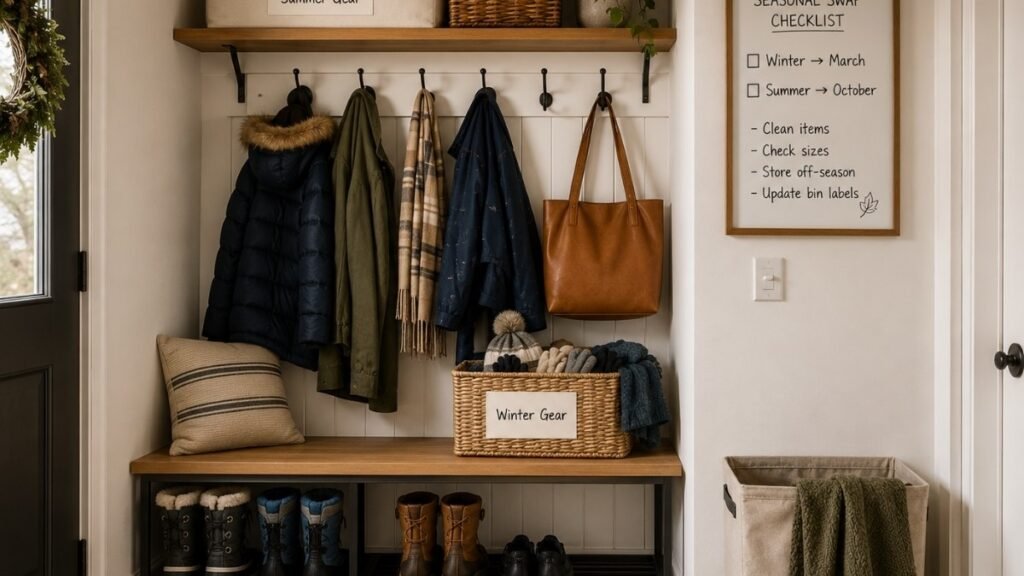
Keeping an off-season bin in a closet or garage — and swapping contents twice a year — prevents the mudroom from trying to hold both wardrobes at once.
Small Space Mudroom Ideas That Don’t Require a Separate Room
This is where most homes actually live, so it deserves specific attention rather than a single afterthought paragraph.
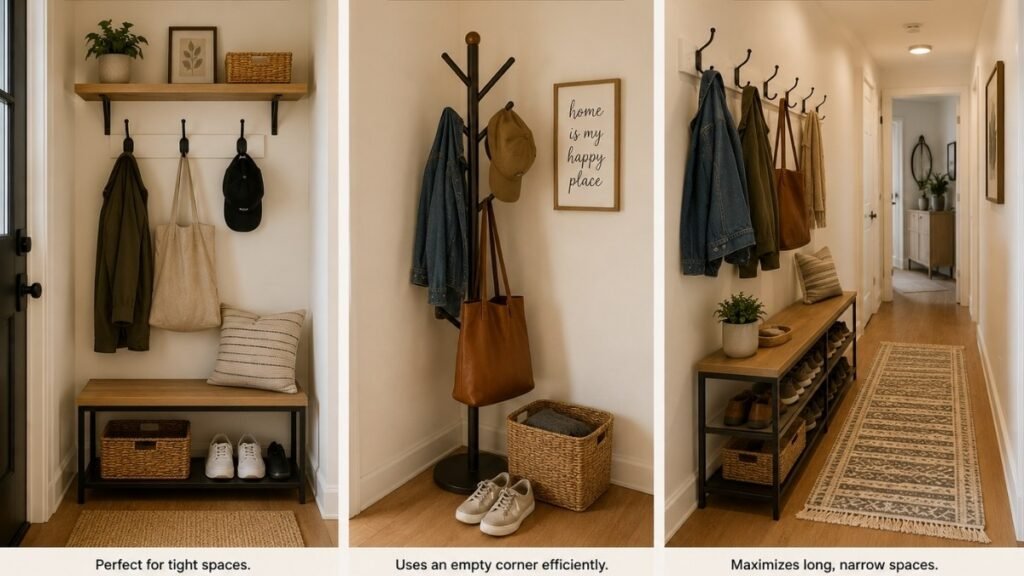
One-wall mudroom
A single wall near the entry, fitted with hooks, a narrow shelf, and a small bench or stool, can handle the basics for one or two people. A reasonable minimum width is about 24 to 30 inches of wall space — enough for hooks and a shallow bench, even if there’s no room for cabinets.
Corner drop zone
An underused corner can hold a slim vertical unit — a coat tree, a narrow shelf stack, or a corner bench — without eating into walkway space. This works particularly well in open-concept apartments where there’s no true entry hallway.
Tiny apartment entry
In studio or one-bedroom apartments, the “mudroom” is often just the strip of floor inside the front door. A slim shoe tray, one or two hooks, and a small basket for keys and mail can cover most of what a household actually needs — no renovation required.
Inside a hallway
A recessed hallway nook, even one only a foot or two deep, can be fitted with slim hooks and a narrow bench. Anything under about 12 inches of depth generally rules out a bench, but hooks and a shoe rack still fit comfortably.
Inside a closet
Closets near the front door, even shallow ones, can be converted with the door left open or removed entirely, turning what was dead storage into an active drop zone. A depth of at least 14 to 16 inches is usually enough for a slim bench and hooks.
Behind the front door
The wall space directly behind an inward-opening front door is one of the most overlooked spots in small homes. A few over-the-door hooks or a slim organizer here can hold umbrellas, leashes, or reusable bags without taking up any floor space at all.
The 5 Essentials Every Functional Mudroom Needs
Design choices matter less than function. These five elements do most of the actual work.
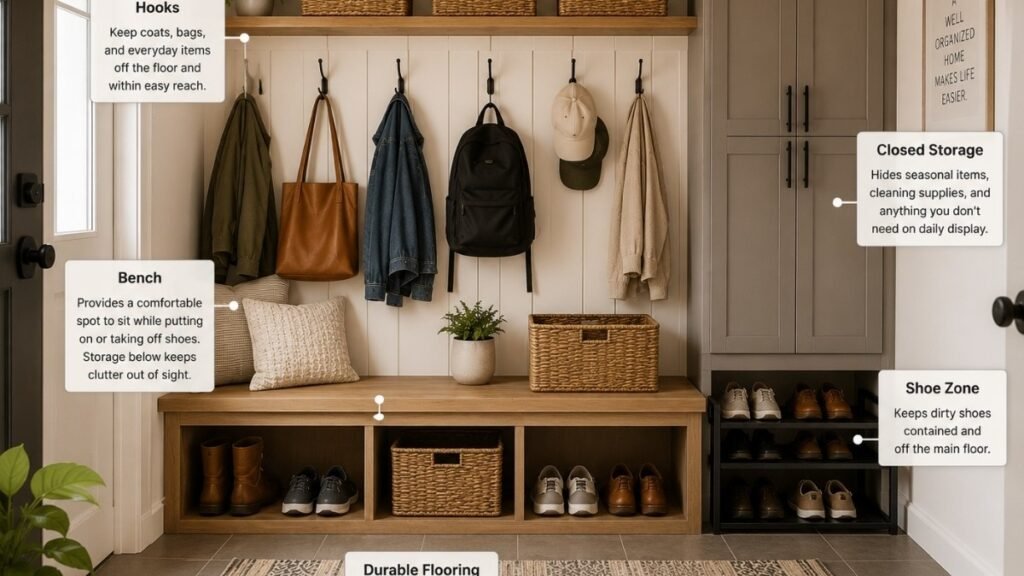
Bench
Why it matters: A place to sit while removing shoes prevents the awkward hopping-on-one-foot routine that leads to shoes getting kicked off wherever, rather than put away. Common mistake: Choosing a bench too shallow or too narrow to actually sit on comfortably, so it becomes a shelf instead. Best budget option: A simple storage cube or ottoman with a flat top works as a stand-in bench for under $40.
Hooks
Why it matters: Hooks are the single fastest way to get coats and bags off the floor, since hanging something up takes less effort than folding or stacking it. Common mistake: Installing too few hooks for the household size — a family of four needs more like eight to ten hooks than the standard four-hook rack sold in most stores. Best budget option: A multi-hook wall rail, often under $20, easily outperforms single hooks purchased individually.
Closed storage
Why it matters: Not everything needs to be on display. Seasonal gear, cleaning supplies, and off-season shoes are better tucked behind a door. Common mistake: Relying entirely on open shelving, which looks tidy for about a week before it becomes visual clutter. Best budget option: A basic cabinet or armoire from a secondhand marketplace, repainted, often costs far less than new closed storage built for entryways specifically.
Open baskets
Why it matters: Frequently used items — daily shoes, gloves, dog leashes — need to be grabbed quickly, and open baskets are faster to use than closed drawers. Common mistake: Choosing baskets without handles, which makes them harder to pull out and more likely to get ignored. Best budget option: Woven or fabric bins from budget retailers typically run $8 to $15 and do the job just as well as premium versions.
Easy-clean flooring
Why it matters: Mudrooms take more daily abuse than almost any other room in the house — mud, salt, water, sand — so flooring needs to handle moisture without warping or staining. Common mistake: Keeping original carpet or hardwood in a mudroom area, which tends to show damage within a year or two of heavy use. Best budget option: A durable washable rug or runner placed over existing flooring is a low-cost way to protect it without a full flooring replacement.
DIY Mudroom Ideas on a Realistic Budget
Budget matters more here than in most rooms in the house, since mudrooms take a beating regardless of how much money went into them.
Under $100
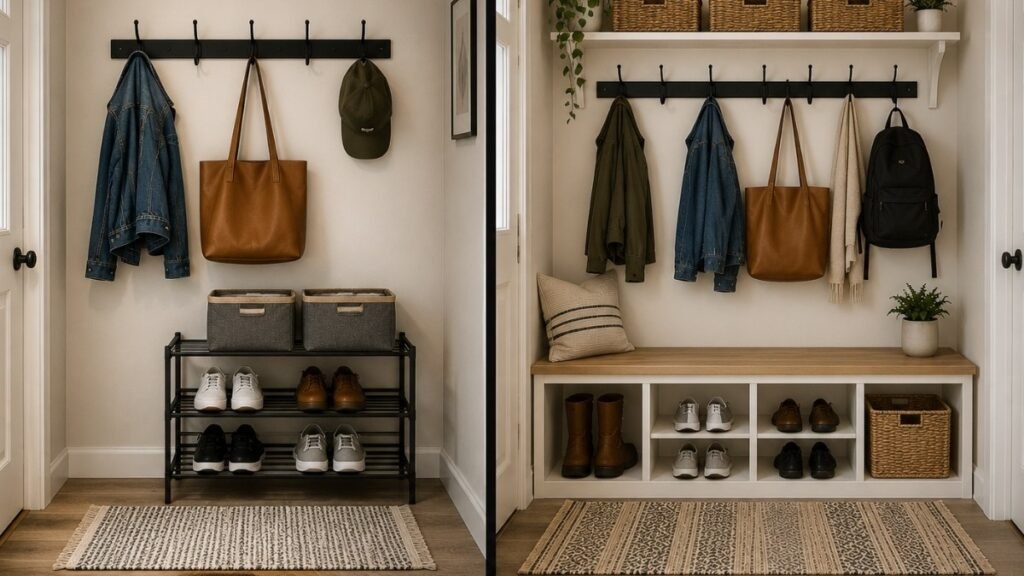
A workable starter setup includes a multi-hook rail, a stackable shoe rack, two or three fabric bins, and a washable entry mat. This combination covers hooks, shoes, and small-item storage without touching furniture costs at all.
Under $300
At this budget, a simple bench (assembled or flat-pack), a wall-mounted shelf above it, baskets underneath, and a small wall organizer for mail and keys creates something that functions much closer to a full mudroom setup.
IKEA hacks
IKEA’s modular furniture lines are popular for mudroom builds because they’re inexpensive relative to custom carpentry and easy to reconfigure.
- PAX wardrobes, fitted with shelves instead of a hanging rod, work well as built-in-style lockers for larger entries.
- BILLY bookcases, turned on their side or fitted with baskets, make an affordable cubby system.
- KALLAX units are a common choice for cubby-style shoe and basket storage, since the square openings are sized well for standard fabric bins.
- HEMNES benches with built-in storage combine seating and closed storage in a single, relatively compact piece.
One practical way to combine these is a KALLAX unit for open cubbies, paired with a HEMNES bench for seating, and PAX along an adjacent wall if closed storage is needed for coats.
The Best Materials That Stay Beautiful After Rain, Snow, and Mud
Mudrooms are one of the few rooms in the house where durability should outrank appearance in the decision-making process.
Best flooring
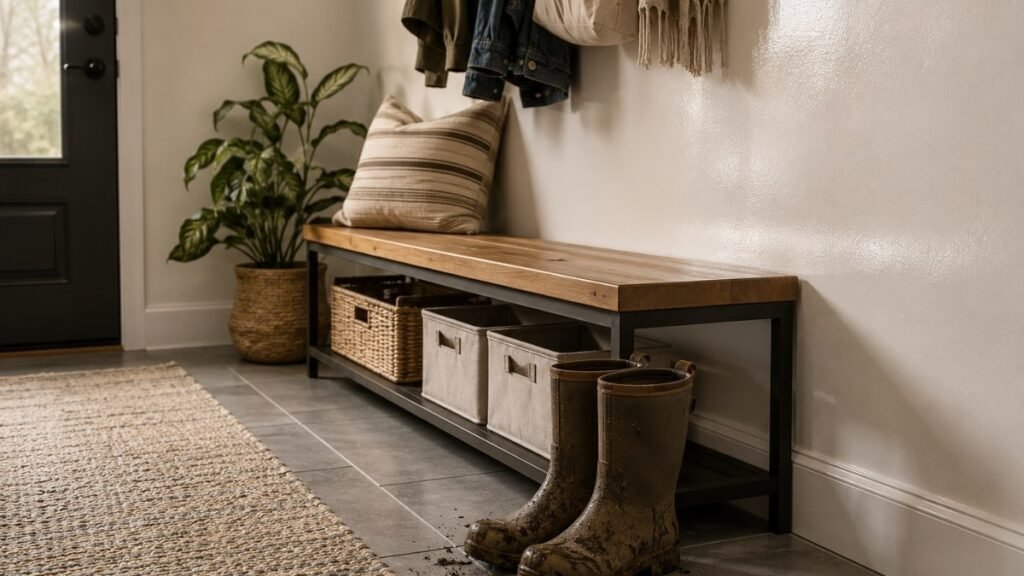
✅ Recommended: Luxury vinyl plank (LVP), sealed tile, or rubber flooring ❌ Avoid: Solid hardwood or wall-to-wall carpet, both of which trap moisture and stain easily
Wall paint
✅ Recommended: Semi-gloss or satin finishes, which wipe clean easily ❌ Avoid: Flat or matte finishes, which absorb moisture and show scuff marks
Cabinet finishes
✅ Recommended: Sealed or painted wood, laminate, or powder-coated metal ❌ Avoid: Unsealed raw wood, which swells and warps with repeated moisture exposure
Bench materials
✅ Recommended: Sealed wood, metal-framed benches, or weather-resistant composite ❌ Avoid: Upholstered benches without a removable or washable cover
Rugs
✅ Recommended: Washable, rubber-backed runners designed for high-moisture areas ❌ Avoid: Natural fiber rugs like jute or sisal, which hold onto moisture and are difficult to clean
Common Mudroom Mistakes That Make Your Home Feel Messier
Most mudroom frustration comes down to a handful of repeated setup mistakes rather than a lack of effort.
- Only open shelves: Everything is visible, which looks organized for about a week and cluttered after that.
- Too few hooks: A single four-hook rack rarely covers more than two people’s daily coats and bags.
- No charging station: Phones and tablets end up scattered across the kitchen counter instead of charging by the door.
- Wrong flooring: Carpet or unsealed wood near an entry point wears out fast and holds onto moisture and odor.
- No sitting area: Without a bench, shoes get kicked off wherever, rather than removed and put away properly.
- Poor lighting: A dim entry makes it harder to find keys, sort mail, or notice when the space needs tidying.
- No hidden storage: Without at least one closed cabinet or drawer, seasonal or rarely used items have nowhere to go and end up cluttering visible surfaces.
How to Organize Your Mudroom Throughout the Year
A mudroom that works well in October can feel completely overwhelmed by January if the contents never change with the seasons.
Spring: Swap heavy coats and boots for lighter jackets, store away snow gear, and add space for umbrellas and rain boots.
Summer: Bring beach bags, sandals, and sun hats to the front, and move winter accessories to deep storage.
Fall: Start reintroducing light jackets and closed-toe shoes, and stage boots near the front of storage ahead of colder weather.
Winter: Prioritize space for heavy coats, snow boots, gloves, and scarves — this is typically the season that demands roughly double the storage space of summer, simply because winter gear takes up more physical room.
Storage rotation checklist:
- Pull all current-season items out and sort into keep, donate, or discard
- Wipe down bins, baskets, and shelves before restocking
- Bring off-season items forward from deep storage
- Check that each household member’s hooks and cubbies still fit what they actually use
- Reassess whether the current bench and hook setup still matches household size and habits
Doing this shift in a focused 15-minute pass, rather than gradually over weeks, tends to keep the space from sliding back into clutter between seasons.
Planning Your Mudroom Before Buying Anything
Buying hooks and bins before assessing the actual space almost always leads to wasted money. A short planning pass first saves both budget and frustration later.
- Measure first: Know the exact wall width, depth, and ceiling height available before shopping for benches or cabinets.
- Family size: More people means more hooks, more cubbies, and likely a wider bench than a single-person entry would need.
- Daily habits: A household that changes shoes constantly needs more bench space than one that mostly just drops bags.
- Pet needs: Factor in leash storage, towel access, and food storage if pets are part of the daily routine.
- Storage priorities: Decide in advance what needs to be visible and grabbable versus what can live behind a closed door.
- Budget: Set a number before browsing, since mudroom furniture ranges enormously in price for similar function.
- Power outlets: Check whether the space has an outlet nearby for charging stations or lighting.
- Charging station: Plan a specific spot — a drawer, a shelf with a cutout, or a small basket — rather than letting devices pile up wherever an outlet happens to be.
- Robot vacuum parking: If a robot vacuum is part of the household, leave dedicated floor space for its dock so it isn’t competing with shoes and bags for the same corner.
Quick Mudroom Shopping Checklist
- Multi-hook wall rail or individual hooks
- Bench (with or without storage underneath)
- Fabric or woven bins for open storage
- Boot tray for wet or muddy footwear
- Washable runner rug
- Wall-mounted organizer for mail and keys
- Umbrella stand or dedicated hook
- Charging drawer or designated charging shelf
FAQ
How much space do I need for a mudroom? A functional setup can work in as little as 24 to 30 inches of wall space for hooks and a shallow bench. Larger households or those wanting closed storage typically benefit from at least 4 to 6 feet of wall space, but there’s no strict minimum — smaller spaces just require more editing of what stays.
Can I create a mudroom without an entryway? Yes. A single wall, a corner, the back of a front door, or a section of hallway can all function as a mudroom. What matters is consistency — picking one spot and committing to it — rather than the size or shape of the space itself.
What’s the cheapest way to build a mudroom? A hook rail, a stackable shoe rack, a couple of fabric bins, and a washable mat can be assembled for well under $100. This covers the core functions — hanging, shoe storage, and small-item catch-all — without any furniture purchase.
What’s better: open cubbies or closed cabinets? It depends on the household. Open cubbies work well for frequently used items and households that want quick, visible access. Closed cabinets suit households that prefer a tidier look or need to store seasonal and less-used items out of sight.
Which flooring is easiest to clean after rain or snow? Luxury vinyl plank, sealed tile, and rubber flooring all handle moisture well and wipe clean easily. Solid hardwood and wall-to-wall carpet are the two materials most likely to stain or warp with repeated exposure.
Can I combine a laundry room and mudroom? Yes, and it’s a common solution in smaller homes. A bench near the washer, hooks on an adjacent wall, and a hamper in the entry path let dirty gear move directly from “just came inside” into the wash cycle.
How do I keep a mudroom organized with kids? Lower hooks placed at a child’s reach, individually labeled cubbies, and a small step stool tend to work better than expecting kids to use adult-height storage. Giving each child ownership over their own space cuts down significantly on daily clutter.
What should every mudroom include? At minimum: a bench or seating area, enough hooks for the household size, some form of closed storage, open baskets for daily items, and flooring that can handle moisture and dirt without damage.
Final Thoughts
An efficient mudroom isn’t about having a dedicated room at all — it’s about building a transition zone that actually matches how your household lives day to day. Whether that’s one wall in an apartment, a corner of a hallway, or a converted closet, the layout matters far more than the square footage. Get the basics right, and the first step back into your home after a long day gets noticeably easier.
🏡 Home Organization Notes: The Thinking Behind This Guide
A well-organized mudroom isn’t about having a picture-perfect entryway—it’s about making everyday routines easier.
That’s why this guide focuses on practical solutions that work in real homes, whether you have a dedicated mudroom, a small hallway, or just a narrow wall beside the front door.
Instead of chasing expensive custom cabinetry, we believe most families benefit more from simple systems that are easy to maintain and adapt as life changes.
This guide is built around three principles:
- 🧺 Store What You Use Every Day — Keep shoes, coats, bags, and daily essentials within easy reach.
- 🏠 Make Small Spaces Work Harder — Even apartments and compact entryways can become organized drop zones.
- 💰 Spend Smarter, Not More — Practical layouts, budget-friendly upgrades, and DIY ideas often outperform expensive renovations.
Because the goal isn’t to create the most beautiful mudroom.
It’s to create one your family will actually use every day.
Continue Organizing Your Home
Your mudroom is only one part of an organized home. Explore these practical guides to build smarter storage solutions throughout every room.
- Shoe Storage Ideas — Find space-saving ways to organize sneakers, boots, and everyday footwear.
- How to Organize a Garage — Keep tools, sports equipment, and seasonal items organized with a zone-by-zone system.
- Small Space Storage Ideas — Simple strategies that help apartments and compact homes stay tidy without expensive renovations.
- How to Declutter Your Home — Clear the clutter before you organize, with a room-by-room guide that actually works.
- Home Organization Ideas — The complete room-by-room guide to organizing every space in your home.
❤️ A Final Note
An organized home isn’t built in a weekend—it’s built one small habit at a time.
At Your Brand, we believe great storage isn’t about buying more products or chasing picture-perfect spaces. It’s about creating simple systems that make everyday life easier to manage.
Our goal is simple: helping you build a home that’s easier to organize, easier to maintain, and more enjoyable to live in.