
You reach for the cumin while something is simmering on the stove. You open the cabinet and twelve bottles cascade forward. You find three different paprikas — sweet, smoked, and one that’s lost its label. The cumin is somewhere behind the turmeric. The thing you bought last month is already buried at the back. The thing you’re actually looking for isn’t there at all, which means you probably have it and just can’t find it, or you used it up and forgot to replace it.
This is the spice situation in most kitchens. Not catastrophic — just a steady friction that costs you thirty seconds every time you cook, sometimes much more. And because spices are small, look similar, and live in a cabinet you open multiple times a day, the disorganization compounds faster than almost anywhere else in the kitchen.
The deeper problem: most spice organization advice starts with buying a product — a new rack, a set of uniform jars, a turntable. But the product doesn’t fix the system. Eleven matching jars filled with spices in random order are just as hard to navigate as eleven mismatched bottles in random order. The system comes first. The products, if needed, come after.
This guide covers spice rack ideas for every kitchen size, how to organize spices so you can find what you need while you’re actively cooking, how to store pots and pans without stacking chaos, and how to keep kitchen counters clear without losing access to the things you actually use.
Key Takeaways
- The average household owns 40+ spices but uses fewer than 10 regularly — most spice organization problems are also volume problems before they’re storage problems.
- Heat, light, and moisture are the three primary causes of spice degradation. Ground spices stored near a stove — the most common placement — lose potency significantly faster than spices stored in a cool, dark cabinet or drawer.
- The most effective spice organization principle is frequency of use, not alphabetical order — the spices you reach for daily belong at the front, at eye level, and within arm’s reach of the cooking area.
- Pots and pans stacked without a system create the kitchen’s most persistent daily friction: pulling out three pans to reach the one at the bottom, then having to restack everything. A dedicated pan organizer or vertical storage eliminates this completely.
- A clear kitchen counter is maintained by having adequate hidden storage for daily-use items — not by willpower. When items don’t have a designated drawer or cabinet home, they default to the counter permanently.
Step 1: The Spice Audit — Before Buying Any Rack
The most important spice organization step costs nothing and takes 20 minutes: auditing what you actually have before deciding how to store it.
Check expiration dates. Ground spices typically last 2-3 years; whole spices 3-4 years; dried herbs 1-3 years. Most households have a meaningful percentage of spices past their prime — these take up storage space and deliver diminished flavor. Discard without deliberation.
Consolidate duplicates. It’s extremely common to discover two or three containers of the same spice — often different brands, different sizes, at different fullness levels. Combine into the fullest container, label it, discard the rest.
Inventory what you actually use. Sort everything into two groups: spices used in the past three months, and spices used less frequently (or never). The first group needs prime accessible storage. The second group can live further back, higher up, or in a designated backup area.
In most kitchens, this audit reduces the spice collection by 30-40% before a single organizer is purchased. The storage problem often solves itself.
How to Organize Spices: The System Before the Products
Once the collection is audited and reduced, the organizational system determines everything else — including which type of spice rack, if any, is actually needed.
The Frequency Principle
Organize by how often you reach for each spice, not alphabetically. An alphabetical system looks satisfying but creates a navigation problem while cooking — you’re scanning for “C” while the onions are browning, not for the bottle near the front where you put it last time.
Front and center: The spices you use multiple times a week — salt, black pepper, garlic powder, the spice blend that goes in everything you make. These belong immediately accessible, ideally within arm’s reach of the cooking area without opening a cabinet.
Accessible but not prime: Spices used weekly — cumin, paprika, chili powder, oregano, coriander. These can live in a drawer, cabinet, or rack one step from the stove.
Back of the cabinet: Spices used occasionally — specialty spices for specific recipes, baking spices used seasonally, things you’re keeping but not reaching for regularly.
The Visibility Rule
The second principle: every spice needs to be visible without moving anything in front of it. A spice you can’t see is a spice you’ll forget you have and eventually replace unnecessarily.
This is why single-row flat shelving — the most common spice storage — is functionally inefficient. The back row is always obscured by the front row. Any storage solution should allow you to see every bottle simultaneously.
Where to Store Spices: The Heat and Light Problem
Most people store spices on the counter near the stove or in the cabinet directly above the stove. Both locations consistently reduce spice quality faster than almost any other placement.
Heat and moisture from cooking degrade essential oils — the compounds that give spices their flavor and aroma. A spice stored immediately above or beside an active burner experiences repeated heat exposure that accelerates this degradation significantly.
Ideal spice storage locations: Inside a cabinet away from the stove, in a drawer (excellent option — cool, dark, naturally protected from light and heat), in a pantry, or on a wall rack on a wall that doesn’t face direct sunlight or the cooking area.
Editor’s note: This is the single most counterintuitive spice storage insight. The most visually appealing spice placement — a rack beside the stove where everything is immediately accessible — is actively degrading your spices. Moving them one cabinet over makes a meaningful difference in how long they stay potent.
Spice Rack Ideas by Kitchen Type
Spice Rack Ideas for Drawers
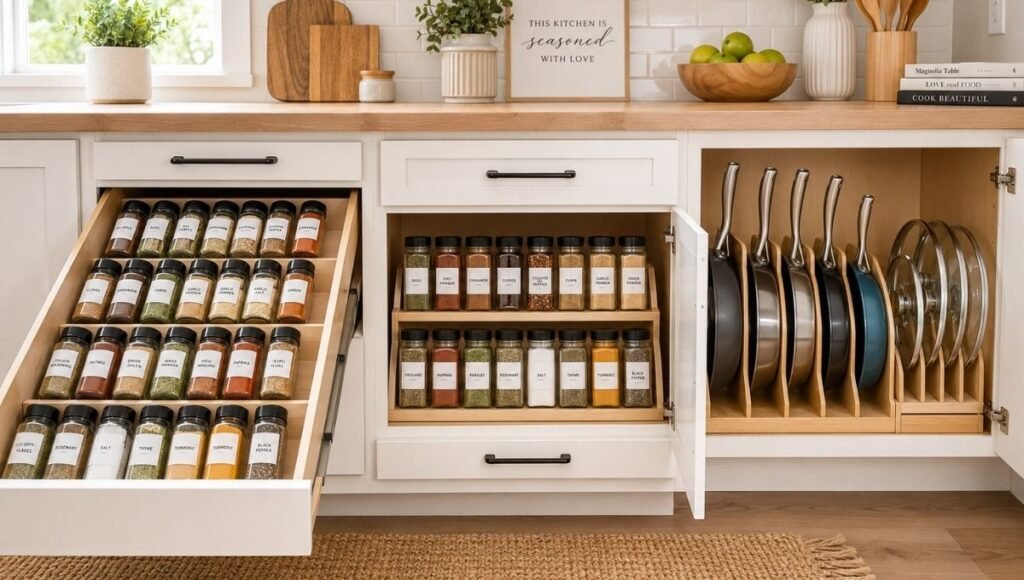
A deep kitchen drawer is arguably the best spice storage location available — cool, dark, naturally protected from heat and light, and allows every label to be read at a glance from above when the drawer is open.
Angled drawer inserts tilt each bottle slightly toward you so labels face upward and are immediately readable. No reaching, no rotating bottles to find the label. This is the highest-visibility, most functional spice storage option for kitchens with a deep drawer available near the cooking area.
Flat drawer organization with tiered inserts works for shallower drawers — arrange spices in rows with the tallest at the back, label every bottle on the top of the lid so you can read them from above.
The one-layer rule for drawers: Never stack spice bottles in a drawer. A single layer where every bottle is simultaneously visible is dramatically more functional than two layers where half the bottles are inaccessible without moving the top layer.
Spice Rack Ideas for Cabinets
Tiered shelf risers inside the cabinet create two visible rows in the same shelf space — the front row at counter level, the back row elevated behind it so both rows are simultaneously visible. This is the lowest-cost, highest-impact cabinet organization change for existing spice collections.
Pull-out cabinet organizers transform deep cabinets where the back half is effectively dead space. A pull-out shelf brings everything in the cabinet to the front with a single slide. Particularly effective for base cabinets.
Door-mounted spice racks use the inside surface of the cabinet door — space that’s otherwise completely unused. An over-door or mounted rack holds 12-30 spice bottles in a space that previously contributed nothing. This is one of the most space-efficient solutions for small kitchens.
Pull-down under-cabinet racks mount to the underside of an upper cabinet and swing down to bring spices to eye level. Ideal for deep upper cabinets where reaching the back is awkward.
Spice Rack Ideas for Countertops
If counter space is available and you prefer spices visible and accessible without opening anything, a countertop rack works — with one important caveat: position it away from direct heat and sunlight, not immediately beside the stove.
Rotating turntable (Lazy Susan): Brings any bottle to the front with a spin. Works well for a collection of 20-30 bottles and fits in a corner or center-counter location. The rotation means no bottle is ever permanently buried.
Tiered countertop stand: Two or three tiered levels so all bottles are simultaneously visible without rotation. More compact than a turntable, works better for smaller collections.
Magnetic wall or fridge-side rack: Magnetic spice containers attach to any magnetic surface — the side of the refrigerator, a magnetic strip mounted to a backsplash, the side of a range hood. Takes zero counter space and keeps frequently-used spices immediately accessible. Works only if the magnetic strip or surface is strong enough to hold the containers securely.
Spice Rack Ideas for Small Kitchens
Small kitchens require maximum space efficiency — every spice storage solution should use space that’s currently unused rather than converting existing functional space.
Cabinet door: The inside of every cabinet door is usable storage. An over-door or mounted spice rack uses this space without competing with shelf or counter space.
Between appliances: The narrow gap between the refrigerator and a cabinet, or between the stove and a counter, can accommodate a slim pull-out spice tower — a narrow vertical rack that slides into the gap and presents spice bottles on tiered shelves.
Under-shelf hanging racks: Small racks that clip or mount to the underside of an existing cabinet shelf hold 6-12 spice bottles below the shelf, using vertical space within the cabinet that’s typically empty.
How to Organize Pots and Pans
Pots and pans create the kitchen’s most persistent daily frustration for one reason: nesting. Nesting is space-efficient but access-inefficient — reaching the sauté pan at the bottom of the stack requires removing two or three pans on top of it, then restacking them when you’re done. This happens multiple times a day in an actively-used kitchen.
How to Store Pots and Pans: The Stacking Problem
The fundamental issue with flat stacking is that it optimizes for storage density at the expense of access. The alternative isn’t to never nest — it’s to create a system where the nesting order matches the frequency of use, and where a single pan can be retrieved without moving multiple others.
Nest by size, with the most-used on top. The pan you reach for every day goes on top of the stack, not buried at the bottom. This sounds obvious but requires actually tracking which pan you use most and positioning accordingly.
Pan organizers with vertical dividers eliminate nesting entirely. Each pan stands vertically in its own slot — like files in a filing cabinet. Every pan is individually accessible without touching any other pan. A pan organizer typically holds 5-8 pans in the same cabinet space that previously held a nested stack of the same number.
Pot lid storage is a separate problem. Lids nest poorly, slide around, and consistently end up as a separate pile that doesn’t correspond to the pots they belong with. Options: lid organizer (a vertical rack specifically for lids, holds 8-12 lids upright), store lids on the pots they belong with (works for closed storage, creates a larger stack), or hang lids on a mounted hook or rail inside a cabinet door.
Wall-mounted or ceiling-hung pot racks move pots and pans completely off shelves and out of cabinets, freeing significant cabinet space. Best for kitchens where overhead or wall space is available and where the aesthetic works — pot racks make cookware permanently visible.
Kitchen Counter Organization: The Clear Counter System
A kitchen counter accumulates items not because of poor habits but because items don’t have a home anywhere else. When a toaster, a blender, the mail, a fruit bowl, the coffee maker, the spice jars, the oils, and three random items that arrived from elsewhere are all competing for the same counter space, the counter is always full regardless of how often it’s cleared.
The solution to a permanently cluttered counter is always adequate hidden storage, not discipline.
Audit what earns counter space. Items used daily and difficult to store elsewhere — coffee maker, toaster — legitimately earn counter space. Items used occasionally — blender, stand mixer — can live in a cabinet and come out when needed. Items that arrived and stayed — mail, random household items, things waiting to be dealt with — need homes elsewhere.
The under-cabinet appliance hook system mounts small appliances like a coffee maker or toaster oven under upper cabinets on a dedicated platform, freeing the counter surface below. More involved to install but frees significant counter space in small kitchens.
A consistent landing zone with a purpose: Counter space works best when each area has a designated purpose rather than being general surface available to anything that lands there. A dedicated section for coffee supplies, a dedicated section for cooking oils and frequently used condiments, a dedicated cutting area. Each section holds only items that belong to that function; other items don’t stay.
If You Only Have 10 Minutes Right Now
10 minutes: Do the spice audit. Pull every bottle out of the cabinet or rack. Discard anything expired. Consolidate duplicates. Put everything back with the most-used spices at the front and at eye level. This one step, done without purchasing anything, transforms the functional usability of most spice collections.
20 minutes: Add a tiered shelf riser to the spice cabinet. This $15-25 addition creates two visible rows and is the highest-impact, lowest-cost single improvement for a cabinet-based spice collection.
30 minutes: Tackle the pot and pan situation. Pull everything out, decide on a nesting order that puts the most-used pan on top, add a lid organizer if available. This single reorganization — no new products required — meaningfully reduces the daily friction of cooking.
FAQ: Spice Rack Ideas
What is the best way to organize spices? By frequency of use, not alphabetically. The spices you reach for every day belong at the front, at eye level, and immediately accessible. Less-used spices go further back. The storage format — drawer, cabinet, rack — matters less than whether every bottle is visible without moving anything in front of it.
Where should spices be stored in the kitchen? In a cool, dark location away from heat and direct sunlight. This means inside a cabinet (not the one directly above the stove), in a drawer, or in a pantry. Counter racks beside the stove — the most common placement — accelerate spice degradation due to heat and moisture from cooking.
How do I organize spices in a small kitchen? Use space that’s currently unused: the inside of cabinet doors (over-door or mounted rack), the gap between appliances (slim pull-out tower), or under existing cabinet shelves (under-shelf hanging rack). These solutions add spice storage capacity without competing with existing counter or shelf space.
What is the best spice rack for a drawer? An angled drawer insert that tilts each bottle slightly so labels face upward and are readable at a glance when the drawer is open. This allows you to see every spice simultaneously without picking up or rotating any bottle.
How should pots and pans be stored? In a pan organizer with vertical dividers if cabinet space allows — each pan in its own vertical slot, individually accessible without moving others. If nesting is necessary, nest by size with the most-used pan on top. Store lids separately in a dedicated lid organizer rather than nested with pots.
How do I keep kitchen counters clear? Ensure every item that currently lives on the counter has a designated cabinet or drawer home. Items on the counter are there because they have no other home, not because of habits. Once adequate hidden storage exists for daily-use items, the counter stays clear naturally.
How long do spices last? Ground spices: 2-3 years. Whole spices: 3-4 years. Dried herbs: 1-3 years. Spices stored near heat (above or beside the stove) degrade significantly faster. The freshness test: crush a small amount between your fingers — if the aroma is weak, the spice has lost most of its potency and should be replaced.
Start With the Spice Audit Tonight
The most organized spice rack in the world doesn’t help if it’s full of expired paprika and four different garlic powders. Start with the audit — 20 minutes, everything out, check the dates, consolidate the duplicates, discard what’s past it.
What remains tells you exactly what kind of storage you actually need. Often it’s significantly less than what you thought, and the right rack becomes an obvious choice rather than a research project.
Explore more on Vomoxs:
- Pantry Organization Ideas: How to Organize Your Pantry So You Can Actually Find Everything
- How to Organize Kitchen Cabinets: A Step-by-Step Zone System
- How to Organize Kitchen Drawers (and Actually Keep Them That Way)
References
- American Spice Trade Association (2023). Spice Freshness and Storage Guidelines. Industry guidelines on proper spice storage conditions and shelf life.
- Saxbe, D. E., & Repetti, R. (2010). No Place Like Home: Home Tours Correlate With Daily Patterns of Mood and Cortisol. Personality and Social Psychology Bulletin, 36(1), 71–81.
- USDA Agricultural Research Service (2022). Essential Oil Degradation in Culinary Herbs and Spices. Research on environmental factors affecting spice quality and potency.
Category: Room Organization | Reading time: 10 min | Last updated: 2026