
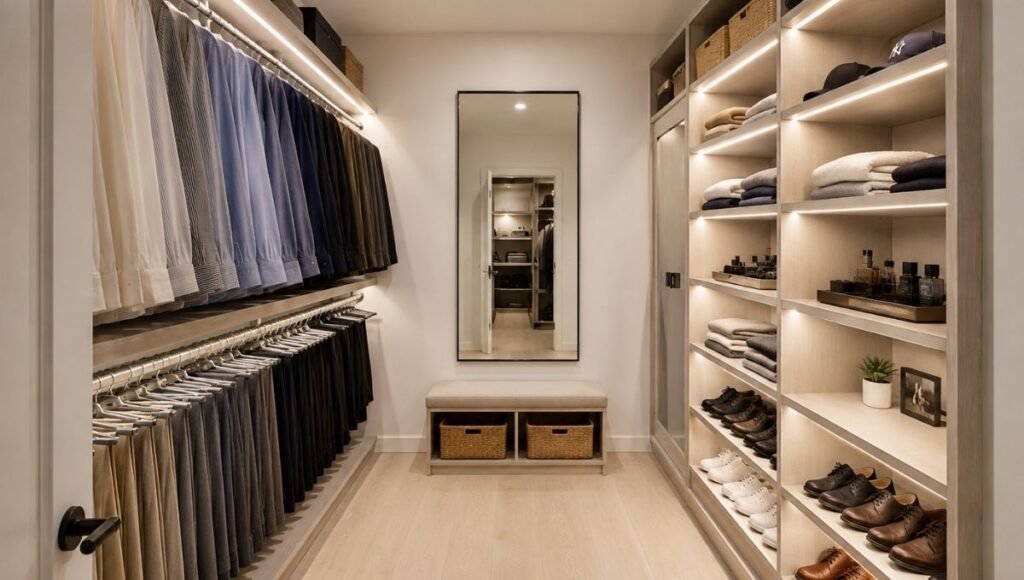
A walk-in closet sounds like a luxury. And if you’ve ever stood in one of those Pinterest closets — the ones with the island in the middle, the chandelier, the color-coded hanging sections, the dedicated shoe wall — it feels like a different world.
But most actual walk-in closets are something more modest: a room you can step into, usually somewhere between 35 and 100 square feet, with a single rod and one overhead shelf that came with the house and hasn’t changed since. Clothes piled in because there’s technically space. Shoes on the floor because there’s nowhere else to put them. The rod sagging slightly in the middle from too much weight on one side. Getting dressed in the morning means navigating this space in low light while making decisions you’d rather not be making.
The gap between the closet you have and the closet you want is almost never about square footage. It’s about how the space is designed. A 40-square-foot closet with the right system is dramatically more functional — and more pleasant to be in — than a 100-square-foot closet with a single rod and a pile on the floor.
This guide covers walk-in closet ideas for every size: the tiny step-in, the small single-wall closet, the medium L-shape or U-shape, and the larger master bedroom closet. For each type, you’ll find specific layout recommendations, system options by budget, and the organizational principles that make any closet stay functional long-term.
Key Takeaways
- Research from the National Association of Home Builders found that a well-organized closet is consistently ranked among the top features buyers look for in a home — behind kitchen and bathroom but ahead of garage storage. Organization directly affects perceived value.
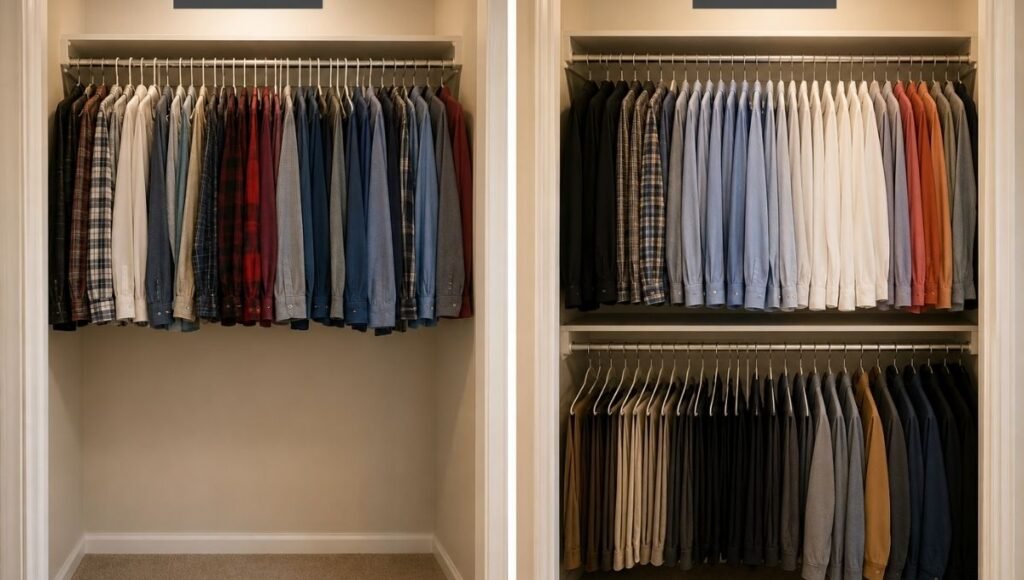
- The most common walk-in closet mistake is keeping the single-rod-and-shelf configuration that came with the house. A double hang rod for shorter items (shirts, folded pants, jackets) costs $15-30 and immediately doubles hanging capacity without any installation.
- Vertical space is the most consistently underused resource in walk-in closets. Most closets have 8-9 feet of ceiling height but use only the bottom 5-6 feet. Shelving to ceiling height or high-mounted hooks for seasonal items recovers this capacity.
- The most functional walk-in closets organize by frequency of use — daily items at eye level and arm’s reach, occasional items higher or further back, seasonal items in dedicated zones or bins.
- A walk-in closet audit — removing anything not worn in 12 months, consolidating duplicates, clearing the floor — typically reduces the effective volume requirement by 25-40% before any storage system is purchased.
Before You Design: The Walk-In Closet Audit
Every walk-in closet organization project should start with the same first step: removing what doesn’t belong there before deciding how to organize what does.
Walk-in closets accumulate three categories of items that don’t belong:
Clothes that don’t fit or aren’t worn. The 12-month rule applies here — if you haven’t worn it in the past year (accounting for seasons), it’s a candidate for donation or removal. This is not about minimalism; it’s about whether your closet is storing clothes you actually wear or clothes from a previous version of your wardrobe. Most people discover the answer is somewhere in between, and removing the latter creates significant space.
Items that aren’t clothing. Walk-in closets become storage annexes — holiday decorations, extra linens, luggage, items that don’t have a home anywhere else in the house. These items belong somewhere else. They’re occupying prime closet real estate for no functional reason.
Shoes without a system. Shoes piled on the floor or stacked randomly on a single shelf are typically taking up more space than a proper shoe storage system would require for the same number of pairs. The audit and a shoe organization solution often recover significant floor space.
After the audit, measure the closet accurately: length and width of every wall section, ceiling height, the location of the door and any light fixture, the position of any existing shelving or rod. These measurements are what determine which systems and configurations will actually fit.
Walk In Closet Ideas by Closet Size
Small Walk In Closet Ideas: The Step-In and Single-Wall Closet
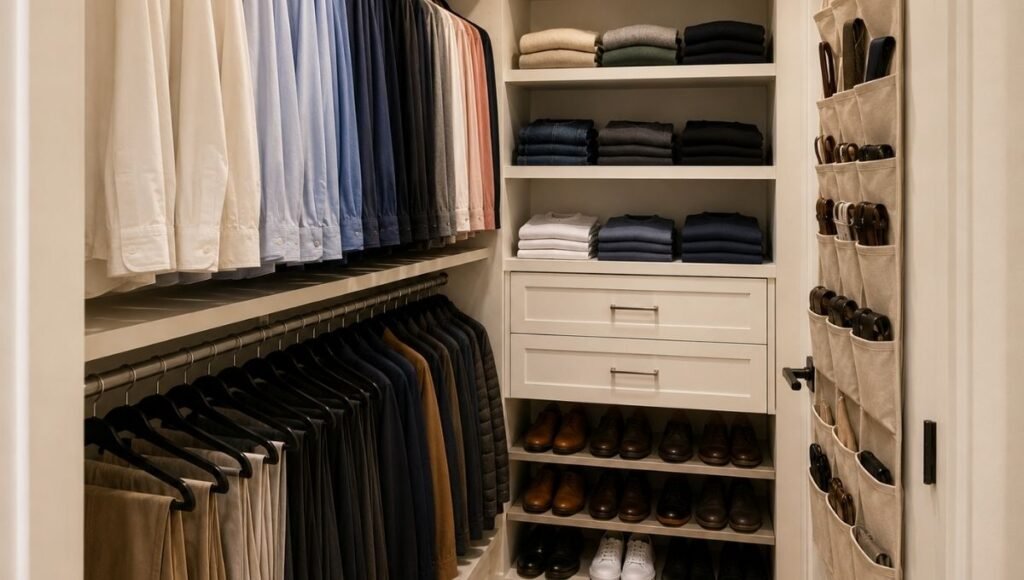
Small walk-in closets — the ones you can barely turn around in, typically 20-40 square feet — require the most disciplined approach because every decision affects everything else. The goal is maximum storage per square foot without creating a space that feels impossible to navigate.
The double hang rod is the highest-impact first change. Most small walk-ins come with a single rod at standard height (about 66 inches from the floor) and one shelf above. This configuration uses roughly 40% of the available vertical space. A second rod hanging below the first (or a purpose-built double hang rod unit) immediately doubles hanging capacity for shorter items — shirts, jackets, folded pants — in the same footprint.
The section that hangs long items (dresses, full-length trousers, long coats) should be limited to exactly the number of long items you own. Everything else — which is usually the majority of a wardrobe — benefits from double hanging.
Wall-to-wall shelving on every usable wall. In a small walk-in, the walls are the storage. Floor space is for standing; walls are for shelving, rods, and hooks. A wall-mounted shelving system (IKEA PAX, Elfa, or a simple shelf-and-bracket system) that runs floor-to-ceiling uses the full vertical height of the closet and provides significantly more storage than a single rod and shelf at standard height.
The floor is not storage. In a small walk-in, shoes on the floor eat into the limited standing space and create visual chaos that makes the closet feel smaller than it is. A floor-level shoe rack, a low shelf section, or over-door shoe pockets move shoes off the floor and onto vertical storage.
The back wall in a single-wall closet: If the closet has one usable wall and a small turning area, the back wall (opposite the door) can often accommodate a short section of shelving or a small dresser-height unit that adds drawer storage without requiring a separate piece of furniture.
Walk In Closet Organization Ideas for Medium Closets
Medium walk-in closets — roughly 40-80 square feet, typically L-shaped or U-shaped — have enough room to include all the storage categories a wardrobe needs without compromising navigation space.
The U-shape layout uses three walls for storage and creates a naturally efficient organization where every wall section can be specialized by category: one wall for hanging clothes, one for folded items and drawers, one for shoes and accessories. The center floor area remains clear as a dressing space.
The L-shape layout works similarly but with two walls, typically with the longer wall dedicated to hanging and the shorter wall to shelving and drawers. The corner requires either a corner shelf system or a gap — corner space in L-shaped closets is notoriously difficult to use efficiently without a dedicated corner unit.
Zone by category, not by person. In shared closets, the instinct is to divide by person — “your side, my side.” A more functional approach divides by category: all hanging clothes on the hanging wall, regardless of whose they are, sorted by type (shirts, pants, jackets, dresses). This allows each category to scale to its actual volume rather than each person having equal hanging space whether they need it or not.
Built-in drawer sections within the closet system replace a standalone dresser in the bedroom and keep all clothing storage in one dedicated space. A drawer section (3-5 drawers, typically 18-24 inches wide) within the closet wall system holds folded clothes, underwear, and accessories without requiring a separate piece of bedroom furniture.
Master Bedroom Walk In Closet Ideas
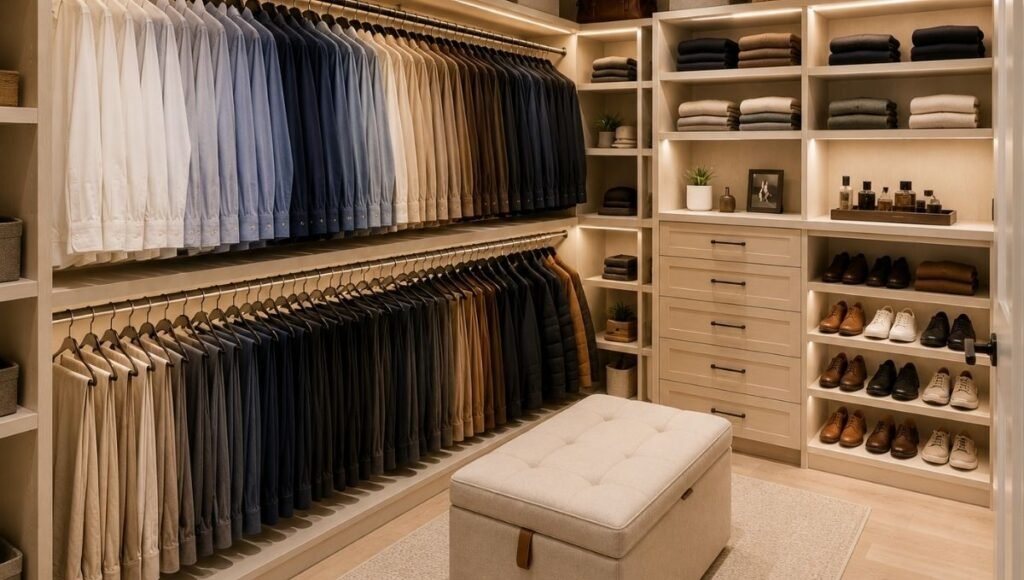
A larger master bedroom walk-in closet — 80+ square feet — has the space to include features that genuinely change how the closet functions as a daily space.
A center island or storage bench becomes possible at larger footprints. A bench with storage below provides seating for putting on shoes, surface space for laying out clothes, and drawer or shelf storage below. This turns the closet from a pure storage room into a functional dressing area.
Dedicated accessory storage. A larger closet has room for specialized storage that smaller closets can’t accommodate: a pull-out belt and tie rack, drawer dividers specifically for jewelry and accessories, a dedicated handbag shelf, a built-in laundry hamper within the closet itself.
Lighting is worth the investment. A master closet used daily benefits significantly from good lighting — ideally LED strip lighting inside drawer sections, under-shelf lighting that illuminates hanging sections, and a primary overhead fixture that provides even light across the whole space. Poor lighting makes organization harder to maintain because items are harder to see and identify.
Walk In Closet Systems: Which One Is Right for You
Once you have a layout plan, the closet system determines how the space gets built out. The three main options vary significantly in cost, flexibility, and durability.
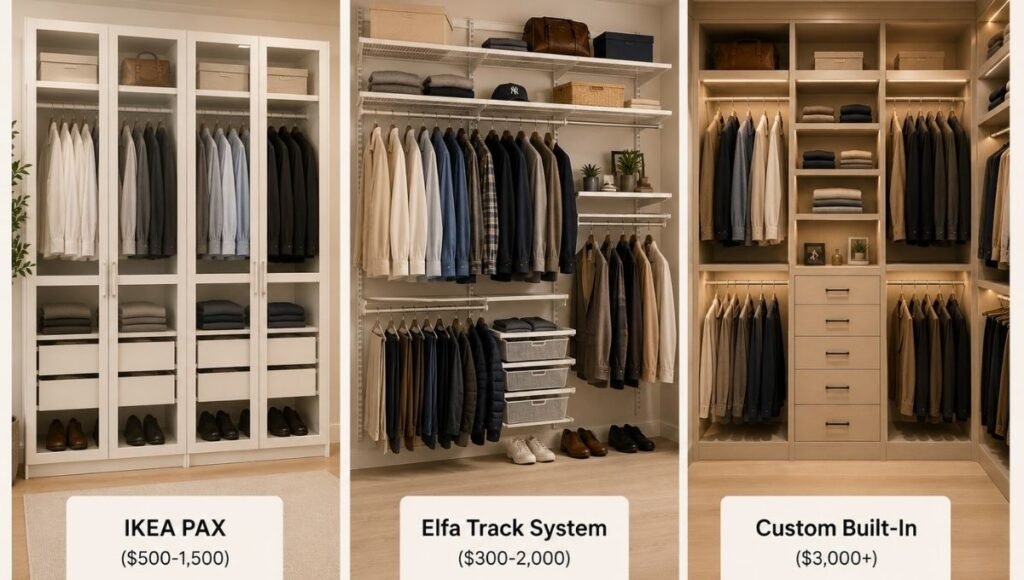
IKEA PAX System
The PAX wardrobe system is the most widely used modular closet system globally for a reason: it’s affordable, widely available, looks clean, and offers enough configuration options to work in most closet shapes.
PAX units come in standard widths (19.75″, 23.25″, 29.5″) and heights (93″ and 79″), with a range of interior fittings — hanging rails, shelves, drawer units, pull-out shoe racks, and more. The system is freestanding and can be configured to fill a closet interior without wall mounting.
Best for: Budget-conscious closet builds, renters who want to take the system when they move, closets with standard dimensions that fit PAX’s fixed widths.
Budget range: A complete small walk-in closet built with PAX typically runs $500-1,500 depending on configuration and fittings.
Elfa and Similar Track Systems
Track-based systems (Elfa from The Container Store, ClosetMaid, Rubbermaid) mount horizontal tracks to the wall and attach adjustable components — shelves, hanging rods, drawer sections — to the tracks. The primary advantage over freestanding systems is complete adjustability: everything can be repositioned without tools as needs change.
Best for: Homeowners who want a flexible system that can grow and change, closets with non-standard dimensions where PAX’s fixed widths don’t fit cleanly, users who prioritize adjustability over aesthetics.
Budget range: $300-2,000+ depending on configuration and system tier.
Custom Built-In Systems
Custom closet systems (California Closets, Closet Factory, or DIY built-in carpentry) are designed specifically for your closet’s exact dimensions, wall configurations, and storage needs. They use the full footprint with no wasted space from standard-width constraints.
Best for: Homeowners with non-standard closet shapes (angled ceilings, odd dimensions), those who want a permanent, high-finish result, closets where the investment in a home is justified by resale value improvement.
Budget range: $3,000-15,000+ for professionally installed custom systems. DIY built-ins using off-the-shelf lumber and hardware run $500-2,000.
How to Organize a Walk In Closet: The Setup Principles
Regardless of which system you choose, the organizational principles that determine whether a closet stays functional are the same.
Organize by Frequency of Use
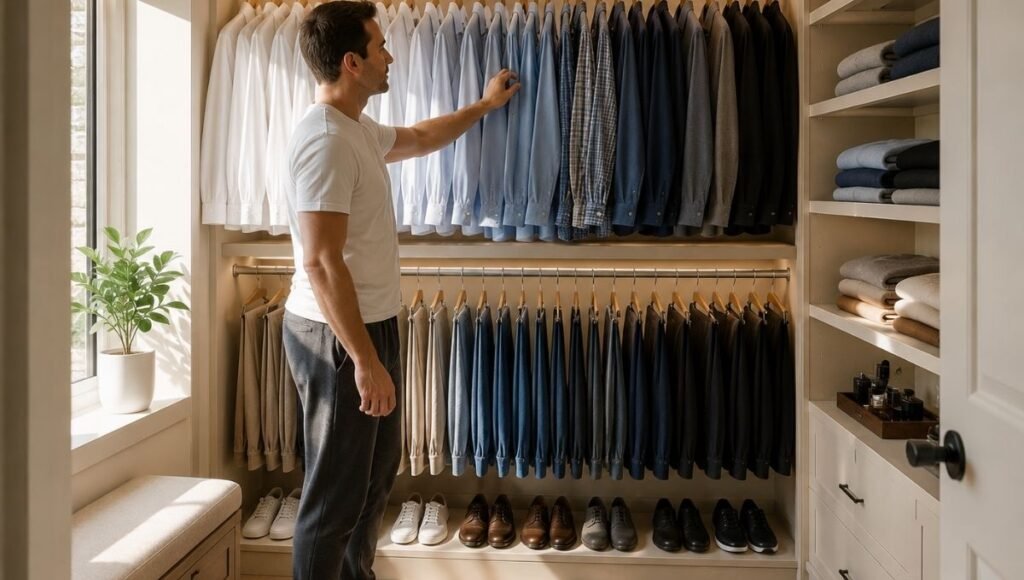
Daily wear zone: Eye level, arm’s reach, most accessible locations. The clothes you wear every week live here — the 20% of your wardrobe you rotate through 80% of the time. This zone should never require searching.
Occasional wear zone: Slightly higher, slightly further back, less immediately accessible. Work clothes worn weekly, going-out clothes used monthly, items for specific occasions.
Seasonal and rarely used zone: High shelves, far reaches of the closet, or dedicated seasonal bins. Winter coats in summer. Formal wear. Items worn a few times a year at most.
Hang Everything You Can
Hanging clothes are easier to see, easier to access, and stay in better condition than folded clothes in most cases. The only items that should be folded rather than hung are knitwear (hanging stretches the shape), jeans (can be hung but work fine folded), and undergarments.
For hanging, organize within each hanging section by type and then by color or gradient — all shirts together light to dark, all pants together, all jackets together. This makes finding specific items faster and gives the closet a visual order that’s easier to maintain.
Use Consistent Hangers
Mismatched hangers create visual noise, take up uneven space, and make hanging clothes look unintentionally messy. Switching to a consistent set of slim velvet hangers (which take up about a third the rod space of standard plastic hangers) has two immediate effects: the closet looks significantly more organized, and the available hanging space increases noticeably.
Walk In Closet Design Ideas: Making It a Space You Want to Be In
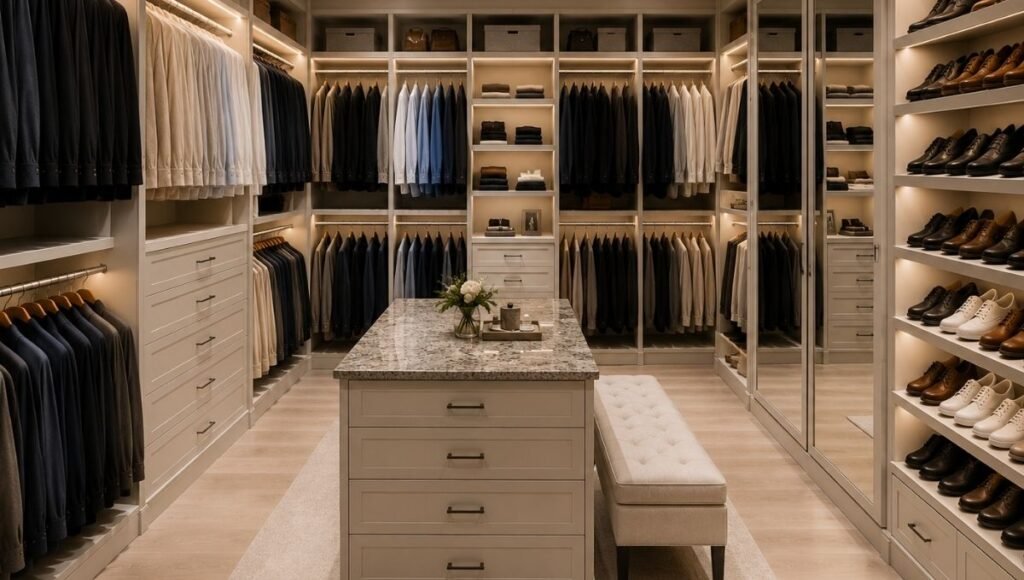
Beyond storage and organization, a walk-in closet can be a genuinely pleasant room — the space where you start the day, where you see your whole wardrobe at once, where getting dressed is a considered activity rather than a frantic search.
A mirror: A full-length mirror inside the closet makes it functional as a dressing room and creates the visual impression of more space. A mirror mounted on the back wall of a small closet makes the space appear nearly twice as large.
Good lighting: Standard closet lighting — a single overhead bulb — creates shadows in hanging sections and makes colors difficult to distinguish. LED strip lighting under shelves or inside drawer sections, combined with a brighter overhead fixture, changes how a closet looks and functions significantly.
A small seat or stool: Even a small folding stool inside or just outside the closet door changes the experience of getting dressed. Sitting to put on shoes, sitting to fold things, having somewhere to put things down temporarily — these small functional additions make the space feel less like a storage room.
Consistent storage for accessories: Hooks inside the door for bags and belts, a small drawer section for jewelry and small accessories, a dedicated shelf for everyday bags — these details prevent the accessories accumulation that typically happens on top of the closet system, on the floor, or piled on the shelf.
If You Only Have 10 Minutes Right Now
10 minutes: Add a double hang rod to whatever section of your current closet holds shorter items. This is a $15-20 purchase and takes 10 minutes to install. Every shirt, jacket, and short garment that was taking up full-height rod space now takes up half, immediately doubling the capacity of that section.
20 minutes: Do the 12-month clothing audit for one clothing category — all shirts, or all pants, or all shoes. Pull everything out, assess what’s been worn in the past year, return what stays, set aside what goes. One category done properly takes 20 minutes and shows you exactly how much your actual wardrobe differs from the total volume currently in the closet.
30 minutes: Measure the closet accurately — every wall section, ceiling height, door position, existing fixture locations. These measurements are what determine which system configurations will actually work in your specific space. Having them ready transforms the planning phase from theoretical to concrete.
FAQ: Walk In Closet Ideas
How do I maximize a small walk-in closet? Install a double hang rod for all shorter hanging items — this doubles hanging capacity without adding floor space. Add wall-mounted shelving that reaches ceiling height. Move shoes off the floor with a dedicated shoe shelf or over-door organizer. Keep the floor clear of anything that’s not absolutely necessary to have at floor level — a clear floor makes a small closet feel significantly larger.
What is the best closet system for a walk-in closet? IKEA PAX offers the best value for most people — affordable, configurable, and available widely. Track-based systems like Elfa offer more flexibility but at higher cost. Custom built-ins are the best long-term investment for homeowners with non-standard spaces or who want a permanent, fitted result. The best system is the one that fits your specific dimensions, budget, and how frequently your storage needs change.
How should I organize a walk-in closet shared with a partner? Organize by clothing category rather than by person — all hanging items on the hanging wall, all folded items in the drawer section, all shoes in the shoe zone — regardless of whose they are. This allows each category to scale to its actual volume rather than splitting the closet in half regardless of each person’s storage needs. Within each category, organize by person if that’s useful.
How do I organize a walk-in closet on a budget? The highest-impact, lowest-cost changes: a double hang rod ($15-20), consistent velvet hangers ($20-30 for a full set), a simple tiered shoe rack ($25-40), and basic wire shelving added to unused wall sections ($30-80). These four changes together transform most basic walk-in closets for under $150 without any custom system.
What should go in a walk-in closet versus a dresser? Items that benefit from hanging — shirts, pants, jackets, dresses — belong in the closet. Items that fold well and don’t wrinkle — knitwear, jeans, underwear, workout clothes — work in either location. The practical question is whether you have enough drawer space inside the closet system to eliminate a standalone dresser entirely, which frees bedroom floor space and consolidates all clothing storage in one location.
How do I keep a walk-in closet organized long term? Return every item to its designated zone after wearing or laundering. Do a quick floor-clear and surface-clear weekly. Do a seasonal wardrobe review twice a year — move off-season items to high shelves or bins, assess what needs to leave the closet entirely. The closet stays organized when the return habit is consistent and when the volume in the closet doesn’t exceed what the system was designed to hold.
Pick One Change. Start With the Hang Rod.
The closet you want isn’t built in a single weekend — it’s built one decision at a time, starting with the highest-impact, lowest-effort change available.
For most walk-in closets, that’s the double hang rod. It costs $15, takes 10 minutes, and immediately demonstrates what the space could be. From there, each subsequent change — better shelving, a shoe system, consistent hangers — builds on a foundation that’s already working.
The closet you walk into every morning can be the calm, organized space that makes getting dressed feel easy. It starts with one small change, not a complete renovation.
Explore more on Vomoxs:
- How to Organize a Small Closet (Even If It’s Stuffed With Clothes)
- Shoe Storage Ideas: How to Organize Every Pair
- Closet Organization: The Complete Bedroom & Clothing Storage Guide
References
- National Association of Home Builders (2023). What Home Buyers Really Want. Annual survey on buyer preferences and home features ranked by importance.
- Saxbe, D. E., & Repetti, R. (2010). No Place Like Home: Home Tours Correlate With Daily Patterns of Mood and Cortisol. Personality and Social Psychology Bulletin, 36(1), 71–81.
- Roster, C. A., Ferrari, J. R., & Jurkat, M. P. (2016). The dark side of home: Assessing possession ‘clutter’ on subjective wellbeing. Journal of Environmental Psychology, 46, 32–41.
Category: Small Space Storage | Reading time: 11 min | Last updated: 2026